Surgical expertise is defined as the combination of specialist training, clinical experience, and technical skill that determines whether a cosmetic procedure is safe and produces lasting results. For patients considering cosmetic surgery in the UK, understanding why surgical expertise matters is not a secondary concern. It is the single most important factor in your decision. The UK cosmetic sector has a well-documented regulation gap: only 33% of practitioners performing non-surgical procedures across 5,500 clinics are qualified doctors. That figure means the majority of people offering cosmetic treatments have no medical degree. Choosing a surgeon on the GMC Specialist Register, with verifiable training and revalidation history, is the clearest way to protect your health and your result.
Why surgical expertise matters: training, certification, and what they guarantee
Surgical expertise in the cosmetic field is built over more than a decade of structured medical training. A consultant plastic surgeon in the UK completes medical school, core surgical training, and then a specialist registrar programme in plastic surgery before sitting the FRCS (Plast) examination. Certified plastic surgeons undergo over 10 years of training and regular revalidation. That timeline is not bureaucratic formality. It reflects the genuine complexity of operating on living tissue and managing the full range of complications that can arise.
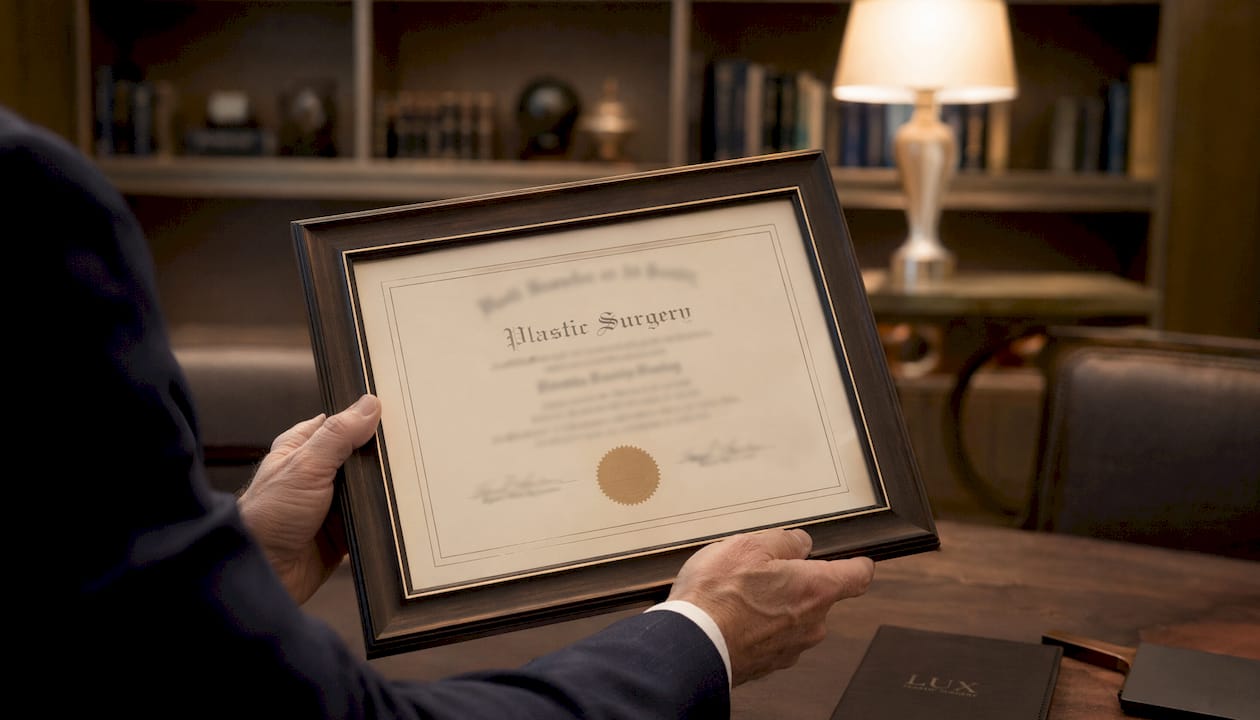
The GMC Specialist Register is the definitive benchmark in the UK. Surgeons listed on it have passed competency assessments in their declared specialty, not simply in general medicine or another field. A practitioner who holds a medical degree but is not on the Specialist Register in plastic surgery has not demonstrated the specific competencies required for cosmetic surgical procedures. The distinction matters enormously when something goes wrong.
Ongoing professional development is a formal requirement, not optional. GMC revalidation requires surgeons to demonstrate continued fitness to practise every five years, including audit of their outcomes, peer review, and patient feedback. This cycle of accountability has no equivalent in the unregulated sector.
The training pathway for a plastic surgeon includes:
- Medical degree (5–6 years)
- Foundation programme (2 years)
- Core surgical training (2 years)
- Specialist registrar training in plastic surgery (6 years)
- FRCS (Plast) examination and entry to the GMC Specialist Register
- Ongoing revalidation every five years
Pro Tip: Before booking any consultation, search the surgeon’s name on the GMC’s public register at gmc-uk.org. Confirm they hold a licence to practise and check whether “plastic surgery” appears as their listed specialty.
How does surgeon experience affect outcomes and patient safety?
The evidence linking surgeon experience to patient outcomes is consistent and clinically significant. Experienced surgeons reduce anaesthesia duration and tissue exposure, which directly lowers the risk of infection, haematoma, and delayed healing. Shorter time under general anaesthesia reduces cardiovascular and respiratory risk. These are not marginal gains. They are measurable differences in patient safety.
The Women and Equalities Committee’s 2026 report on cosmetic procedures identified a clear pattern: unregulated providers normalising cosmetic procedures without accountability leads to dangerous outcomes and costly revision surgery. The Committee called for high-risk procedures to be restricted to regulated healthcare professionals. That recommendation reflects the scale of harm being caused by inadequate oversight.
The table below illustrates the contrast between outcomes associated with specialist-trained surgeons and those linked to unverified practitioners.
| Factor | Specialist-trained surgeon | Unverified practitioner |
|---|---|---|
| Complication rate | Lower, due to technical proficiency and risk assessment | Higher, due to limited training and no formal audit |
| Anaesthesia duration | Reduced through efficient technique | Prolonged, increasing patient risk |
| Revision surgery | Less frequently required | More common, often at significant cost |
| Regulatory accountability | GMC revalidation every five years | None in unregulated sector |
| Patient recourse | Clear complaints pathway via GMC | Limited or absent |
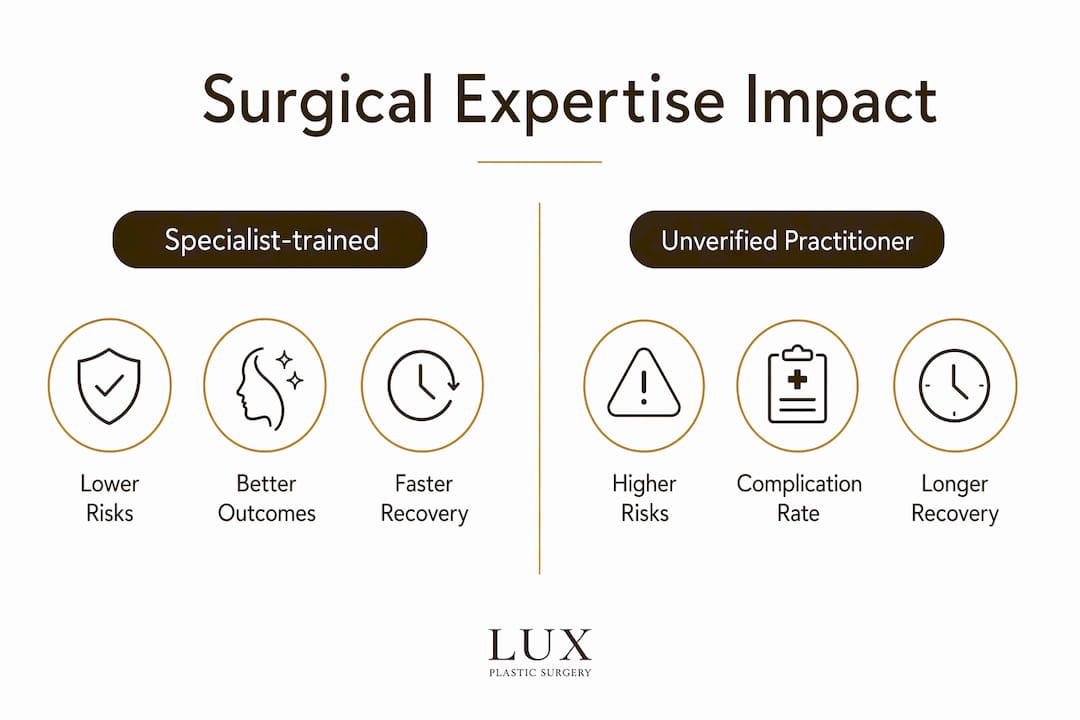
The significance of this data is practical. Patients who choose unverified providers often face not only physical complications but also financial ones. Revision surgery to correct a poorly performed procedure frequently costs more than the original operation. The impact of surgeon experience on outcomes is not abstract. It shows up in recovery time, scarring, symmetry, and long-term satisfaction.
Beyond technical skill: what else defines a safe and effective surgeon?
Technical proficiency alone does not define surgical expertise. Non-technical skills such as communication and decision-making contribute critically to surgical safety. Situation awareness, the ability to read a procedure as it unfolds and adapt accordingly, and team leadership in the operating theatre are now recognised as formal components of surgical competence. A surgeon who operates well but communicates poorly with their team introduces risk at every stage.
The pre-operative consultation is where many of these non-technical skills become visible to the patient. A thorough consultation does several things that a brief or superficial one cannot. It establishes whether the patient is medically suitable for the procedure. It identifies psychological factors that may affect satisfaction. It sets realistic expectations about results, recovery, and risk. And it gives the surgeon the opportunity to decline a case that is not appropriate.
Board-certified surgeons provide care that includes managing patient expectations and rejecting unsuitable cases. That willingness to say no is a marker of genuine expertise. A practitioner motivated primarily by volume will rarely decline a case. A specialist motivated by outcomes will do so regularly.
Questions worth asking during any consultation include:
- Are you on the GMC Specialist Register in plastic surgery?
- How many times have you performed this specific procedure?
- What is your personal complication rate for this operation?
- What happens if I need revision surgery?
- Can I speak with previous patients or see a verified before-and-after portfolio?
Understanding what an aesthetic consultation involves helps patients arrive prepared and ask the right questions. The quality of the answers tells you a great deal about the surgeon’s approach to patient care.
Pro Tip: If a surgeon cannot or will not answer questions about their complication rate, treat that as a significant warning sign. Transparent surgeons track their outcomes and share them.
How to verify a surgeon’s credentials before you commit
Verifying a surgeon’s credentials takes less than ten minutes and can prevent serious harm. The GMC’s public register is free to use and updated in real time. The GMC register confirms practising status, specialist training, and any restrictions on practice. Enter the surgeon’s name or GMC number and confirm three things: that they hold a current licence to practise, that plastic surgery is listed as their specialty, and that there are no conditions or warnings on their registration.
Membership of professional bodies provides an additional layer of assurance. The British Association of Aesthetic Plastic Surgeons (BAAPS) and the British Association of Plastic, Reconstructive and Aesthetic Surgeons (BAPRAS) both require members to hold GMC Specialist Register status in plastic surgery. Membership is not a substitute for checking the GMC register, but it signals that a surgeon has met peer-reviewed standards and subscribes to a professional code of conduct.
The following are clear warning signs that a provider may not meet the standards required for safe cosmetic surgery:
- No verifiable GMC registration or not listed on the Specialist Register
- Offers of heavily discounted procedures without a face-to-face consultation
- Pressure to book quickly or claims of limited availability
- No clear information about where surgery will take place or who will administer anaesthesia
- Inability to provide verifiable outcome data or patient references
Cosmetic tourism carries particular risk. Procedures performed abroad may be cheaper, but follow-up care, complication management, and legal recourse are all significantly more difficult to access. The Women and Equalities Committee has highlighted the consequences of patients seeking unregulated procedures, both abroad and from domestic unregulated providers. The financial saving rarely outweighs the physical and financial cost of managing complications on return.
Patients considering how to select cosmetic procedures safely should treat credential verification as the first step, not an afterthought. The importance of surgical skills is not visible in a clinic’s marketing material. It is visible in a surgeon’s training record, their outcomes data, and the quality of their consultation.
Key takeaways
Surgical expertise, verified through GMC Specialist Register status and a minimum of ten years of specialist training, is the most reliable predictor of safe outcomes in cosmetic surgery.
| Point | Details |
|---|---|
| GMC Specialist Register is the benchmark | Only surgeons listed in plastic surgery have demonstrated the required specialist competencies. |
| Experience reduces complication risk | Experienced surgeons shorten anaesthesia time and tissue exposure, lowering infection and recovery risk. |
| Non-technical skills matter | Communication, situation awareness, and willingness to decline unsuitable cases are markers of genuine expertise. |
| Credential verification is straightforward | The GMC public register is free, real-time, and takes under ten minutes to check. |
| Unregulated providers carry measurable risk | Only 33% of non-surgical cosmetic practitioners in the UK are qualified doctors, exposing patients to avoidable harm. |
What I have learned from two decades of consultant-led cosmetic surgery
Patients often arrive at a consultation having already chosen their procedure. They have researched the result they want, sometimes in considerable detail. What they have rarely researched is the person who will deliver it. That gap concerns me more than almost anything else in this field.
The cosmetic sector is increasingly treated like a retail transaction. Patients compare prices, read reviews, and book online. That model works for many services. It does not work for surgery. A low price for a rhinoplasty or a breast augmentation is not a bargain. It is a signal that something in the cost structure has been reduced, and in surgery, cost reductions almost always come from training, time, or facility standards.
What I have observed over many years is that the patients who experience the most difficult outcomes are rarely those who had complex anatomy or unusual risk factors. They are patients who chose a provider based on price or convenience, without verifying credentials. The revision cases I see most often are the result of procedures performed by practitioners who were not trained in plastic surgery and had no formal mechanism for outcome review.
The surgical proficiency significance of a properly trained specialist is not just technical. It is the ability to say, before the procedure begins, “this patient is not suitable for this operation at this time.” That judgement requires clinical experience that cannot be acquired in a weekend course or a short aesthetic training programme.
My advice to anyone considering cosmetic surgery is this: verify the GMC register first, ask for outcome data second, and treat any reluctance to provide either as a reason to look elsewhere. The benefits of surgical expertise are real and measurable. The cost of inadequate expertise is also real, and it is paid by the patient.
— Lux
Surgical care at Lux Plastic Surgery: what patients can expect
Lux Plastic Surgery offers consultant-led cosmetic procedures directed by Professor Sandip Hindocha, GMC-registered Consultant Plastic Surgeon, NHS Clinical Director, and FRCS (Plast). Every patient receives a thorough pre-operative consultation, honest assessment of suitability, and a clear explanation of risks and expected outcomes.

Professor Hindocha holds Specialist Register status in plastic surgery and has published over 150 peer-reviewed papers. Lux Plastic Surgery operates across Bedford, London, and Manchester, with procedures performed in accredited facilities to NHS clinical standards. Patients can review plastic surgery options, benefits, and safety before their consultation to arrive informed and prepared. To discuss your individual circumstances with a GMC-registered specialist, contact Lux Plastic Surgery to book a consultation.
This article is for informational purposes only and does not constitute medical advice. Consult a GMC-registered specialist before making any decision about cosmetic surgery.
FAQ
What qualifications should a cosmetic surgeon have in the UK?
A cosmetic surgeon in the UK should hold GMC registration with a licence to practise and be listed on the GMC Specialist Register in plastic surgery. Membership of BAAPS or BAPRAS provides additional assurance of peer-reviewed standards.
How does surgeon experience affect my results?
Experienced surgeons complete procedures more efficiently, reducing anaesthesia duration and tissue exposure, which lowers complication rates and supports faster recovery. Studies confirm that surgical proficiency directly improves both safety and aesthetic outcomes.
How can I check if my surgeon is properly registered?
Search the surgeon’s name or GMC number on the free public register at gmc-uk.org. Confirm they hold a current licence, that plastic surgery is their listed specialty, and that no restrictions appear on their record.
What are the risks of choosing an unregulated provider?
Patients who choose unregulated providers face higher complication rates, limited legal recourse, and often require costly revision surgery. The Women and Equalities Committee’s 2026 report found that unregulated cosmetic procedures cause serious harm due to absent accountability standards.
Is a non-surgical cosmetic treatment safer than surgery?
Non-surgical treatments carry lower procedural risk, but the same credential checks apply. Across UK clinics, only 33% of non-surgical cosmetic practitioners are qualified doctors, meaning the risk from unverified providers exists across both surgical and non-surgical categories.