Medically reviewed by Professor Sandip Hindocha, GMC-registered Consultant Plastic Surgeon and NHS Clinical Director. Articles are reviewed against current UK guidance from the GMC, BAAPS, BAPRAS and NICE.
TL;DR:
- Follow a structured, evidence-based process to ensure safety and achieve satisfying results.
- Verify surgeon qualifications and choose regulated, accredited clinics to reduce risks.
- Proper aftercare and waiting periods are essential to prevent complications and ensure recovery.
Cosmetic surgery in the UK is more popular than ever, yet rising demand has brought a parallel surge in avoidable harm. Unregulated practitioners, overseas packages, and social media advertising have made it harder to distinguish genuinely safe care from dangerous shortcuts.
The NHS outlines a structured, multi-step process for anyone considering cosmetic surgery, covering everything from honest self-reflection through to post-operative aftercare. Whether you are exploring breast surgery, body contouring, or a facial procedure, following these evidence-based steps is the single most reliable way to protect your health and achieve results you will genuinely love.
Key Takeaways
| Point | Details |
|---|---|
| Research qualifications | Only choose surgeons with GMC, BAAPS, or BAPRAS credentials and verify clinic regulation before proceeding. |
| Consult and question | Bring a thorough list of questions and expect honest discussions about risks, recovery, and aftercare during consultations. |
| Plan for aftercare | Rigorous aftercare, especially local follow-up, is crucial for maintaining safety and optimal results. |
| Avoid shortcuts | Resist offers promising instant results or unregulated overseas deals to prevent long-term complications. |
Understanding motivations and eligibility for cosmetic surgery
Before you research surgeons or browse before-and-after galleries, the most important question is one you must ask yourself: why do you want this procedure? Motivations matter enormously, not only for your psychological wellbeing but also because experienced surgeons actively assess them. Wanting a subtle improvement for your own confidence is very different from seeking dramatic change to satisfy a partner or chase an aesthetic trend. Surgeons who prioritise your safety will explore this distinction during assessment.
Mental health is a central part of eligibility. Conditions such as anxiety, depression, or body dysmorphic disorder (BDD, which involves persistent, distressing preoccupation with a perceived flaw) can significantly affect how satisfied you will feel after surgery. The NHS emphasises psychological readiness and cautions against rushing into any procedure. A responsible surgeon may recommend a mental wellbeing assessment or suggest you speak with a counsellor before proceeding.
Eligibility boundaries are equally important to understand:
- Under-18s are not eligible for most cosmetic surgical procedures in the UK
- Smokers face higher risks of wound complications and may be advised to quit for several weeks pre-operatively
- Those with untreated mental health conditions may be asked to defer surgery until they are in a more stable position
- People with unrealistic expectations about outcomes are often counselled to reconsider
- Those with certain medical conditions, including uncontrolled diabetes or blood-clotting disorders, may require additional medical clearance
Discussing your goals openly, including any concerns about body image or past experiences, helps your surgeon tailor the consultation and gives you the best chance of a satisfying outcome. You can find useful expert advice on motivations to help you frame your thinking before you even pick up the phone.
Pro Tip: Write down your three main reasons for wanting surgery and bring that list to your first consultation. If any reason involves pleasing someone else, discuss it openly with your surgeon.
Researching providers and verifying surgeon qualifications
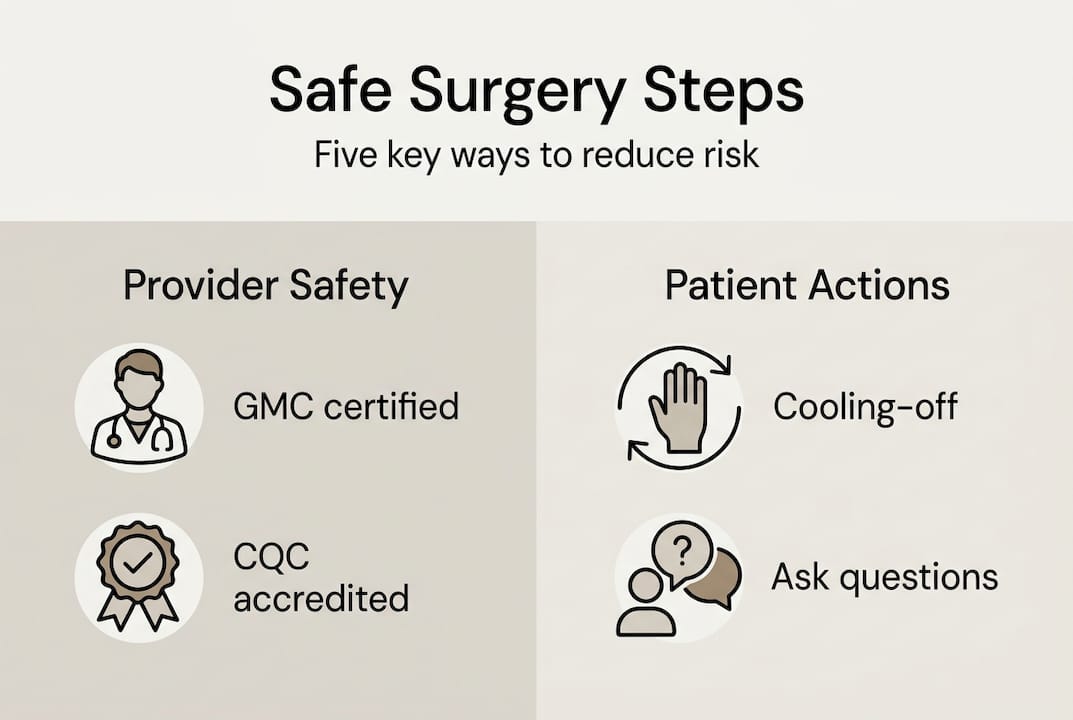
Once you have examined your motivations honestly, finding a safe, regulated provider becomes your most critical practical task. The UK has robust systems in place, but they only protect you if you use them. The NHS advises that you verify GMC registration, CQC clinic registration, and membership of BAAPS (British Association of Aesthetic Plastic Surgeons) or BAPRAS (British Association of Plastic, Reconstructive and Aesthetic Surgeons) before booking anything.
Here is a quick comparison of what separates a safe provider from a risky one:
| Feature | Safe provider | Red flag |
|---|---|---|
| GMC registration | Fully verified and current | Cannot be found on GMC register |
| Clinic regulation | CQC-accredited | No traceable registration |
| Professional membership | BAAPS or BAPRAS member | Social media ads only |
| Pricing model | Transparent, itemised | Discount events, group deals |
| Consultation process | Mandatory, unhurried | Same-day surgery offered |
Red flags are worth memorising. Group or “party” booking events, providers with no traceable NHS or private hospital history, and surgeons who push discounted packages are warning signs that should prompt you to walk away immediately. Surgeon experience matters far more than brand recognition. Ask specifically how many times your surgeon has performed your intended procedure, what their complication rate is, and whether they carry adequate indemnity insurance.
Overseas surgery deserves particular mention. Many patients are drawn to lower prices in Europe or further afield, but complications from procedures abroad frequently cost more when UK follow-up care is factored in. The NHS often ends up managing these complications, which are harder and costlier to treat when your operating surgeon is overseas.
“Choosing a surgeon purely on price is the most expensive decision you can make.” This is the reality that plastic surgeons across the UK consistently report.
Reviewing GMC-registered surgeon criteria before your search will also give you a precise checklist to work through.
Preparing for consultation: Key questions and what to expect
The consultation is not a formality. It is your primary safety checkpoint, and making the most of it requires preparation. Bring your full medical history, a list of current medications (including supplements), and a written list of questions. If possible, bring a trusted friend or family member. A second pair of ears catches details you might miss when you are nervous or excited.
The NHS requires that your consultation cover procedure details, including specific risks, realistic outcomes, recovery timelines, and, for breast procedures, implant type and longevity. Here are the essential topics to cover in order:
- Procedure specifics: Exactly what will be done, which technique, and why that approach suits your anatomy
- Risk profile: Complication rates for this specific procedure, not just generic risks
- Realistic outcomes: Request to see before-and-after images of patients with a similar starting point
- Recovery timeline: How much time off work, driving restrictions, when exercise resumes
- Aftercare provision: Who to call if problems arise, how many follow-up appointments are included
- Implant details (breast surgery): Brand, material, warranty, and future exchange timelines
- Cooling-off period: Confirmation that no surgery will be booked immediately after consultation
The cooling-off period is mandatory under UK government and professional body guidance. No reputable surgeon will offer you a surgery date on the same day as your consultation. This waiting period exists to protect you from impulsive decisions and allows time for you to ask further questions or seek a second opinion.
Pro Tip: Ask your surgeon what they would do if they encountered an unexpected finding during the procedure. How they answer tells you a great deal about their experience and transparency.
Understanding the surgeon consultation importance in advance makes the appointment far more productive. The role of consultations in shaping genuinely safe outcomes cannot be overstated.
Procedure-specific safety: Breast enhancements and body contouring
Different procedures carry different risk profiles, and being informed about your specific surgery is essential. Here is an overview of the most common procedures and their key safety considerations:
| Procedure | Primary risks | Safety priority |
|---|---|---|
| Breast augmentation | Capsular contracture, rupture, BIA-ALCL | Implant selection, CQC clinic |
| Body contouring | DVT, infection, asymmetry | Pre-op BMI assessment |
| Rhinoplasty | Breathing changes, asymmetry | Specialist facial surgeon |
| Facelift | Nerve damage, scarring | Surgeon’s facial surgery volume |
| BBL (fat transfer) | Fat embolism, mortality risk | Highly regulated, specialist only |
Breast augmentation is the UK’s most popular surgical procedure. Key risks include capsular contracture (scar tissue hardening around the implant), implant rupture, and the rare but serious condition BIA-ALCL (Breast Implant Associated Anaplastic Large Cell Lymphoma). Understanding breast augmentation steps before your consultation helps you ask the right questions about incision placement, implant position, and the likely need for future replacement surgery.
For body contouring, complication rates can reach up to 50% in certain higher-risk patient groups, and procedures must be performed by experienced surgeons in accredited facilities. Pre-operative BMI assessment, DVT and pulmonary embolism risk screening, and anaesthetic review are non-negotiable.
Brazilian Butt Lift (BBL) procedures carry the highest mortality rate of any cosmetic surgery. In the UK, they are tightly regulated and should only ever be performed by a consultant plastic surgeon in a CQC-registered facility.
Men seeking rhinoplasty or facelift procedures face specific risks related to facial anatomy and should seek surgeons with a demonstrable specialism in male facial surgery. Reviewing the broader plastic surgery procedure types available will help you compare your options before committing. UK complication statistics from 2024 confirm that procedure volumes remain high but complication rates stay elevated where patients bypass regulated providers.
Aftercare and staying safe: Recovery and red flags
Even a flawlessly performed procedure can result in harm if aftercare is neglected. Robust aftercare is part of the surgery package, not an optional extra. Before you commit to any surgeon, confirm precisely what post-operative support is included.
A comprehensive aftercare plan should provide:
- Wound checks at defined intervals following surgery
- A 24-hour patient helpline staffed by clinical professionals
- Scheduled follow-up appointments over a minimum of 12 months
- Clear written guidance on activity restrictions, diet, and wound care
- A named point of contact for concerns between appointments
Knowing the warning signs of complications could save your life. Seek urgent medical attention if you experience any of the following: unexplained fever, rapidly increasing swelling or redness, severe or worsening pain, wound breakdown or discharge, breathlessness, or sudden changes in sensation.
The BAAPS 2024 audit confirms that aftercare is vital and that complications from procedures done abroad frequently burden the NHS, often proving far more complex to treat without the original surgical team available. Local, registered aftercare is consistently safer and more cost-effective.
“The surgeon who operates on you should be the same team managing your recovery.” Continuity of care is not a luxury. It is a safety standard.
Non-surgical procedures such as dermal fillers and anti-wrinkle injections are also now subject to tighter UK regulation. Always choose an established clinic with a clear aftercare protocol, regardless of how minor the treatment appears. Guidance on cosmetic surgery recovery walks you through what a well-managed healing process should look like.
Pro Tip: Before signing any consent forms, ask your clinic to show you their written aftercare protocol. If they cannot produce one, that is a serious warning sign.
The uncomfortable truth: Safety trumps speed and bargain deals
Experienced plastic surgeons share a common frustration: the patients who suffer the most are rarely those who chose poorly from the available regulated options. They are the ones who prioritised speed or price over process. Cheap packages, weekend deals, and overseas offers are appealing precisely because they feel efficient. But efficiency is not a virtue in cosmetic surgery.
Cooling-off periods feel slow until you realise they exist to protect you from a permanent decision made in an emotionally elevated state. Thoroughly vetting a surgeon feels labourious until you understand that complication rates from unregulated providers remain disproportionately high. Local aftercare feels expensive until you consider the alternative: managing a serious infection or implant failure far from the operating team.
The process outlined in this guide is not bureaucratic box-ticking. It is the framework that separates outcomes patients celebrate from outcomes they regret. Truly evaluating options safely means accepting that the best results take time, regulated care, and genuine transparency from your surgical team. That is not a limitation. That is the standard.
Take your next step with trusted, regulated experts
You now have a clear, practical framework for approaching cosmetic surgery safely in the UK. The next step is putting that knowledge to work with a provider who meets every standard discussed here.
At Lux Plastic Surgery, Professor Sandip Hindocha leads a team of regulated specialists across Bedford, London, and Manchester, combining surgical expertise with thorough consultations, mandatory cooling-off periods, and dedicated aftercare support. Whether you are considering breast surgery, body contouring, or a facial procedure, you can explore the full range of plastic surgery services or review plastic surgery options in detail before booking your consultation. Safety is not an afterthought here. It is built into every step.
FAQ
What is the safest way to choose a cosmetic surgery provider in the UK?
Select only GMC-registered surgeons working in CQC-accredited clinics and avoid any provider that advertises solely through social media or offers same-day surgery bookings.
Why is aftercare important for cosmetic surgery?
Proper aftercare allows early identification and treatment of complications. The BAAPS 2024 audit confirms that most NHS complications stem from procedures performed abroad, where follow-up care is unavailable.
Are cooling-off periods mandatory before surgery?
Yes. UK professional bodies and government guidance require a cooling-off period following consultation before any cosmetic surgery is scheduled, giving you time to reflect without pressure.
What are the main risks of breast and body contouring surgeries?
Risks include capsular contracture, implant rupture, BIA-ALCL, and poor scarring for breast procedures. Body contouring carries high complication rates, as confirmed by BAAPS procedure statistics, particularly when performed outside regulated settings.