Choosing cosmetic surgery is one of the most personal decisions you will ever make. The stakes could not be higher, yet many people focus almost entirely on price or clinic aesthetics when they book their first consultation. Understanding why select experienced surgeons matters is not a formality. Patients of less experienced surgeons face 42% higher odds of 30-day mortality compared to those treated by seasoned professionals. That single figure should reframe how you approach every conversation about your care. This article covers training standards, safety data, emotional factors, and practical steps to help you choose with confidence.
Key takeaways
| Point | Details |
|---|---|
| Experience directly affects safety | Patients treated by less experienced surgeons face significantly higher mortality and complication risks. |
| Board certification is non-negotiable | Certified surgeons train for at least six years and operate in accredited, regulated facilities. |
| Emotional resilience matters too | Surgeon wellbeing and stress management affect clinical judgement, not just technical skill. |
| Verify more than credentials | Ask about procedure volume, complication rates, and the qualifications of the entire surgical team. |
| Second opinions protect you | Seeking a second consultation before committing is a sign of informed decision-making, not mistrust. |
Why select experienced surgeons: training and specialisation
Not every surgeon is trained equally, and the gap between a general practitioner who offers cosmetic treatments and a fully qualified plastic surgeon is enormous. Understanding what separates them is your first line of defence.
GMC-registered plastic surgeons complete at least six years of surgical training, including two to three years dedicated exclusively to plastic and reconstructive surgery. After that, they sit rigorous written and oral examinations before they can call themselves board certified. This is not a box-ticking exercise. It represents years of supervised procedures, studied failures, refined technique, and accumulated clinical judgement that you simply cannot shortcut.
Specialisation matters because cosmetic surgery is not a single discipline. A surgeon who focuses primarily on facial procedures will have a fundamentally different depth of experience than one who specialises in body contouring or breast surgery. Volume matters enormously here. Surgeons who perform a high number of a specific procedure each year develop a muscle memory and spatial awareness that dramatically reduces the time they spend in reactive decision-making during an operation.
- A specialist in rhinoplasty who has performed 300 procedures this year will anticipate complications a general surgeon performing their fifth ever nose job simply cannot foresee.
- High-volume surgeons develop refined pre-operative assessment skills, spotting contraindications earlier.
- Specialised training means understanding the anatomy at a cellular level, not just as a textbook diagram.
- Ongoing continuing professional development keeps experienced surgeons current with evolving techniques and safety protocols.
Pro Tip: When you meet a surgeon for a consultation, ask directly: “How many times have you performed this specific procedure in the past twelve months?” A confident, specific answer tells you a great deal. Vagueness is a warning sign.
Safety outcomes with certified surgeons
The data on surgeon experience and patient outcomes is not ambiguous. It is consistent, peer-reviewed, and should inform every cosmetic surgery decision you make.
GMC-registered surgeons operate in accredited facilities, follow strict ethical codes, and maintain ongoing education. This translates directly into lower complication rates for patients. Accreditation of the facility itself means that sterility standards, emergency protocols, and equipment quality are all independently verified rather than self-reported.
Continuity of care is linked to lower complication rates and reduced hospital readmissions in high-risk surgical cases. When you choose an experienced surgeon who manages your pre-operative assessment, the procedure itself, and your post-operative recovery, there is no information lost between handovers. Fragmented care, where multiple practitioners handle different stages, introduces gaps where errors occur.
Consider the following benefits of choosing a certified, experienced surgeon:
- Lower rates of post-operative infection and wound complications.
- Reduced likelihood of requiring revision surgery due to poor technique.
- More accurate pre-operative planning that accounts for your specific anatomy and medical history.
- Faster recognition and management of intraoperative complications.
- Better post-operative monitoring because the surgeon knows exactly what they did and what to watch for.
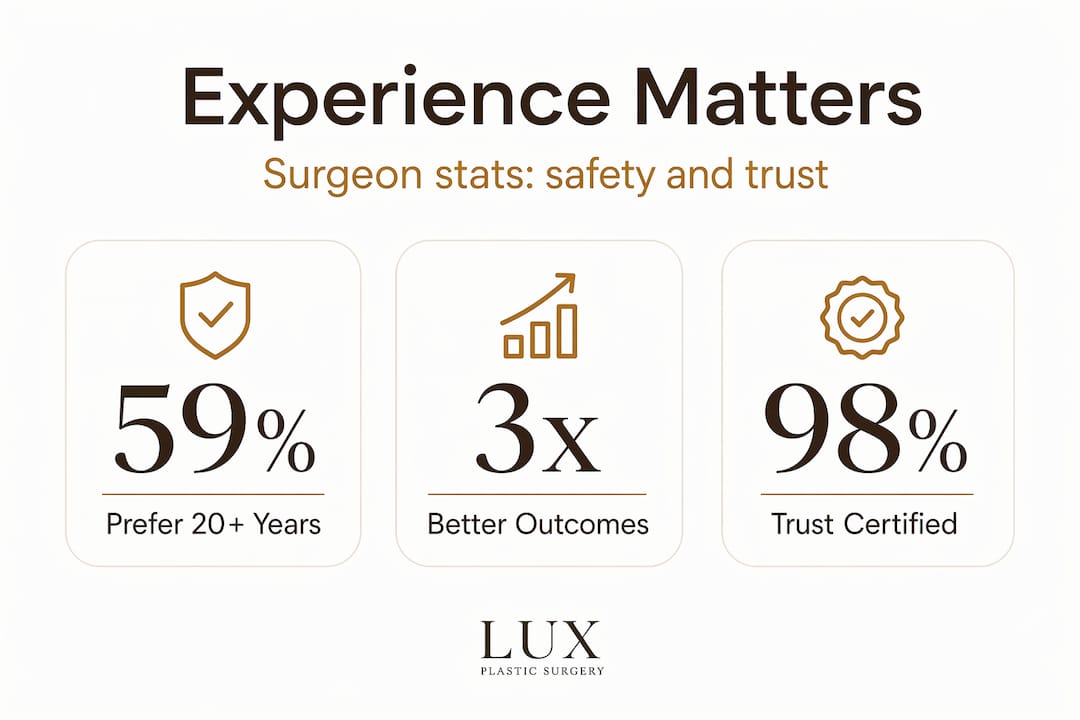
59% of patients preferred surgeons with over 20 years of experience when selecting a surgeon for a major procedure. Patients instinctively understand that experience matters. The evidence simply confirms what your instincts already suggest. Understanding the full scope of surgeon qualifications and outcomes can help you ask the right questions from the outset.
The human side: surgeon resilience and wellbeing
This is the part of surgical safety that nobody talks about, but it deserves your attention every bit as much as board certifications and procedure volumes.
Surgeons are human. They experience fear, stress, grief, and self-doubt just like anyone else. What is remarkable about the profession is how rarely this is acknowledged openly. Research shows that emotional factors such as fear can affect surgeons’ performance and clinical decision-making in ways that directly impact patient safety. A surgeon operating under significant psychological distress may take on cases they should decline, hesitate during procedures, or make conservative decisions that are not in the patient’s best interest.
“Surgical fear and emotional distress are rarely discussed, yet they are critical to safe performance. Resilience training in surgery may improve patient outcomes in ways we are only beginning to understand.” — The hidden emotional burden of surgeons
What does this mean for you as a patient? It means that when you assess a surgeon, the conversation should extend beyond qualifications. Notice how they communicate under pressure. Ask how they handle complications and what their support systems are. A surgeon who speaks openly and calmly about difficult cases, acknowledging both outcomes and lessons, demonstrates the psychological stability that underpins consistent performance.
Experienced surgeons have typically developed greater emotional resilience precisely because they have encountered more difficult situations. They have processed adverse outcomes, sought supervision, and built a professional identity that is not shattered by a single bad result. This is one of the less visible but genuinely important advantages of seasoned surgeons. For a broader understanding of how a surgeon’s mental approach links to post-surgical recovery support, the connection between practitioner wellbeing and patient outcomes is worth exploring.

Pro Tip: During your consultation, pay attention to how your surgeon responds when you raise concerns or ask about worst-case scenarios. Dismissiveness is a red flag. Calm, detailed engagement is a green light.
How to find and vet a qualified cosmetic surgeon
Knowing that experience matters is only useful if you have a practical method for finding and verifying it. Here is a structured approach that removes guesswork from your search.
Check board certification independently. Do not rely solely on the clinic’s website. In the UK, verify that your surgeon is registered with the General Medical Council (GMC) and holds a Certificate of Completion of Training (CCT) in plastic surgery. The GMC register is publicly searchable.
Ask about procedure-specific volume. Request the number of times your specific procedure has been performed by this surgeon in the past year. Anything below 20 for a specialist procedure warrants further scrutiny.
Request complication and revision rates. Experienced surgeons track their outcomes. If a surgeon cannot or will not share data on their complication rate, that absence of transparency is itself informative.
Seek a second consultation. Seeking second opinions before committing to surgery is standard practice in informed patient care. A second opinion does not insult the first surgeon. It protects you.
Evaluate the facility’s accreditation. The location where your surgery takes place must meet regulated standards. Private hospitals and clinics in the UK should hold Care Quality Commission (CQC) registration.
Vet your anaesthesiologist. Patients rarely vet anaesthesiologists, yet the anaesthesiologist is as critical to your safety as the surgeon. Ask who will administer your anaesthetic and whether they hold specialist anaesthesia qualifications. You can request a specific anaesthesiologist.
Scrutinise referrals critically. Recommendations from friends or referring doctors do not always reflect clinical excellence. Professional networks and personal relationships can influence referrals. Unbiased opinions from nursing staff or theatre teams who have worked directly with the surgeon are often more revealing.
| What to assess | Why it matters |
|---|---|
| GMC registration and CCT | Confirms legal authority to practise plastic surgery in the UK |
| Procedure-specific volume | Reflects depth of hands-on experience with your chosen procedure |
| Complication and revision rates | Indicates outcome quality and honesty about results |
| Facility CQC registration | Ensures safety standards meet independent regulatory requirements |
| Anaesthesiologist credentials | Reduces risk during and immediately after the procedure |
The guide on choosing the right plastic surgeon in the UK provides further detail on each of these verification steps if you want to go deeper.
My perspective on choosing the right surgeon
I have spent considerable time reviewing how patients approach cosmetic surgery decisions, and the pattern I keep seeing is the same. People do thorough research on procedures but far less on the person performing them.
Marketing is exceptional at creating the impression of expertise. Before-and-after galleries are carefully curated. Testimonials are selected. A polished website and a charming consultation can make almost anyone seem qualified. What cuts through all of that is a simple, direct conversation about numbers, credentials, and outcomes. Ask the uncomfortable questions. An experienced surgeon will welcome them.
In my view, the board certification question is not optional. It is the floor, not the ceiling. What sits above that floor is surgical volume, honest outcome tracking, psychological stability, and the kind of unshakeable calm that only comes from having navigated difficult situations and emerged with hard-won knowledge intact. Those qualities cannot be faked in a genuine conversation.
What many patients overlook is the relationship between trust and results. When you genuinely trust your surgeon, you follow post-operative guidance more carefully, communicate concerns sooner, and recover in a more settled state of mind. That is not a soft consideration. It is clinically relevant. Understanding the importance of expert consultations before you commit to any procedure is where the decision-making process should begin, not end.
Choose experience. Choose certification. And then choose the surgeon who makes you feel genuinely heard.
— Gregg
Exceptional care from experienced surgeons at Luxplasticsurgery
At Luxplasticsurgery, every procedure is performed by Professor Sandip Hindocha, an award-winning consultant with years of specialist experience in cosmetic and reconstructive surgery. Professor Hindocha holds the qualifications, the procedure volume, and the accredited facility standards that this article describes as non-negotiable for safe, effective outcomes.
Whether you are considering body contouring, breast surgery, facial procedures, or non-surgical treatments, the Luxplasticsurgery team offers personalised consultations at clinics in Bedford, London, and Manchester. Every consultation is a genuine dialogue about your goals, your anatomy, and your safety. You can explore plastic surgery options and safety considerations in detail on the website, or browse types of plastic surgery to understand the full range of procedures available. When you are ready to take the next step, book a consultation with Professor Hindocha and experience what surgeon expertise actually feels like in practice.
FAQ
Why does surgeon experience matter for cosmetic surgery?
Experienced surgeons have performed higher volumes of specific procedures, resulting in refined technique, faster complication recognition, and lower patient risk. Patients treated by less experienced surgeons face 42% higher odds of 30-day mortality.
What does board certification mean for a plastic surgeon?
Board certification confirms a surgeon has completed at least six years of surgical training, passed rigorous examinations, and operates within regulated, accredited facilities with strict professional standards.
How can I verify a cosmetic surgeon’s qualifications in the UK?
Check that your surgeon is registered with the GMC and holds a CCT in plastic surgery. Both are publicly verifiable. Ask directly about procedure volume and request complication rate data.
Should I ask about the anaesthesiologist too?
Yes. Anaesthesiologist quality directly influences surgical safety and recovery. Ask about their specialist qualifications and request a named anaesthesiologist if you have concerns.
Is getting a second surgical opinion really necessary?
A second consultation is standard practice in informed cosmetic surgery decision-making. It confirms your diagnosis, validates the proposed approach, and ensures you are comfortable with your choice before committing to surgery.