A surgical consultation workflow is the structured, step-by-step process that guides you from your first enquiry through clinical assessment, treatment planning, and preparation for cosmetic surgery.
It is the foundation on which safe, informed, and personalised surgical decisions are built. In the UK, this process is shaped by GMC guidance, BAAPS standards, and BAPRAS best practice, all of which place patient safety and informed consent at the centre of every interaction.
Understanding each stage before you attend your first appointment reduces anxiety, improves the quality of your questions, and helps you get the most from the time you spend with your surgeon.
What is the surgical consultation workflow in cosmetic surgery?
The surgical consultation workflow is the clinical framework that takes a patient from initial contact to a confirmed, fully informed surgical plan. In private cosmetic practice, this is not a single appointment. It is a series of structured steps, each with a defined purpose, that together protect your safety and support your decision-making.
The process covers pre-consultation preparation, the consultation itself, post-consultation reflection, and surgery scheduling. Each stage is governed by ethical obligations that your surgeon carries under GMC registration.
The consultation is not a preliminary step before the real work begins. Consultation frameworks treat it as the core treatment framework that directly influences outcomes and patient satisfaction. That means the quality of your consultation shapes the quality of your result. A thorough, unhurried consultation with a qualified surgeon is one of the strongest predictors of a positive surgical experience.

At Lux Plastic Surgery, the workflow is led by Professor Sandip Hindocha, GMC-registered Consultant Plastic Surgeon, FRCS (Plast), NHS Clinical Director, and author of over 100 published papers. Every consultation follows a patient-centred structure that prioritises listening, clinical accuracy, and honest communication. Understanding how consultations shape outcomes is the first step in preparing yourself well.
What are the essential pre-consultation preparations?
Arriving well prepared transforms a good consultation into an excellent one. Preparation is not about knowing the answers. It is about giving your surgeon the information they need to assess you accurately and plan safely.
The following steps form a practical surgical intake checklist for patients attending a cosmetic surgery consultation:
- Medical history and medications. Write down all current medications, including supplements, herbal remedies, and over-the-counter drugs. Aspirin, ibuprofen, fish oil, and vitamin E all affect bleeding and must be disclosed.
- Aesthetic goals and reference images. Bring photographs that illustrate what you hope to achieve. A photograph of yourself from 10 years ago is particularly useful for facial procedures, as it shows your natural anatomy rather than an idealised external reference.
- A written question list. Patients who write questions in advance ask better questions during the appointment. Include queries about recovery time, risks, costs, and what happens if you are not satisfied with the result.
- Surgeon credentials. Verify that your surgeon is listed on the GMC Specialist Register under plastic surgery. BAAPS and BAPRAS membership provides additional assurance of training standards and ethical accountability.
- Lifestyle adjustments. UK surgeons require patients to be nicotine-free for at least six weeks before surgery to reduce severe risks including skin necrosis. This is a clinical requirement, not a preference.
Pro Tip: Bring a trusted friend or family member to your consultation. A second pair of ears captures details you may miss when you are focused on the conversation, and they can help you reflect on the discussion afterwards.
Patients who bring historical photos, medication lists, and prepared questions consistently report more productive consultations. This preparation aids your surgeon’s understanding and supports a personalised surgical plan from the outset.
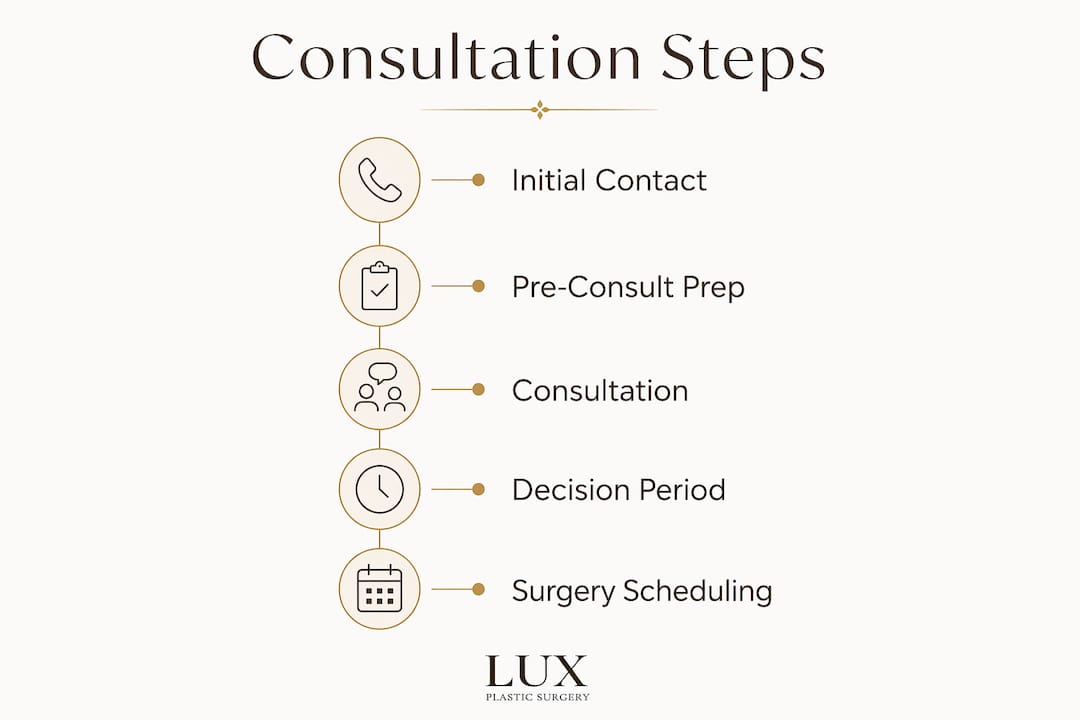
How is the surgical consultation structured?
A well-run cosmetic surgery consultation follows a clear sequence. Each stage serves a specific clinical and ethical purpose. The following steps reflect the preoperative consultation steps used in consultant-led UK practice.
Active listening. The consultation begins with your surgeon listening to your motivations, concerns, and expectations without interruption. Structured listening reduces defensiveness and improves clinical decision-making. This is not small talk. It is diagnostic.
Clinical assessment. Your surgeon examines the area of concern, assesses your anatomy, skin quality, and tissue characteristics, and considers how these interact with your stated goals. This assessment is collaborative. Your surgeon explains what they observe and why it matters to the surgical plan.
Filtering treatment options. Not every procedure a patient requests is appropriate for their anatomy or health profile. A responsible surgeon presents only the options that are clinically suitable, not every option that is technically available. This is a mark of ethical practice, not limitation.
Setting realistic expectations. Transparent discussions of realistic outcomes, risks, downtime, and costs during consultations lead to higher patient satisfaction. Under-promising and honest communication about limitations are critical to managing expectations well.
Informed consent discussion. Under 2016 GMC guidelines, consent must be obtained by the operating surgeon who will perform or supervise the procedure. Consent cannot be delegated to a nurse or patient coordinator. Your surgeon must personally discuss the intervention, its risks, and its alternatives with you before you sign anything.
Questions and clarification. The final stage of the consultation is yours. Ask every question on your list. A good surgeon welcomes detailed questions. If a surgeon discourages questions or rushes this stage, treat it as a warning sign.
Pro Tip: Ask your surgeon directly: “What result would you consider a success for someone with my anatomy?” This question reveals whether their expectations align with yours and whether they have thought carefully about your individual case.
The facial procedure step-by-step guide from Lux Plastic Surgery illustrates how anatomical evaluation and surgical planning connect within this consultation structure.
What happens after the consultation?
The post-consultation phase is where the surgery scheduling workflow begins. This stage is as clinically significant as the consultation itself, and patients who rush through it take on unnecessary risk.
| Stage | Purpose | Typical Timeframe |
|---|---|---|
| Cooling-off period | Allows reflection before committing to surgery | Minimum two weeks |
| Second consultation | Addresses new questions and confirms suitability | Within four to six weeks of first |
| Preoperative assessment | Medical checks, blood tests, anaesthetic review | Two to four weeks before surgery |
| Surgery scheduling | Date confirmed, team coordinated, instructions issued | Following preoperative clearance |
| Preoperative instructions | Medication review, fasting, lifestyle compliance | One to two weeks before surgery |
A two-stage consultation process with a minimum two-week cooling-off period improves decision-making by allowing patient reflection before surgery. This period exists because decisions made under emotional pressure or time constraints carry a higher risk of regret. Reputable UK practices build this pause into their process as standard.
Effective surgical workflows incorporate multidisciplinary coordination, including anaesthetist and facility scheduling alongside patient education. This means your surgery date is not simply a diary entry. It requires confirmation from the anaesthetist, the surgical facility, and the nursing team. All of these are coordinated by your surgical team, not by you.
Fee transparency is also part of this stage. All costs, including surgeon fees, anaesthetist fees, facility charges, and VAT, should be provided in writing before you commit. Ask for a fully itemised quote. Any practice that cannot provide one clearly is not operating to the standard you should expect.
The aftercare checklist for patients is a useful reference for understanding what comes after surgery is confirmed, covering recovery expectations and follow-up care.
What are common challenges in the consultation process?
Several predictable problems arise during cosmetic surgery consultations. Knowing them in advance helps you avoid them.
- Misunderstanding who performs the consultation. Patients commonly misunderstand consultation roles, which creates confusion over consent and surgeon involvement. Always confirm that the person conducting your consultation is the surgeon who will operate on you.
- Unrealistic expectations driven by social media. Filtered images and edited photographs create reference points that do not reflect surgical reality. Your surgeon’s job is to assess what is achievable for your anatomy, not to replicate an image.
- Pressure to decide quickly. Any consultation that ends with pressure to book surgery on the same day is a red flag. Ethical UK practice builds in reflection time as a matter of course.
- Failing to disclose relevant medical history. Omitting medications, supplements, or previous procedures does not protect you. It prevents your surgeon from planning safely. Full disclosure is in your interest.
- Not asking about complications. Patient anxiety sometimes leads people to avoid asking about risks. A structured consultation reduces uncertainty precisely because it addresses complications directly. Ask what the most common complications are, how they are managed, and what the revision policy is.
The safe cosmetic surgery steps guide from Lux Plastic Surgery provides further detail on risk-aware decision-making throughout the surgical planning process.
If you leave a consultation feeling uncertain, pressured, or unclear about who will perform your surgery, seek a second opinion. This is not a sign of disloyalty to your surgeon. It is a sign of good judgement.
Key takeaways
A thorough surgical consultation workflow, led by a GMC-registered specialist, is the single most important factor in achieving a safe, satisfying cosmetic surgery outcome.
| Point | Details |
|---|---|
| Consultation is the core process | The consultation shapes outcomes directly, not just the surgery itself. |
| Preparation improves results | Bring a medication list, reference photos, and written questions to every appointment. |
| Consent cannot be delegated | Under GMC guidelines, only the operating surgeon may obtain your informed consent. |
| Cooling-off periods are clinical, not optional | A minimum two-week reflection period reduces regret and improves decision quality. |
| Transparency on costs is non-negotiable | Request a fully itemised written quote before committing to any procedure. |
Why the consultation matters more than most patients realise
Patients often arrive at a consultation focused on the procedure they want. That is understandable. What surprises many of them is how much of the consultation is spent not on the procedure at all, but on understanding the person in front of us.
In my experience, the consultations that lead to the best outcomes are the ones where the patient has thought carefully about their motivations, not just their desired result. When someone can articulate why they want a change, and what they expect that change to do for them, the clinical conversation becomes far more productive. We can assess whether surgery is the right tool for the job, or whether a different approach would serve them better.
The GMC’s 2016 consent guidelines changed the standard of care in a meaningful way. Consent is now a conversation, not a signature. That shift reflects something I have always believed: a patient who genuinely understands what they are agreeing to, including the risks, the recovery, and the realistic limits of what surgery can achieve, is a patient who is far better prepared for the experience. Informed patients recover better. They manage discomfort better. They are more satisfied with their results, even when those results are modest.
The cooling-off period is another element that separates ethical practice from rushed practice. Two weeks feels like a long time when you are excited about a procedure. It does not feel long at all when you are in recovery and reflecting on the decision you made. I would rather a patient take three months to decide than three days.
The expert surgeon consultation guide from Lux Plastic Surgery reflects this philosophy. The consultation is not a gateway to surgery. It is the treatment itself, beginning.
— Lux
Considering cosmetic surgery? Start with the right conversation
Lux Plastic Surgery offers consultant-led consultations with Professor Sandip Hindocha across Bedford, London, and Manchester. Every appointment follows a structured, patient-centred process that covers clinical assessment, honest expectation-setting, and full fee transparency before any decision is made.
Professor Hindocha holds GMC registration, FRCS (Plast) qualification, and NHS Clinical Director status, with over 100 published papers in plastic and reconstructive surgery. Whether you are considering a surgical or non-surgical procedure, the first step is a thorough consultation. Read our plastic surgery options and safety guide to understand what is available, then contact Lux Plastic Surgery to arrange your appointment.
This article is for informational purposes only and does not constitute medical advice. Consult a GMC-registered specialist before making any decisions about cosmetic surgery.
FAQ
What is a surgical consultation workflow?
A surgical consultation workflow is the structured sequence of steps a patient follows from initial enquiry through clinical assessment, treatment planning, and surgery preparation. It covers pre-consultation preparation, the consultation appointment, the cooling-off period, and preoperative scheduling.
How long does the surgical consultation process take?
The full process typically spans four to eight weeks from first consultation to confirmed surgery date. This includes a minimum two-week cooling-off period, a second consultation where needed, and a preoperative medical assessment.
Can a nurse or coordinator obtain my consent for surgery?
No. Under 2016 GMC guidelines, consent must be obtained by the surgeon who will perform or supervise the procedure. Delegation of consent to non-surgical staff is not permitted.
Why do I need to stop smoking before cosmetic surgery?
UK surgeons require patients to be nicotine-free for at least six weeks before surgery. Nicotine restricts blood flow and significantly increases the risk of skin necrosis and poor wound healing.
What should I bring to my first cosmetic surgery consultation?
Bring a full medication list including supplements, reference photographs, a written list of questions, and any relevant medical records. This preparation helps your surgeon assess your suitability accurately and plan your care from the outset.