Scheduling a cosmetic consultation is the first and most consequential step towards safe, personalised aesthetic care. A consultation, formally known as a pre-operative assessment in surgical settings, gives you direct access to a qualified surgeon who can evaluate your suitability, explain your options, and outline realistic outcomes. The General Medical Council (GMC), the British Association of Aesthetic Plastic Surgeons (BAAPS), and the British Association of Plastic, Reconstructive and Aesthetic Surgeons (BAPRAS) all identify the pre-operative consultation as the cornerstone of patient safety. Knowing how to schedule a cosmetic consultation correctly, and what to prepare beforehand, protects you from avoidable risk and sets the foundation for a result you can trust.
How to schedule a cosmetic consultation: what you need before you book
Preparation before booking a cosmetic appointment is not optional. Arriving at a consultation without a clear picture of your health history, your goals, and your surgeon’s credentials wastes clinical time and can lead to poorly matched treatment plans.
Gather your personal and medical information
Your surgeon needs a complete picture of your health before any procedure can be safely discussed. Prepare a written summary covering your current medications, known allergies, previous surgical procedures, and any chronic conditions such as diabetes, hypertension, or autoimmune disorders. If you have had previous cosmetic treatments, note the dates, the techniques used, and the outcomes. This information directly shapes which procedures are appropriate and which carry elevated risk for you specifically.

Define your aesthetic goals clearly
Vague goals produce vague consultations. Before booking, write down what you want to change, why you want to change it, and what outcome you would consider a success. Bring reference photographs if they help communicate your expectations. A surgeon cannot tailor a treatment plan to goals that have not been articulated. Clarity on your part makes the clinical dialogue more productive from the first appointment.
Verify your surgeon’s specialist registration
Only surgeons listed on the Specialist Register for Plastic Surgery on the GMC website can legally call themselves plastic surgeons in the UK. This is not a technicality. It is the definitive credential that separates qualified plastic surgeons from other GMC-registered doctors who may offer cosmetic procedures without the same depth of training. Search the GMC register by name before you book, not after. Patients often assume any GMC-registered doctor qualifies, but registration alone does not confer plastic surgery specialist status.
Many experienced cosmetic surgeons dedicate approximately 80% of their clinical time to one specific subspecialty. That concentration of practice is a reliable indicator of procedural competence and outcomes predictability. When researching a surgeon, look for evidence of subspecialty focus relevant to the procedure you are considering.
Pro Tip: Search the GMC register at gmcuk.org by the surgeon’s full name before you book. Confirm the entry reads “Plastic Surgery” under the Specialist Register column, not simply “General Surgery” or another specialty.
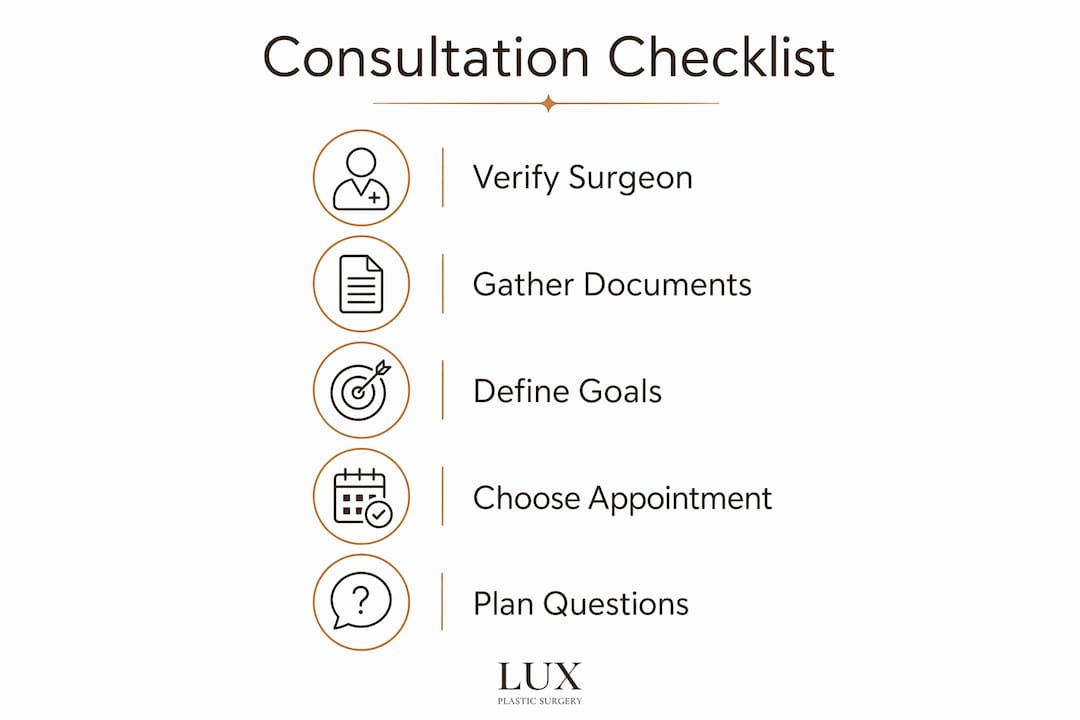
The table below summarises the key prerequisites for booking a cosmetic appointment.
| Prerequisite | What to prepare |
|---|---|
| Medical history | Current medications, allergies, chronic conditions, and previous surgeries |
| Aesthetic goals | Written description of desired outcomes, with reference photographs if helpful |
| Surgeon credentials | GMC Specialist Register confirmation for Plastic Surgery |
| Clinic registration | CQC registration status verified for the hospital or clinic |
| Questions list | Written questions covering risks, recovery, costs, and surgeon experience |
What are the practical steps to book your appointment?
Booking a cosmetic consultation follows a clear sequence. Skipping any step increases the risk of ending up with an unqualified practitioner or an unsuitable procedure.
- Confirm the surgeon’s GMC Specialist Register status. Search the GMC register online before making contact with any clinic. This takes under two minutes and is non-negotiable.
- Verify clinic registration with the Care Quality Commission (CQC). Hospitals and clinics must be registered with the CQC to legally provide cosmetic surgery in the UK. An unregistered facility cannot meet the safety and quality standards required for surgical procedures.
- Choose your consultation format. Most reputable practices offer both in-clinic and virtual consultations. Virtual consultations are a useful option for initial assessments but cannot replace face-to-face evaluations in many cases, particularly where physical examination is needed to assess tissue quality, symmetry, or anatomical variation.
- Contact the clinic directly. Use the clinic’s official website or verified telephone number. Avoid booking through third-party aggregator platforms where surgeon identity and credentials may be obscured.
- Confirm that the consulting surgeon will perform the procedure. Ask this question explicitly at the point of booking. The Care Quality Commission advises patients to verify initial consultations are conducted by the operating surgeon, not a patient coordinator or junior clinician.
- Request written confirmation of the appointment. A reputable clinic will confirm the date, time, surgeon’s name, and consultation format in writing.
Choosing between virtual and in-clinic appointments
Virtual consultations suit patients who are geographically distant from a clinic, or who want an initial conversation before committing to travel. They work well for non-surgical procedures such as injectable treatments or skin consultations, where visual assessment is the primary tool. For surgical procedures including breast surgery, body contouring, or facial surgery, an in-clinic appointment is the appropriate first step. Physical examination cannot be replicated through a screen.
Pro Tip: When booking, ask the clinic whether the consultation fee is deducted from the procedure cost if you proceed. Many reputable practices apply the consultation fee as a credit. Knowing this upfront removes a common source of confusion.
The table below compares the two main booking methods.
| Booking method | Advantages | Limitations |
|---|---|---|
| In-clinic appointment | Full physical assessment, direct surgeon contact | Requires travel, longer lead time |
| Virtual consultation | Geographic convenience, faster to arrange | Cannot support physical examination for surgical cases |
| Telephone enquiry | Quick initial information gathering | No clinical assessment possible |
What happens during a cosmetic consultation?
A cosmetic consultation follows a structured clinical format. Understanding the process helps you participate actively rather than passively receiving information.
The appointment typically opens with a discussion of your goals and motivations. The surgeon will ask why you are seeking treatment, what outcome you are hoping for, and how long you have been considering the procedure. This is not a formality. The answers directly inform whether the procedure is appropriate and whether your expectations are realistic.
A health assessment follows. The surgeon reviews your medical history, examines the area of concern, and identifies any anatomical or physiological factors that affect your suitability. For surgical procedures, this may include assessment of skin quality, tissue volume, and structural symmetry. The surgeon then presents the options available, explains the benefits and risks of each, and answers your questions.
Questions to ask during your consultation
Patients who ask detailed questions about surgeon qualifications, procedure risks, and complication rates experience better satisfaction and outcomes. Prepare your questions in writing before the appointment. Key areas to cover include:
- The surgeon’s specific experience with the procedure you are considering
- The realistic range of outcomes, including what cannot be achieved
- The full risk profile, including rare but serious complications
- Recovery timeline and any restrictions on work or activity
- Total cost, including anaesthesia, facility fees, and follow-up appointments
- What happens if a complication arises after the procedure
The consent process and cooling-off period
Reputable surgeons do not seek consent at the end of the first consultation. The Care Quality Commission recommends allowing at least two weeks after the consultation before consenting to surgery. This cooling-off period gives you time to review the information provided, consider alternatives, and seek a second opinion if you wish. Any clinic that pressures you to sign consent forms on the day of the consultation is not following best practice.
Pro Tip: Take written notes during the consultation or ask whether the appointment can be recorded for your personal reference. Patients frequently recall only a fraction of the clinical information shared in a first appointment.
What mistakes should you avoid when scheduling a consultation?
Common errors in the booking and consultation process are well documented. Booking without verifying surgeon credentials, failing to prepare questions, and consenting too quickly after consultation are the three most frequent mistakes patients make. Each increases the risk of dissatisfaction and complications.
The specific pitfalls to avoid are:
- Assuming GMC registration equals plastic surgery qualification. A doctor can be fully GMC-registered and legally practise medicine without holding Specialist Register status in plastic surgery. Always verify the specific register entry.
- Booking based on price alone. The lowest consultation fee does not indicate the best value. It frequently indicates reduced surgeon experience or a clinic that cuts costs in areas that affect safety.
- Failing to confirm the operating surgeon. Some clinics conduct consultations with one surgeon and assign a different surgeon to perform the procedure. This is not acceptable practice. Confirm the arrangement in writing.
- Neglecting clinic accreditation. A CQC-registered facility meets defined safety standards. An unregistered clinic does not. Check the CQC register before attending any appointment.
- Consenting under time pressure. No reputable surgeon requires an immediate decision. If you feel pressured to commit before you are ready, that is a clinical red flag.
“The consultation is not the beginning of a transaction. It is the beginning of a clinical relationship. A surgeon who rushes you towards consent before you have had adequate time to reflect is not prioritising your welfare. Take the time you need. A good surgeon will expect you to.”
Patients who want a second opinion are entitled to seek one, both within the NHS and in the private sector. A qualified surgeon will not discourage this. Requesting a second opinion is a sign of informed decision-making, not indecision.
For further guidance on choosing the right surgeon, the Lux Plastic Surgery resource library covers credential verification, subspecialty assessment, and what to expect from a thorough pre-operative assessment.
Key takeaways
Scheduling a cosmetic consultation safely requires verifying GMC Specialist Register status, confirming CQC clinic registration, and allowing at least two weeks between consultation and consent before proceeding.
| Point | Details |
|---|---|
| Verify specialist registration | Confirm the surgeon holds Specialist Register status for Plastic Surgery on the GMC website before booking. |
| Check clinic accreditation | Only attend clinics registered with the Care Quality Commission for cosmetic surgery. |
| Prepare before you book | Gather your medical history, define your goals, and write your questions before the appointment. |
| Confirm the operating surgeon | Ask explicitly that the surgeon who consults will also perform the procedure. |
| Respect the cooling-off period | Allow at least two weeks after consultation before signing consent for any surgical procedure. |
What I have learned from years of cosmetic consultations
The consultation is the most underestimated part of the entire cosmetic surgery process. Patients frequently focus their attention on the procedure itself, the recovery, and the result. The consultation is where all three of those outcomes are actually determined.
What I observe consistently is that patients who arrive prepared achieve better results. Not because preparation changes the surgery, but because it changes the conversation. A patient who has written down their goals, verified their surgeon’s credentials, and prepared specific questions receives a more tailored, more honest clinical assessment. The surgeon can spend the appointment addressing real concerns rather than establishing basic context.
The subspecialty question matters more than most patients realise. A surgeon who has dedicated the majority of their clinical career to breast surgery will bring a depth of pattern recognition to a breast augmentation that a generalist cannot replicate. That experience shows in the quality of the pre-operative assessment, the precision of the surgical plan, and the management of unexpected findings during the procedure.
The cooling-off period is not a bureaucratic formality. It is a clinical safeguard. Patients who consent quickly, particularly when they feel emotionally invested in a result, are more likely to experience regret or dissatisfaction, regardless of the technical quality of the surgery. The two-week minimum exists because good decisions require distance from the initial emotional response.
My strongest advice is to treat the consultation as a clinical interview, not a sales appointment. You are assessing the surgeon as much as the surgeon is assessing you. A practitioner who welcomes your questions, provides clear answers, and does not pressure you towards a decision is demonstrating the professional standard you should expect. Anything less is a reason to look elsewhere.
— Lux
Scheduling your consultation with Lux Plastic Surgery
Lux Plastic Surgery offers both in-clinic and virtual consultations with Professor Sandip Hindocha, a GMC-registered Consultant Plastic Surgeon, NHS Clinical Director, and FRCS (Plast) with over 100 published papers. Every consultation is conducted directly by Professor Hindocha, not a patient coordinator, and follows the structured pre-operative assessment format described in this article.
Patients considering surgical or non-surgical procedures can review the full range of cosmetic surgery options and surgeon qualifications before booking. Consultations are available at clinics in Bedford, London, and Manchester. To arrange your appointment, contact Lux Plastic Surgery directly through the official website.
This article is for informational purposes only and does not constitute medical advice. Consult a GMC-registered specialist before making any decisions about cosmetic procedures.
FAQ
What is a cosmetic consultation?
A cosmetic consultation is a pre-operative assessment in which a qualified surgeon evaluates your suitability for a procedure, discusses your goals, and outlines the risks and options available to you.
How do I verify a plastic surgeon’s qualifications in the UK?
Search the GMC register at gmcuk.org by the surgeon’s full name and confirm the entry shows “Plastic Surgery” under the Specialist Register. GMC registration alone does not confirm plastic surgery specialist status.
Can I have a virtual consultation instead of attending in person?
Virtual consultations are suitable for initial assessments and non-surgical procedures, but cannot replace a face-to-face evaluation for surgical cases where physical examination is required.
How long should I wait before consenting to surgery after a consultation?
The Care Quality Commission recommends allowing at least two weeks after your consultation before consenting to surgery. This cooling-off period supports considered, pressure-free decision-making.
What questions should I ask during a cosmetic consultation?
Ask about the surgeon’s specific experience with your procedure, the realistic range of outcomes, the full risk profile, recovery timeline, total costs, and the process for managing complications if they arise.