Breast augmentation, the procedure commonly referred to as a boob job, is a surgical operation that increases breast size, restores lost volume, or improves shape and symmetry using implants or fat transfer. It is one of the most frequently performed cosmetic procedures in the UK, carried out under general anaesthesia in a private surgical setting. The procedure addresses a range of concerns, from asymmetry and post-pregnancy volume loss to personal preference for a fuller silhouette. Recovery, cost, and surgical risks vary by individual, and a thorough consultation with a GMC-registered consultant plastic surgeon is the starting point for any informed decision.
What does a boob job procedure involve?
Breast augmentation is performed under general anaesthesia and typically takes 1–2 hours from incision to closure. The surgeon makes a small incision, usually in the inframammary fold beneath the breast, and creates a pocket to house the implant or transferred fat.
Implant types available
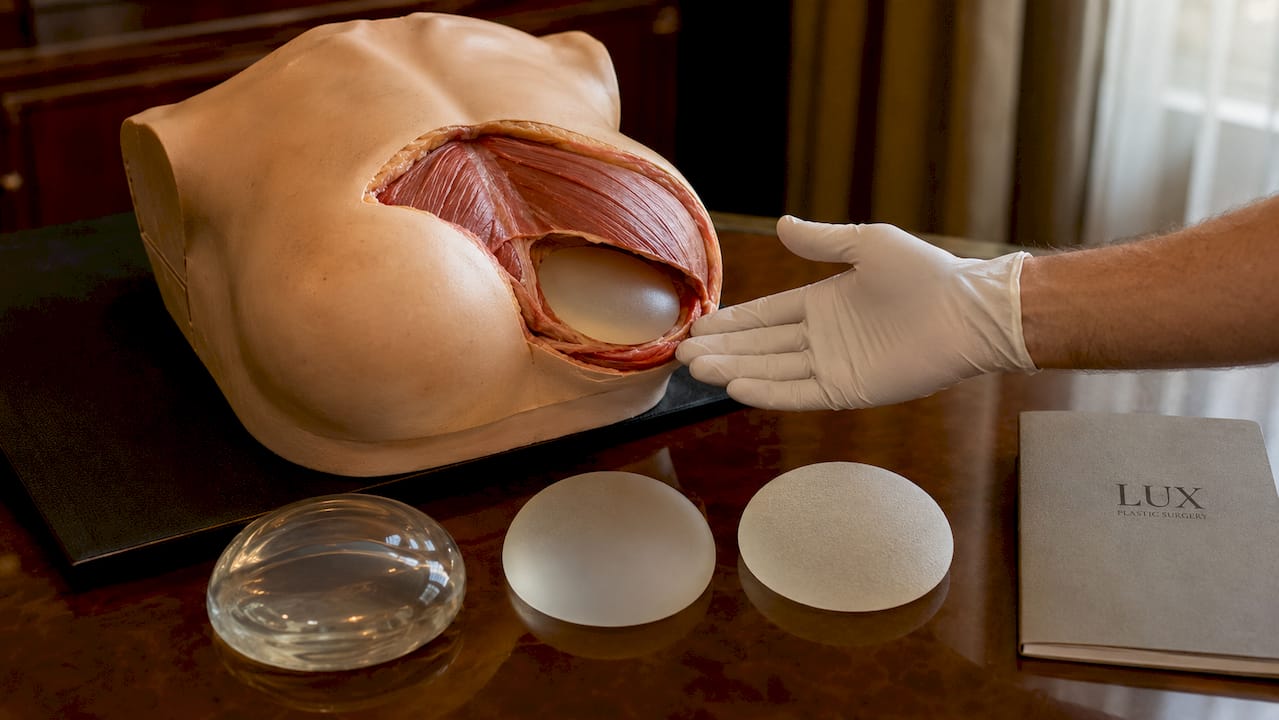
Three main implant types are used in the UK. Silicone gel implants are the most common and produce a soft, natural feel. Saline implants are filled with sterile salt water after insertion, allowing a smaller incision. Cohesive gel implants, often called “gummy bear” implants, hold their shape even if the outer shell is compromised and are increasingly favoured for their anatomical profile.
Fat transfer is a fourth option. It uses liposuction to harvest fat from the abdomen or thighs, which is then purified and injected into the breasts. The result is modest in size increase but avoids implant-related risks entirely. It suits patients seeking a subtle change rather than a significant size increase.
Implant placement options
Implant placement significantly affects both the aesthetic result and the recovery experience. The three main positions are submuscular, subglandular, and subfascial.
| Placement | Position | Advantages | Considerations |
|---|---|---|---|
| Submuscular | Beneath the pectoral muscle | Lower capsular contracture risk | Longer recovery; animation deformity risk in active patients |
| Subglandular | Between breast tissue and muscle | Shorter recovery | Higher contracture risk; less coverage for thin patients |
| Subfascial | Beneath the fascial layer | Reduced muscle movement issues | Less common; requires experienced surgeon |
Submuscular placement can cause animation deformity, where the implant shifts visibly during muscle contraction. This is particularly relevant for patients who exercise regularly or work in physically demanding roles. Subfascial placement reduces this issue and is growing in popularity among surgeons who prioritise natural movement.
Natural-looking results come from careful implant sizing, pocket design, and anatomical balance rather than from maximising volume. Surgeons also use asymmetrical implant sizing to correct uneven breasts, placing different volumes on each side to achieve a balanced outcome.
Pro Tip: Ask your surgeon to show you before and after photographs of patients with a similar starting anatomy to yours. This gives a far more accurate picture of likely results than generic imagery.
Who is suitable for breast augmentation?
Breast augmentation suits adults who are in good general health, have realistic expectations, and have stable body weight. Candidacy is assessed during a formal consultation and is not determined by breast size alone.
Common reasons patients seek the procedure include:
- Increasing breast size for personal preference or proportion
- Restoring volume lost after pregnancy, breastfeeding, or significant weight loss
- Correcting natural asymmetry between the two breasts
- Rebuilding breast shape following medical treatment
Demand for augmentation is frequently driven by both enhancement and restoration goals, particularly among women in their late thirties and forties who have experienced changes after pregnancy or weight loss. Exploring breasts after weight loss is a useful starting point for patients in this group.
Age is a relevant factor. Most surgeons recommend waiting until breast development is complete, typically in the early twenties, before proceeding with implants. There is no upper age limit, provided the patient is medically fit for surgery and anaesthesia.
Seventy per cent of patients choose an increase of one to two cup sizes to maintain a natural appearance. This reflects a broader shift in patient preference away from dramatic results and towards proportionate, understated outcomes.
Pro Tip: Selecting a surgeon who holds full membership of BAAPS (British Association of Aesthetic Plastic Surgeons) or BAPRAS (British Association of Plastic, Reconstructive and Aesthetic Surgeons) provides an additional layer of assurance beyond GMC registration alone.
What is recovery from breast augmentation like?
Recovery from breast augmentation follows a predictable pattern, though individual timelines vary based on implant placement, the patient’s general health, and the physical demands of their daily life.
Full recovery takes 6–12 weeks, with most patients returning to desk-based work within 1–2 weeks. This timeline matters because returning to strenuous activity too early increases the risk of complications including wound breakdown and implant displacement.
What to expect in the first two weeks
Immediately after surgery, the breasts are dressed and supported with a post-surgical bra. Swelling, bruising, and tightness are normal in the first week. Pain is typically managed with prescribed oral analgesia and settles significantly by day five to seven. Drains are occasionally used but are not standard in all cases.
Specialist supportive bras are recommended for several months post-surgery to support the healing tissue and assist in shaping the final result. Patients should expect the implants to sit high initially before settling into their final position over six to twelve weeks.
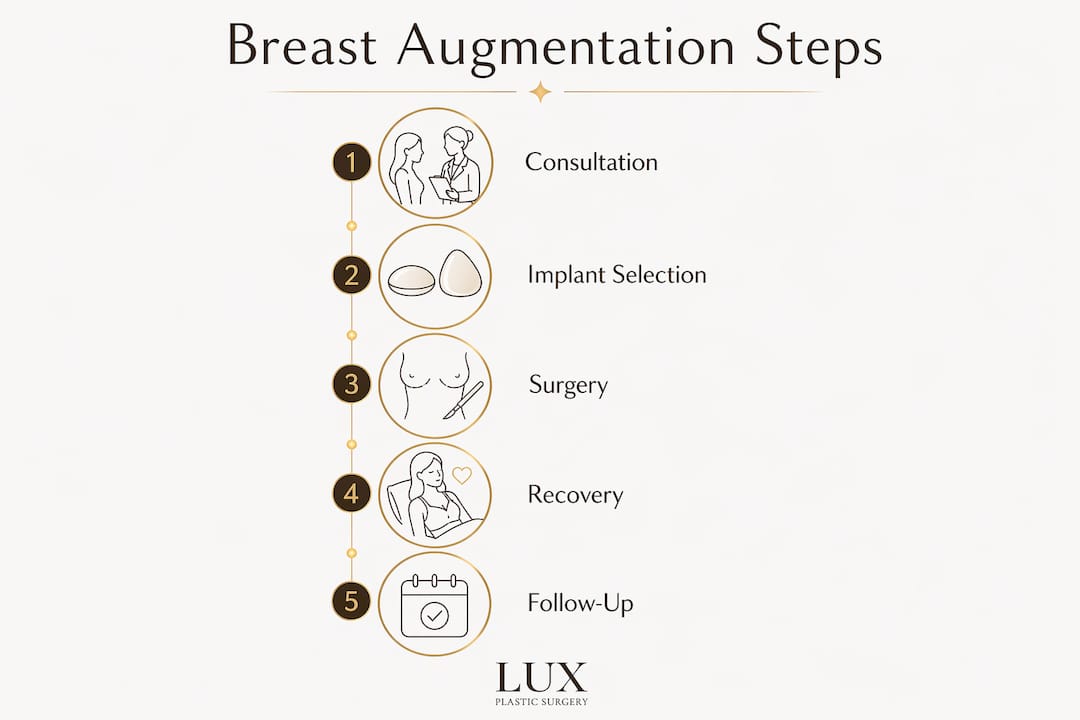
For a detailed breakdown of what to expect at each stage, the step-by-step recovery guide at Lux Plastic Surgery covers each phase clearly.
Recovery do’s and don’ts
| Phase | Do | Avoid |
|---|---|---|
| Week 1–2 | Rest, wear your surgical bra, attend follow-up appointments | Lifting, driving, strenuous movement |
| Week 3–6 | Light walking, gentle daily activity | Upper body exercise, heavy lifting |
| Week 6 onwards | Gradual return to exercise with surgeon approval | High-impact sport until fully cleared |
The following points summarise key recovery guidance:
- Sleep on your back with your upper body slightly elevated for the first two weeks
- Avoid submerging the incision sites in water until wounds are fully healed
- Attend all post-operative appointments, even if you feel well
- Report any sudden increase in pain, redness, or warmth around the implant promptly
- Do not smoke during the recovery period, as smoking significantly impairs wound healing
How much does breast augmentation cost in the UK?
Private breast augmentation in the UK typically costs between £5,000 and £6,000 as of 2025 data from NHS Inform Scotland. This figure represents the procedure itself and does not always include all associated costs.
What affects the price?
Several factors influence the final cost:
- Surgeon experience and qualifications: Consultant-led care from a BAAPS or BAPRAS member commands a higher fee, and rightly so.
- Implant type: Cohesive gel and anatomical implants carry a higher unit cost than standard round silicone.
- Hospital or clinic facility: Private hospital fees vary considerably across London, Manchester, and Bedford.
- Anaesthetist fees: These are sometimes included in a package price and sometimes billed separately.
NHS funding for breast augmentation is available only in very specific clinical circumstances, such as reconstruction following mastectomy or in cases of significant developmental asymmetry. Cosmetic augmentation for personal preference is not funded by the NHS.
Ongoing costs are a reality that patients must factor in. Breast implants are not lifetime devices and may require replacement or removal in future years due to complications or natural changes in the body. Future surgery carries its own costs, which should be considered before proceeding.
| Cost Element | Typical Range (GBP) |
|---|---|
| Surgical procedure | £5,000–£6,000 |
| Post-operative garments | £50–£150 |
| Follow-up appointments | Often included; confirm in advance |
| Future revision surgery | Variable; plan for this possibility |
Pro Tip: Always request a written breakdown of what is included in the quoted price before signing any agreement. Confirm whether anaesthetist fees, post-operative appointments, and revision consultations are covered.
What are the main risks of breast surgery?
Breast augmentation carries surgical risks that every patient must understand before consenting to the procedure. No cosmetic operation is without risk, and informed consent requires a clear discussion of what can go wrong.
The most commonly reported complications include:
- Capsular contracture: The body forms scar tissue around the implant, which can harden and distort the breast shape. This is the most frequent long-term complication.
- Implant rupture or leakage: Silicone gel ruptures are often silent and detected only on MRI scanning. Saline ruptures are immediately visible as the breast deflates.
- Infection: Most infections respond to antibiotics, but severe cases may require implant removal.
- Asymmetry: Minor differences between the two sides are common after surgery and usually settle. Significant asymmetry may require revision.
- Changes in nipple sensation: Temporary or permanent changes in sensitivity occur in a proportion of patients.
- Animation deformity: Particularly associated with submuscular placement, where the implant moves visibly during muscle contraction.
Implants require long-term monitoring and patients should expect the possibility of further surgery at some point in their lifetime. This is not a failure of the original procedure. It is a known characteristic of implant-based surgery that surgeons are obliged to discuss at consultation.
Choosing a board-certified plastic surgeon reduces the risk of avoidable complications through rigorous training, proper technique, and thorough aftercare protocols. Patients researching their options can find useful guidance on selecting experienced surgeons for cosmetic procedures.
The psychological dimension of risk is also worth acknowledging. Some patients experience body image concerns or dissatisfaction with results that do not match their expectations. A thorough pre-operative consultation, including a discussion of realistic outcomes, is the most effective way to reduce this risk.
Key takeaways
Breast augmentation is a well-established surgical procedure, but its safety and success depend directly on surgeon selection, realistic expectations, and commitment to post-operative care.
| Point | Details |
|---|---|
| Procedure overview | Augmentation uses silicone, saline, or cohesive gel implants, or fat transfer, under general anaesthesia. |
| Recovery timeline | Most patients return to work within 1–2 weeks; full recovery takes up to 12 weeks. |
| UK cost range | Private procedures typically cost £5,000–£6,000, with additional ongoing costs to plan for. |
| Implant longevity | Implants are not lifetime devices and may require future replacement or revision surgery. |
| Surgeon selection | Choosing a GMC-registered, BAAPS or BAPRAS-affiliated surgeon is the single most important safety decision. |
What i have learned from consulting patients on breast augmentation
The most common misconception I encounter is that breast augmentation is primarily about size. In practice, the patients who report the greatest satisfaction are those who focused on proportion and balance rather than a specific cup size. A well-chosen implant that complements your frame is far more satisfying long-term than one selected purely for volume.
I have also observed that patients who arrive at consultation having done thorough research ask better questions and make more confident decisions. Questions about implant placement, the surgeon’s revision rate, and what happens if complications arise are the mark of a patient who will be well-prepared for both surgery and recovery.
The ongoing nature of implant care is something I feel is not communicated clearly enough in general information sources. Implants are not a one-time intervention. They require monitoring, and patients should budget emotionally and financially for the possibility of future procedures. This is not a reason to avoid surgery. It is simply the reality of implant-based treatment, and understanding it upfront leads to better long-term outcomes.
Finally, the consultation itself is diagnostic. A surgeon who listens carefully, examines your anatomy thoroughly, and discusses options without pressure is the right surgeon. If a consultation feels rushed or one-sided, seek a second opinion. You are making a significant and lasting decision about your body, and you deserve the time and information to make it well.
— Lux
Considering breast augmentation at lux plastic surgery?
Lux Plastic Surgery offers consultant-led breast augmentation in Bedford under the direction of Professor Sandip Hindocha, GMC-registered Consultant Plastic Surgeon and NHS Clinical Director. Every patient receives a thorough pre-operative consultation, personalised implant selection, and structured aftercare designed around their individual anatomy and goals.
Professor Hindocha’s approach prioritises natural, proportionate results and full informed consent at every stage. Whether you are considering augmentation for the first time or seeking a revision, the team at Lux Plastic Surgery provides the clinical rigour and personalised attention that this decision requires. To explore the full range of procedures available, visit the Lux Plastic Surgery services page.
This article is for informational purposes only and does not constitute medical advice. Consult a GMC-registered specialist before making any decisions about surgical treatment.
FAQ
What is a boob job, medically speaking?
A boob job is the colloquial term for breast augmentation, a surgical procedure that uses implants or fat transfer to increase breast size, restore volume, or improve symmetry. It is performed under general anaesthesia and typically takes 1–2 hours.
How long does recovery from breast augmentation take?
Most patients return to light work within 1–2 weeks, with full recovery taking 6–12 weeks depending on implant placement and individual healing. Strenuous exercise and heavy lifting should be avoided for at least six weeks.
What do breast implants cost in the UK?
Private breast augmentation in the UK typically costs between £5,000 and £6,000 according to NHS Inform Scotland 2025 data. This figure may not include anaesthetist fees, post-operative garments, or future revision procedures.
Do breast implants need to be replaced?
Breast implants are not lifetime devices and may require replacement or removal due to complications such as capsular contracture or rupture. Patients should plan for the possibility of further surgery at some point after their original procedure.
How do i choose the right surgeon for breast augmentation?
Select a GMC-registered consultant plastic surgeon who holds membership of BAAPS or BAPRAS. Verify their specific experience in breast augmentation, ask to see before and after results, and attend a thorough consultation before committing to any procedure.