Breast augmentation is far more than a cosmetic trend. For many women, it’s about reclaiming confidence after pregnancy, correcting a lifelong asymmetry, or simply feeling at home in their own body. According to the NHS, the procedure aims to increase size, improve shape, or correct asymmetry using implants or fat transfer. Yet misconceptions abound, from fears about looking unnatural to confusion about safety and recovery. This guide cuts through the noise, walking you through the main procedures, what surgery actually involves, realistic risks, recovery timelines, and how to choose a surgeon you can genuinely trust.
Key Takeaways
| Point | Details |
|---|---|
| Multiple procedure options | There are several breast augmentation techniques including implants and fat transfer, each with unique benefits. |
| Risks and recovery matter | Understanding complications and a structured recovery plan is key to safe, satisfying results. |
| Surgeon qualifications count | Always choose a GMC-registered, specialist plastic surgeon for best outcomes. |
| Results take time | Full healing and final results can take 3-6 months to settle after surgery. |
Understanding breast augmentation: procedures and options
Breast augmentation refers to surgery designed to change the size, shape, or symmetry of the breasts. It is not exclusively sought by women wanting to go dramatically larger. Many patients choose it to address uneven breasts, restore volume lost after breastfeeding, or simply feel more proportionate in their frame.
There are two primary methods. The first involves implants, either silicone or saline. Silicone or saline implants each have distinct properties: silicone gel implants tend to feel more natural, while saline implants are filled with sterile salt water and can be adjusted in size during surgery. The second method is fat transfer, where fat is liposuctioned from another part of your body and injected into the breasts. Fat transfer typically offers a more subtle increase in volume but involves two treatment sites.
Common motivations include:
- Boosting self-confidence and body image
- Correcting natural asymmetry between breasts
- Restoring breast volume after pregnancy or weight loss
- Improving proportion relative to body shape
- Reconstructive purposes following illness or injury
The numbers speak clearly. BAAPS 2024 audit data shows 5,200 breast augmentation procedures were performed by BAAPS members in 2024, making it the most popular cosmetic surgery in the UK and representing a 6% increase on the previous year. This growth reflects both rising demand and greater openness around the decision.
| Method | Feel | Volume increase | Recovery |
|---|---|---|---|
| Silicone implants | Natural | Significant | 4 to 6 weeks |
| Saline implants | Firmer | Significant | 4 to 6 weeks |
| Fat transfer | Very natural | Subtle | Slightly shorter |
Pro Tip: Fat transfer often results in a slightly easier recovery since there is no implant pocket to heal, but the volume increase is limited. If you want more than one cup size, implants are usually the more reliable route. Explore the full range of reasons for breast augmentation to help clarify your own motivations before booking a consultation.
What happens during breast augmentation surgery?
Understanding the surgical process removes a great deal of anxiety. Knowing what happens from the moment you arrive to when you wake up in recovery helps you feel in control of your decision.
Here is a typical step-by-step overview of the day:
- You arrive at the clinic and meet your surgical team for final checks.
- A general anaesthetic is administered so you are fully asleep throughout.
- Your surgeon makes a small incision, usually around or below the breast.
- The implant is positioned either behind the breast tissue or behind the chest muscle.
- Incisions are closed with sutures and dressings are applied.
- You recover in a monitored environment before being discharged, usually the same day.
The surgery typically lasts 60 to 90 minutes and is performed under general anaesthetic, with incisions made near or below the breast depending on your anatomy and the chosen technique.
Implant placement is one of the most important decisions you and your surgeon will make together. Here is a comparison of the main options:
| Placement | Best suited for | Key benefit |
|---|---|---|
| Subglandular (above muscle) | Women with adequate breast tissue | Shorter recovery |
| Submuscular (below muscle) | Slim women with little natural tissue | More natural look |
| Dual-plane | Post-breastfeeding or ptosis cases | Combines both benefits |
For women with very little natural breast tissue, submuscular placement reduces the risk of visible implant edges. For those correcting asymmetry or post-breastfeeding changes, dual-plane techniques offer a particularly tailored result.

Pro Tip: Discussing incision placement and implant position in detail with your surgeon before the day is not just helpful, it directly affects how natural your results look and how smoothly you recover. Reviewing breast augmentation procedure details in advance means you arrive at your consultation with the right questions ready.
Risks, safety, and long-term outcomes
No surgical procedure is without risk, and breast augmentation is no exception. Being well-informed about potential complications is not a reason to be put off. It is a sign of a responsible approach to your own health.
The most commonly reported complications include:
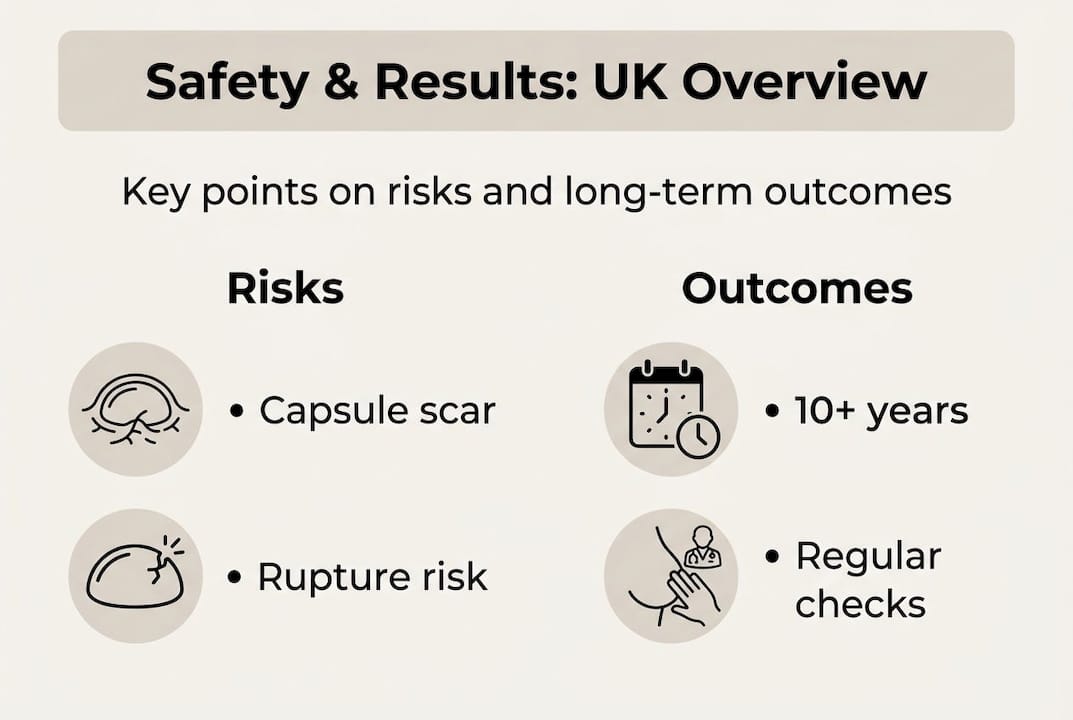
- Capsular contracture: Scar tissue hardens around the implant, affecting shape and comfort. This affects up to 10% of patients.
- Implant rupture: Rare but possible, particularly as implants age.
- Infection: Usually manageable with antibiotics if caught early.
- Changes in nipple or breast sensation: Often temporary but can be permanent.
- Scarring: Varies by incision type and individual healing.
- BIA-ALCL: A very rare lymphoma linked specifically to textured implants, not smooth ones.
“Implants are not lifetime devices and typically last around 10 years, though many last longer. Planning for eventual replacement is a realistic part of the decision.”
Long-term monitoring matters. The Breast and Cosmetic Implant Registry (BCIR) tracks outcomes across the UK, and patients are encouraged to register their implants so complications can be identified early at a population level. This is not bureaucracy; it is genuinely useful protection for you.
If you ever need to address implant concerns later in life, understanding your options for removal and replacement of implants is an important part of planning your long-term care.
Breast augmentation recovery: what to expect and how to support healing
Recovery from breast augmentation is very manageable when you know what to expect and prepare accordingly. Most women are surprised by how quickly they feel like themselves again, though the final results take longer to fully appear.
Here is a realistic week-by-week timeline:
- Week 1: Rest is essential. Expect soreness, swelling, and limited arm movement. Sleep on your back.
- Weeks 1 to 2: Most women take 1 to 2 weeks off work, depending on how physical their job is.
- Weeks 2 to 4: Gentle walking is encouraged. Avoid lifting, reaching overhead, or strenuous activity.
- Month 1 onwards: Exercise can typically resume after approximately one month, starting with low-impact activities.
- 3 to 6 months: Swelling fully settles and final results become visible.
Practical tips to support your recovery:
- Keep the surgical area clean and dry as directed
- Attend all follow-up appointments without skipping
- Eat a protein-rich diet to support tissue repair
- Stay well hydrated and avoid smoking, which impairs healing
- Apply scar treatments only once wounds are fully closed and with surgeon approval
Pro Tip: Wearing a well-fitted, supportive sports bra throughout recovery is one of the simplest things you can do to protect your results. It reduces movement, supports healing tissue, and can genuinely affect how your final shape settles.
For broader guidance, a plastic surgery recovery guide can help you plan the weeks ahead, and specific advice on quick healing after surgery is worth reading before your procedure date.
Choosing a qualified breast augmentation surgeon in the UK
This is where the stakes are highest. The quality of your surgeon has a greater influence on your outcome than almost any other factor, including implant brand or technique. Choosing well is non-negotiable.
Here is what to look for and verify:
- GMC registration: Every surgeon operating in the UK must be registered with the General Medical Council. You can check this online in minutes.
- Specialist register: Your surgeon should appear on the GMC specialist register specifically for plastic surgery, not just general surgery.
- Professional membership: GMC-registered surgeons with BAAPS or BAPRAS membership have met additional standards of training, ethics, and peer review. The Association of Breast Surgery (ABS) is another credible body.
- Experience with augmentation specifically: Ask how many procedures they perform per year and request to see recent patient photos.
- Complication and revision rates: A confident, ethical surgeon will share this data openly.
- Cooling-off period: Reputable clinics offer time between consultation and surgery, not pressure to book immediately.
Pro Tip: Ask to see before and after photos from patients with a similar starting point to you, not just the most impressive transformations. This gives a far more honest picture of what your results might realistically look like.
Reading about GMC-registered surgeons helps clarify what credentials genuinely mean in practice. Understanding key surgeon qualifications and what to expect from a surgeon consultation process will help you walk into any clinic with confidence.
A surgeon’s perspective: what most guides never tell you
Most articles focus on techniques and timelines. What they rarely acknowledge is that the most important conversation in breast augmentation happens before any surgical plan is drawn up.
At Lux Plastic Surgery, we have observed that long-term satisfaction is most strongly linked to one thing: how clearly a patient understands her own motivations. Women who choose augmentation to meet someone else’s expectations, or to chase a trend rather than a personal goal, are far more likely to feel uncertain about their results even when the surgery itself is technically excellent.
Emotional readiness is not a soft consideration. It is a clinical one. A thorough consultation should explore not just what you want physically, but why you want it and what you expect your life to look like afterwards. Surgeons who skip this conversation are cutting corners in a way that no amount of technical skill can compensate for.
Surprises happen too. Swelling can persist longer than expected. Implants settle asymmetrically at first before evening out. These are normal parts of the process, but patients who were not prepared for them often experience unnecessary distress. Knowing how to evaluate plastic surgery options safely is as much about psychological preparation as it is about research.
Explore your options with trusted breast surgery experts
If this guide has helped you think more clearly about breast augmentation, the next step is a conversation with a specialist who can give you personalised, impartial guidance.
At Lux Plastic Surgery, Professor Sandip Hindocha and his team offer expert consultations for women considering breast augmentation surgery across Bedford, London, and Manchester. From your first consultation through to aftercare and follow-up, every stage is managed with clinical rigour and genuine attention to your goals. Whether you are at the early research stage or ready to move forward, reading our safe procedure selection guide is a practical next step before you book.
FAQ
How long do breast implants last?
Most implants last around 10 years, though some women need replacement sooner due to complications such as rupture or capsular contracture.
What’s the difference between saline and silicone implants?
Saline implants are filled with sterile salt water, while silicone implants contain gel; silicone tends to feel more natural, whereas saline can feel firmer and may ripple more noticeably.
Is breast augmentation covered by the NHS?
Breast augmentation is rarely NHS-funded unless there is a clear medical or reconstructive need, such as following mastectomy or to address a significant developmental condition.
What results can I expect after recovery?
You can expect fuller, more symmetrical breasts, but final results appear 3 to 6 months after surgery once swelling has fully settled and implants have dropped into their natural position.
Are there risks of breast cancer after augmentation?
Standard implants do not increase breast cancer risk, but BIA-ALCL is a rare lymphoma linked specifically to certain textured implants, which is why smooth implants are now more commonly recommended.