Breast augmentation is one of the most popular cosmetic procedures in the UK, yet many women begin their journey feeling uncertain about what actually happens, what questions to ask, and how to stay safe. The gap between wanting a procedure and truly understanding it can lead to rushed decisions and disappointing outcomes. This guide walks you through every phase, from choosing the right surgeon and preparing for your consultation, to understanding exactly what happens in theatre and how to recover well. Whether you are just beginning to research or are close to booking, you will leave with the knowledge to make confident, informed choices.
Key Takeaways
| Point | Details |
|---|---|
| Surgeon selection matters | Choosing a GMC/BAAPS/BAPRAS-registered surgeon is key for safe, individualised results. |
| Understand each surgical step | Knowing the operation process helps you make confident, informed decisions. |
| Recovery takes time | Expect 1–2 weeks off work, with full activity resumed after 4–6 weeks and swelling settling over several months. |
| Be aware of risks | Capsular contracture and other complications can occur, but risks are reduced with careful planning and regular follow-up. |
| Implants are not permanent | Most women require implant replacement after 10+ years, making ongoing care important. |
Preparing for breast augmentation: What to know before you start
Preparation is where safe, personalised outcomes are won or lost. Before you even think about implant shapes or sizes, your first task is finding a surgeon you can genuinely trust. In the UK, that means checking that your surgeon holds GMC, BAAPS, or BAPRAS registration, as these credentials confirm they have met rigorous training and ethical standards. Registration alone is not a guarantee of excellence, but it is the minimum standard you should accept.
Your consultation is the most valuable appointment in the entire process. A thorough surgeon will review your medical history, assess your anatomy, discuss your aesthetic goals honestly, and use imaging tools to help you visualise potential results. This is your opportunity to share what you want and to hear what is realistically achievable for your body. For expert insights on what UK women should consider before proceeding, it helps to research widely before your first appointment.
Understanding the NHS versus private landscape also matters. Cosmetic breast augmentation is rarely available on the NHS, so most women pursue private care. If you do proceed privately, ask whether your surgeon registers your implants with the Breast and Cosmetic Implant Registry (BCIR), which helps track long-term outcomes across the UK. Choosing a GMC-registered surgeon who supports registry participation is a meaningful safety step.
Pre-operative requirements typically include:
- Blood tests and a general health assessment
- Stopping smoking at least six weeks before surgery, as smoking significantly raises complication risk
- Avoiding aspirin, ibuprofen, and certain supplements for two weeks beforehand
- Arranging post-operative support at home for the first 48 hours
- Attending a safe cosmetic surgery consultation to discuss your individual suitability
Pro Tip: Bring reference photos to your consultation, not to copy a look exactly, but to help your surgeon understand your aesthetic preferences. Also ask specifically about scar placement options and which incision type suits your anatomy best.
| Consideration | What to check |
|---|---|
| Surgeon credentials | GMC, BAAPS, BAPRAS registration |
| Implant tracking | BCIR registry enrolment |
| Funding route | Private (NHS rarely covers cosmetic augmentation) |
| Pre-op requirements | Blood tests, smoking cessation, medication review |
Step-by-step guide to breast augmentation surgery
Once you have prepared and chosen your surgeon, here is exactly what happens in the operating theatre. Knowing the sequence removes the fear of the unknown and helps you ask smarter questions during your pre-operative appointments.
Breast augmentation is performed under general anaesthetic and typically takes 60 to 90 minutes, though more complex cases at private clinics may run to two hours. You will be asleep throughout and will not feel anything during the procedure.
- Anaesthesia: A general anaesthetic is administered by a consultant anaesthetist. You are monitored continuously throughout.
- Incision: Your surgeon makes a small cut at one of three sites. The inframammary fold (beneath the breast) is the most common and offers excellent visibility. The periareolar site (around the nipple edge) leaves a well-concealed scar. The transaxillary approach (through the armpit) avoids breast scarring entirely but is less frequently used in the UK.
- Pocket creation: A space is created either beneath the breast tissue (subglandular) or beneath the chest muscle (submuscular or dual plane). Submuscular placement tends to look more natural and is often preferred for women with less natural breast tissue.
- Implant insertion: The chosen implant, whether silicone or saline, round or teardrop shaped, is placed carefully into the pocket. Silicone implants are by far the most popular choice in the UK because they feel closest to natural breast tissue.
- Closure: The incision is closed in layers, and post-operative dressings are applied. Most surgeons use dissolvable sutures.
Pro Tip: Ask your surgeon which incision site they personally prefer for your anatomy and why. A confident, experienced surgeon will give you a clear, reasoned answer rather than a vague one.
| Incision site | Scarring | Visibility | Common use |
|---|---|---|---|
| Inframammary | Beneath breast fold | Hidden when standing | Most common in UK |
| Periareolar | Nipple edge | Well concealed | Good for lift combinations |
| Transaxillary | Armpit | No breast scar | Less common |
For a detailed look at breast augmentation surgery options and what to expect at a specialist UK clinic, it is worth reviewing your choices with a specialist before deciding. A safety evaluation guide can also help you weigh your options with confidence.
Recovery and expected outcomes: Healing after augmentation
Understanding the procedure is just part of the journey. Recovery is where patience and preparation genuinely pay off.
“Most swelling settles within months and scars fade, but your final outcome becomes clear only after full healing.”
The recovery timeline most women follow looks like this:
- Days 1 to 3: Rest at home. Expect soreness, tightness, and fatigue. Pain is manageable with prescribed medication.
- Week 1 to 2: Most women take one to two weeks off work, depending on the physical demands of their job.
- Week 1: Avoid driving until you can perform an emergency stop comfortably without pain.
- Weeks 2 to 6: Light daily activity resumes gradually. Avoid lifting anything heavier than a kettle for the first few weeks.
- Weeks 4 to 6: Most women can return to non-contact exercise. High-impact sport and heavy gym work should wait until your surgeon clears you.
- Up to 3 months: Wear a supportive sports bra continuously, day and night, as directed by your surgeon.
Swelling is normal and can make your results look larger or uneven initially. Bruising typically fades within two to three weeks. Emotionally, some women experience a period of adjustment as their body changes. This is entirely normal and usually resolves as swelling settles and confidence grows.
For practical fast recovery tips that can genuinely speed up healing, preparation before surgery matters as much as aftercare. Knowing your recovery expectations in advance helps you plan your time off, arrange childcare if needed, and avoid the frustration of unexpected setbacks.
In the UK, breast augmentation costs between £3,500 and £8,000 at private clinics, depending on the surgeon’s experience, the implants used, and the location of the clinic.
Risks, complications, and how to make safe choices
While most women recover well, it is vital you understand the risks clearly before proceeding. Knowing what to watch for means you can act quickly if something does not feel right.
The most frequently reported complications include:
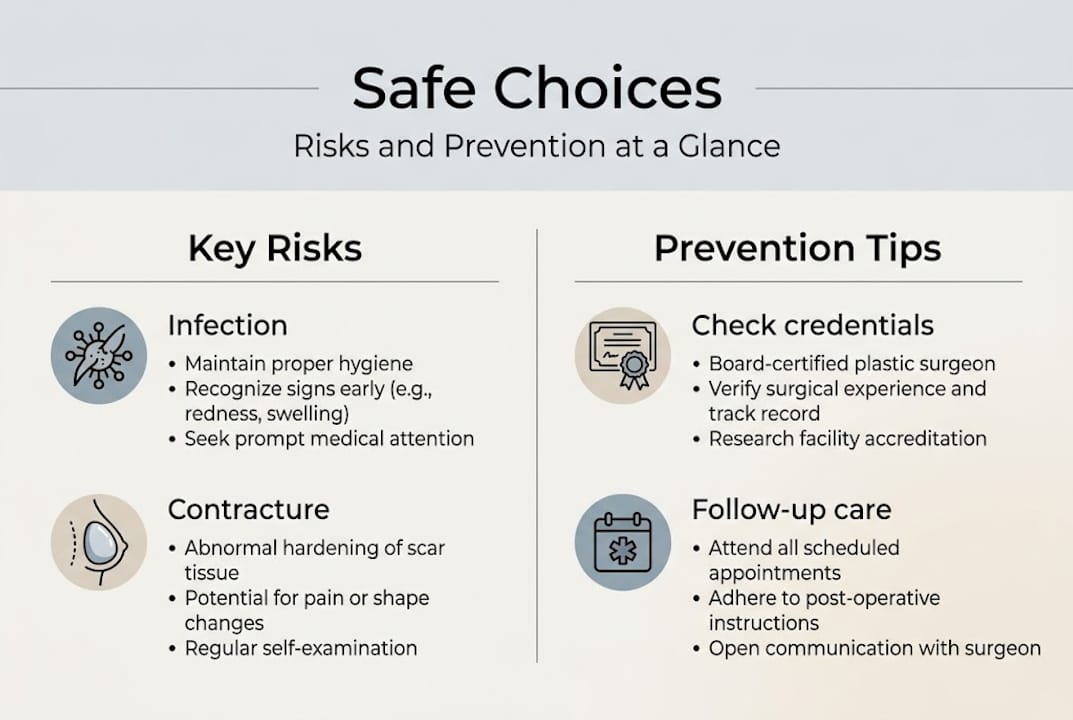
- Capsular contracture: The most common complication, where scar tissue hardens around the implant. Rates range from 2 to 15% depending on implant type and placement.
- Infection: Usually manageable with antibiotics, but severe cases may require implant removal.
- Rupture or leakage: More likely over time, which is why implants are not considered lifetime devices.
- Rippling: Visible or palpable wrinkling, more common in women with little natural breast tissue.
- BIA-ALCL: A rare lymphoma associated primarily with textured implants. It is uncommon but important to know about.
- Reoperation: Reoperation rates sit at approximately 7.7% across studies, often for revision or complication management.
Certain factors raise your individual risk. Smoking, being under 27, having a higher BMI, and choosing textured implants are all associated with higher rates of contracture and BIA-ALCL. Discussing these factors honestly with your surgeon is essential.
Breast Implant Illness (BII) is a term used to describe a range of symptoms, including fatigue, joint pain, and brain fog, that some women report after surgery. Between 25 and 35% of women report such symptoms, and many find they improve after implant removal. Research is ongoing, and it is a topic worth raising openly during your consultation.
To reduce your risk: choose a GMC/BAAPS/BAPRAS-registered surgeon, attend all follow-up appointments, register your implants with the BCIR, and contact your surgical team promptly if you notice any unusual changes. For further expert insights on safety and how to evaluate your options safely, reviewing credible resources before committing is always time well spent.
What most guides miss about achieving the best breast augmentation outcome
Most articles on breast augmentation focus heavily on the technical steps and list credentials as if ticking boxes is enough. In our experience, the women who achieve the most satisfying, lasting results are those who treat the consultation as a genuine two-way conversation, not an audition.
Registration and positive reviews are important starting points, but they tell you very little about whether a surgeon truly listens. A personalised outcome depends on a surgeon who challenges your assumptions, explains trade-offs honestly, and tailors their approach to your specific anatomy rather than applying a one-size-fits-all technique.
Many guides also gloss over the psychological dimension. Adjusting to a changed body takes time, and setting realistic expectations before surgery protects your wellbeing as much as any clinical precaution. Being proactive about your concerns, including BII, long-term implant lifespan, and revision possibilities, is not pessimism. It is self-advocacy.
Implants are not permanent. They typically need attention after ten or more years. Building a relationship with a surgeon who offers long-term follow-up, rather than one who disappears after your six-week check, is one of the most underrated factors in long-term satisfaction. Reviewing surgeon results and credentials carefully before committing is the foundation everything else is built upon.
Take the next step with expert support
If you are ready to move forward with confidence, the right support makes all the difference.

At Lux Plastic Surgery, Professor Sandip Hindocha and his team offer bespoke consultations for women across Bedford, London, and Manchester, with a commitment to safety, honesty, and natural-looking results. Whether you are just starting to explore your options or are ready to plan your procedure, our resources are designed to guide you clearly. Start with the basics of plastic surgery to build your knowledge, learn how to choose the right surgeon for your needs, and explore our plastic surgery recovery tips to prepare for a smooth healing journey.
FAQ
How long does breast augmentation surgery take?
In the UK, breast augmentation typically lasts 60 to 90 minutes under general anaesthetic, though more complex cases at private clinics may take up to two hours.
Can I get breast augmentation on the NHS?
Cosmetic breast augmentation is rarely covered by the NHS, so the vast majority of women in the UK pursue treatment through private clinics.
What are the most common risks after breast implants?
Capsular contracture, infection, rupture, and rippling are the most frequently reported complications, with reoperation rates of around 7.7% across studies.
How long will breast implants last before needing replacement?
Breast implants are not lifetime devices; replacement is generally expected after ten or more years, making long-term follow-up with your surgeon essential.
What is Breast Implant Illness (BII)?
BII refers to a range of symptoms such as fatigue and joint pain that some women report after surgery; symptoms often improve following implant removal, though research is still ongoing.