Natural-looking results are defined as cosmetic outcomes that refresh and enhance appearance without altering a person’s unique features or creating an obvious “done” look. The term describes a standard of care where the goal is balance, harmony, and a rested quality rather than dramatic transformation. Regulatory bodies including the GMC and BAAPS consistently emphasise that safe, ethical cosmetic practice centres on preserving identity and setting realistic expectations. Understanding what constitutes natural results helps you make informed decisions before any procedure, whether surgical or non-surgical.
What defines natural-looking results and why facial harmony matters?
Natural-looking results are not about invisibility. They are about visible improvement that leaves others thinking you look well or rested, not that you have had work done. The distinction matters because many patients arrive at consultations with a vague wish to “look better” without a clear framework for what that means clinically.

Facial harmony is the foundation of natural aesthetic results. The face is not a collection of independent features. The forehead, cheeks, lips, chin, jawline, and skin quality all exist in proportion to one another, and a change in one area affects the visual weight of every other. A practitioner who treats features in isolation, adding volume to the lips without considering the chin projection, for example, risks creating disproportion that reads as artificial.
Whole-face assessment is the clinical standard that prevents this. Treating features independently often causes the “overdone” appearance that patients specifically wish to avoid. Skilled practitioners assess the face as a single unit, identifying which areas are driving the ageing process and which require support rather than volume.
The following principles define what natural aesthetics means in practice:
- Proportion: Changes respect the existing ratios between facial thirds and fifths.
- Balance: No single feature dominates the face after treatment.
- Movement: Expressions remain fluid and recognisable.
- Skin quality: Texture and tone complement structural work rather than being ignored.
- Identity preservation: The patient looks like themselves, only refreshed.
Pro Tip: Before any consultation, bring photographs of yourself from five to ten years ago. These give your practitioner a reference point for your natural anatomy rather than a trend-driven ideal.
Natural aesthetics cannot be standardised because individual facial relationships differ. The best outcomes consider the face as a whole rather than addressing isolated features in isolation.
How do personalised treatment plans help achieve natural aesthetic results?
A personalised treatment plan is the mechanism through which natural results become achievable rather than accidental. Generic protocols applied uniformly across patients produce uniform outcomes, and uniform outcomes rarely look natural because no two faces share identical anatomy.
The consultation is where personalisation begins. Thorough assessments that include discussion of goals, risks, and likely outcomes improve both safety and satisfaction. A practitioner who listens carefully to what you want to achieve, and who is equally willing to recommend no treatment or an alternative approach, is demonstrating the clinical judgement that natural results require. The British Association of Aesthetic Plastic Surgeons (BAAPS) warns against impulsive decisions driven by discounts or advertising, precisely because rushed choices bypass this essential assessment stage.
Anatomical understanding is what separates a personalised plan from a menu selection. A skilled practitioner assesses bone structure, soft tissue volume, skin laxity, and muscle activity before recommending any intervention. At Lux Plastic Surgery, personalised cosmetic evaluations form the basis of every treatment decision, with Professor Hindocha directing care according to each patient’s individual anatomy and goals.
A well-constructed personalised plan typically follows this sequence:
- Initial consultation: Establish goals, review medical history, assess facial anatomy, and discuss realistic outcomes.
- Photographic assessment: Document baseline appearance and use imaging to model potential changes where appropriate.
- Treatment recommendation: Propose the minimum effective intervention to achieve the stated goal.
- Staged delivery: Where multiple treatments are appropriate, sequence them to allow reassessment between sessions.
- Review appointment: Evaluate results at an appropriate interval and adjust the plan if needed.
- Long-term maintenance: Agree a schedule that sustains results without accumulating excess volume or correction over time.
Gradual treatment is not a compromise. It is the method most likely to produce results that integrate naturally with ageing. Patients who refresh rather than transform report higher long-term satisfaction, because incremental changes allow both the patient and the practitioner to assess each stage before proceeding.
What techniques produce natural-looking cosmetic results?
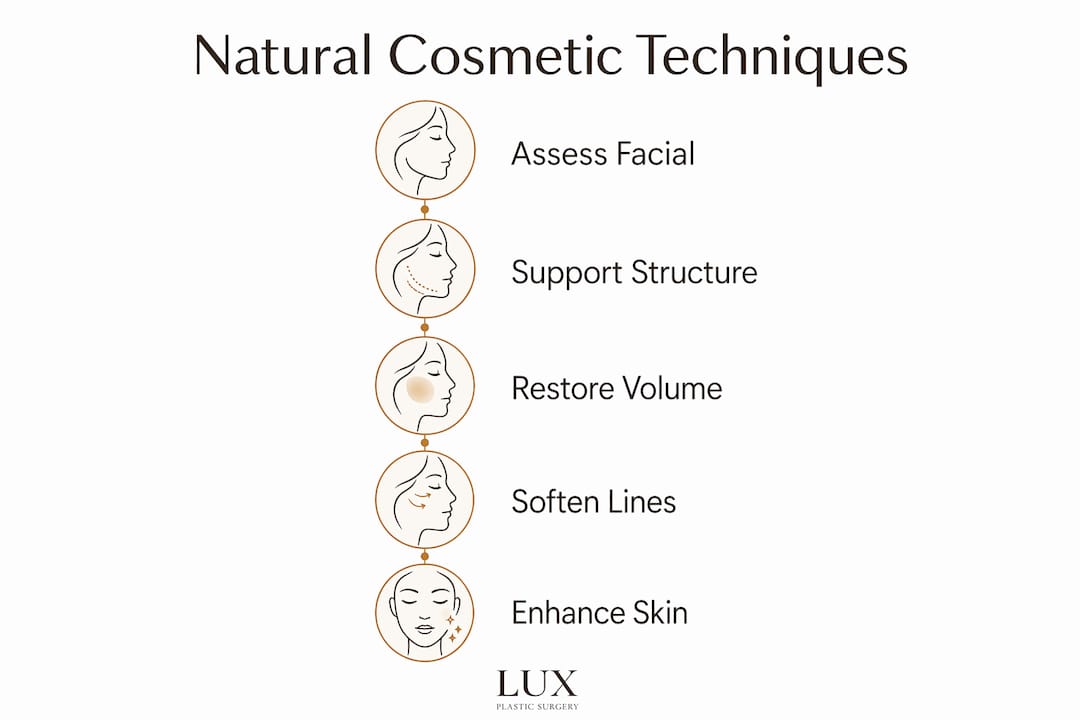
The techniques that produce natural results share a common philosophy: support the structure that exists rather than imposing a new one. The specific procedures vary, but the principle of minimum effective intervention applies across all of them.
Dermal fillers for volume and hydration
Dermal fillers restore volume that has been lost through ageing rather than adding volume for its own sake. Hyaluronic acid fillers, when placed correctly, provide hydration and light structural support. The distinction between restoring and augmenting is clinically significant. Restoring a deflated cheek to its former position looks natural. Adding volume beyond the patient’s anatomical baseline creates an appearance that reads as artificial. Subtle placement of fillers achieves refined outcomes precisely because the practitioner is working with the face’s existing architecture.
Botulinum toxin to soften without freezing
Botulinum toxin, commonly known as Botox, softens the muscles that create dynamic lines without eliminating movement entirely. The goal is to reduce the depth of lines at rest while preserving the full range of facial expression. A patient who cannot raise their eyebrows or show surprise has been overtreated. Correct dosing and placement produce a result where lines are softened and the face appears rested, but movement remains natural and recognisable.
Profhilo and skin quality treatments
Profhilo is a bio-remodelling treatment that improves skin laxity and hydration without adding structural volume. It works by stimulating collagen and elastin production, improving the quality of the skin itself rather than altering its shape. This category of treatment is particularly relevant for patients whose primary concern is skin texture or early laxity rather than volume loss. Improving skin quality often produces a more natural result than structural intervention alone, because healthy skin reflects light differently and appears more youthful without any obvious change in facial shape.
The table below summarises how these approaches differ in their mechanism and appropriate application:
| Treatment | Primary mechanism | Best suited for | Natural result achieved by |
|---|---|---|---|
| Dermal fillers | Volume restoration | Mid-face deflation, tear troughs | Restoring lost anatomy, not augmenting |
| Botulinum toxin | Muscle relaxation | Dynamic lines, brow position | Preserving expression while softening |
| Profhilo | Skin bio-remodelling | Laxity, texture, hydration | Improving skin quality without altering shape |
| Surgical procedures | Structural repositioning | Significant laxity, volume redistribution | Repositioning tissue to its natural position |
Pro Tip: Ask your practitioner to show you before-and-after photographs of patients with a similar facial structure to yours, not just the most dramatic transformations in their portfolio.
For patients considering non-surgical aesthetic treatments, understanding how each technique contributes to the overall result helps set realistic expectations before the first appointment.
How should patients manage expectations for realistic beauty outcomes?
Realistic expectations are the single most important factor in patient satisfaction after a cosmetic procedure. Patients with realistic goals report positive outcomes at significantly higher rates than those who approach treatment with an idealised or perfection-focused mindset.
Perfection is not a clinical outcome. It is a subjective concept that shifts with trends, age, and personal perception. A practitioner who promises perfection is not being honest about what cosmetic procedures can deliver. The appropriate goal is improvement: a measurable, visible change that makes you look refreshed and more like yourself at your best.
Gradual enhancement produces better long-term results than single, large interventions for several reasons:
- Each stage can be assessed before the next is undertaken.
- The face adapts incrementally, and the result integrates more naturally.
- Overcorrection is far easier to avoid when changes are made in small steps.
- Patients develop a clearer sense of their own preferences as they see results evolve.
- Practitioners can identify and address asymmetries before they become pronounced.
The MHRA’s Cosmetic Breast Augmentation Risk Awareness Tool illustrates the broader principle that shared decision-making and detailed risk communication during consultations improve informed consent across all cosmetic procedures. The same logic applies to facial treatments: the more thoroughly a patient understands what a procedure can and cannot achieve, the more satisfied they are likely to be with the outcome.
Honest communication between patient and practitioner is not a courtesy. It is a clinical requirement. A practitioner who tells you that a particular treatment will not achieve your stated goal, and who offers an alternative or recommends no treatment, is providing a higher standard of care than one who proceeds regardless. The benefits of plastic surgery are real and well-documented, but they are realised most reliably when the procedure is matched carefully to the patient’s anatomy and expectations.
Key takeaways
Natural-looking cosmetic results require whole-face assessment, minimum effective intervention, and realistic expectations managed through thorough consultation with a qualified practitioner.
| Point | Details |
|---|---|
| Natural means refreshed, not invisible | Visible improvement that preserves identity is the clinical definition of a natural result. |
| Whole-face assessment prevents disproportion | Treating features in isolation creates imbalance; skilled practitioners assess the face as a single unit. |
| Personalised plans outperform generic protocols | Individual anatomy, goals, and skin quality must guide every treatment decision. |
| Gradual enhancement increases satisfaction | Incremental changes allow reassessment and reduce the risk of overcorrection. |
| Realistic expectations are a clinical requirement | Patients who understand procedure limits report higher satisfaction and better emotional outcomes. |
What natural results actually look like: a clinical perspective
The phrase “natural-looking” gets used so frequently in cosmetic medicine that it has almost lost its meaning. Patients hear it in consultations, read it in clinic brochures, and see it in before-and-after captions. What it rarely gets is a precise clinical definition.
From my perspective, a natural result is one where the improvement is visible but the intervention is not. When someone looks at you after a well-executed procedure, they should notice that you look well, not that you have had something done. That is a high standard. It requires restraint as much as skill.
The cases that concern me most are not the ones where patients ask for too much. They are the ones where practitioners deliver too much without being asked. Volume accumulates over repeated filler sessions. Brow position drifts upward with repeated toxin use. Skin tightens beyond its natural range after repeated energy-based treatments. Each individual session may seem modest, but the cumulative effect moves the face away from its natural state rather than towards it.
The solution is proportion-led care. Every decision should be tested against a single question: does this bring the face closer to its natural, healthy state, or does it move it further away? If the answer is the latter, the treatment should not proceed. That is not a failure of ambition. It is the correct clinical judgement.
Patients who come to Lux Plastic Surgery with a clear sense of what they want to preserve, not just what they want to change, tend to achieve the best outcomes. Identity is not a barrier to improvement. It is the framework within which improvement happens.
— Lux
How Lux Plastic Surgery approaches natural-looking results
Lux Plastic Surgery offers consultant-led, bespoke treatment planning across Bedford, London, and Manchester. Every patient is assessed by Professor Sandip Hindocha, GMC-registered Consultant Plastic Surgeon and NHS Clinical Director, whose approach prioritises proportion, identity, and long-term satisfaction over trend-driven intervention. For a thorough overview of the procedures available and the safety standards that govern them, the plastic surgery options guide covers surgical and non-surgical pathways in detail. Patients considering their first consultation can also review the facial surgery options available at Lux Plastic Surgery to understand what a personalised assessment involves.
To book a consultation, contact Lux Plastic Surgery directly. This article does not constitute medical advice. Always consult a GMC-registered specialist before proceeding with any cosmetic procedure.
FAQ
What is the clinical definition of natural-looking results?
Natural-looking results are cosmetic outcomes that produce visible improvement while preserving a patient’s individual features, movement, and identity. The result reads as refreshed rather than surgically altered.
How do I know if a practitioner will deliver natural results?
Ask to see before-and-after photographs of patients with similar anatomy, and assess whether the practitioner recommends the minimum effective treatment rather than the most extensive option. A willingness to advise no treatment when appropriate is a strong indicator of sound clinical judgement.
Are natural results possible with surgical procedures?
Yes. A well-executed surgical procedure, such as a facelift, repositions tissue to where it sat naturally in youth rather than pulling the skin tight. Facial surgery performed by an experienced consultant produces results that others notice as an improvement without identifying the cause.
Why does gradual treatment produce better natural results?
Gradual treatment allows each stage to be assessed before the next is undertaken, reducing the risk of overcorrection and allowing the face to adapt incrementally. Patients who refresh rather than transform report higher long-term satisfaction with their cosmetic results.
How do I select cosmetic procedures safely in the UK?
Choose a GMC-registered practitioner, attend a thorough consultation that includes discussion of risks and realistic outcomes, and avoid decisions driven by discounts or time-limited promotions. The BAAPS advises against impulsive cosmetic surgery decisions influenced by advertising. A detailed guide to selecting procedures safely is available for patients researching their options.