Lip enhancement is widely misunderstood. Many people picture the exaggerated, over-inflated results that circulated on social media a decade ago, and assume that is what the procedure delivers. It is not. What is lip enhancement in reality? It is a carefully administered cosmetic lip treatment designed to add subtle volume, improve definition, and restore symmetry to the lips, using techniques that respect your natural anatomy. Modern lip augmentation procedures, performed by qualified practitioners across the UK, are far more nuanced than the caricatures suggest. This guide covers how it works, what it costs, how safe it is, and what natural results actually look like.
Key Takeaways
| Point | Details |
|---|---|
| Lip enhancement basics | Lip enhancement uses hyaluronic acid fillers to add volume and definition temporarily. |
| UK regulations and costs | Procedures require a consultation by qualified practitioners and typically cost £150-£500 depending on volume and location. |
| Natural look strategy | Start conservatively with small filler volumes and build up gradually for natural results. |
| Treatment and recovery | Expect brief procedure time, swelling and bruising for days, with full results visible after up to two weeks. |
| Safety first | Choosing GMC, NMC, or GDC-registered practitioners reduces risks and ensures proper care. |
Understanding lip enhancement and how it works
Lip enhancement, at its core, involves injecting a filler substance into the lips to alter their shape, volume, or definition. The vast majority of treatments in the UK use hyaluronic acid, a substance that occurs naturally in the body and is well-tolerated by most people. Because the body gradually metabolises hyaluronic acid, the results are temporary. According to lip fillers UK guidance, fillers typically last between six and twelve months, with swelling and bruising common initially and final results visible after one to two weeks.
The procedure itself is straightforward. A numbing cream is applied beforehand to minimise discomfort, and the injections typically take between 15 and 30 minutes in a clinical setting. You leave with immediate volume, though the first few days involve some puffiness that can make the result look more dramatic than it will ultimately be. Patience matters here. The lips you see at day two are not the lips you will have at day fourteen.
What makes aesthetic medicine genuinely interesting is the range of results achievable with a single product. Hyaluronic acid filler can be placed to:
- Add overall volume to thin lips
- Define the border and Cupid’s bow for sharper edges
- Correct asymmetry between the left and right sides
- Restore volume lost through ageing
- Improve hydration and texture without dramatic size changes
This flexibility is why lip fillers have remained the dominant non-surgical lip enhancement method in the UK for over a decade.
Cost, regulation, and safety considerations in the UK
Lip enhancement is a cosmetic procedure and is not available on the NHS for the vast majority of adults. You will pay privately, and costs vary considerably depending on location, practitioner experience, and the volume of filler used.
UK lip filler costs typically range from £200 to £500 per 1ml, with first-time patients often opting for 0.5ml at £150 to £300. London prices tend to run 20 to 40% higher than regional clinics in cities such as Manchester or Bedford.
| Treatment volume | Typical UK cost (outside London) | Typical London cost |
|---|---|---|
| 0.5ml (starter) | £150 to £250 | £200 to £350 |
| 1ml (standard) | £200 to £400 | £300 to £500 |
| 1.5ml (enhanced) | £300 to £500 | £400 to £650 |
On the regulatory side, the UK Health and Care Act 2022 introduced mandatory pre-treatment consultations for lip filler procedures, meaning no reputable clinic should be offering same-day walk-in injections. Medically qualified practitioners are strongly recommended, though it remains legal for non-medics to inject adults in certain circumstances. This is a critical distinction.
Key safety checks before booking any treatment:
- Verify the clinic holds CQC (Care Quality Commission) registration
- Look for Save Face accreditation, the UK’s national register of accredited practitioners
- Confirm the injector holds a medical qualification such as a nurse, doctor, or dentist
- Ensure a consultation is offered before any treatment is agreed
- Ask what product is being used and whether hyaluronidase (the dissolving agent) is available on-site
The most serious risk associated with lip fillers is vascular occlusion, where filler accidentally enters a blood vessel and restricts blood flow. It is rare, but it requires immediate treatment. Only a medically trained practitioner has the knowledge and access to manage this safely. Knowing how to select cosmetic procedures safely before you book is not optional; it is the difference between a good outcome and a dangerous one.
Pro Tip: Do not let price be your primary filter. A £150 treatment from an unqualified injector carries far greater risk than a £300 treatment from a registered nurse or doctor. The cost of correcting a complication far exceeds any saving made upfront.
When researching clinics, also read about safe cosmetic surgery steps to understand the broader framework of risk-aware decision-making that applies to all aesthetic treatments.
Techniques for a natural-looking lip enhancement
The single most common reason people end up with unnatural-looking lips is too much filler, too soon. It is not a technique failure. It is a volume failure. Expert guidance consistently advises starting first-timers with 0.5ml, building volume gradually over sessions spaced months apart to maintain natural lip proportions.
The logic is simple. Your lips have an existing shape, tissue density, and relationship to the rest of your face. Introducing a large volume all at once overwhelms those natural structures. Starting small allows both the patient and the practitioner to assess how the tissue responds and what refinements are needed.
A staged approach to lip enhancement typically looks like this:
- Session one: 0.5ml placed conservatively to add subtle volume or definition
- Review at four weeks: Assess the settled result and discuss whether more is wanted
- Session two (if desired): A further 0.5ml to refine shape or add volume
- Maintenance: Top-up treatments every six to twelve months as the filler metabolises
“The best lip enhancement results are the ones nobody notices. They see you and think you look well, refreshed, or attractive. They do not think about your lips.”
One anatomical principle that separates skilled practitioners from average ones is the upper-to-lower lip ratio. Naturally, the lower lip is slightly fuller than the upper. Reversing this ratio, or making both lips equal in volume, tends to look artificial. Respecting this proportion is fundamental to facial harmony.
Supporting your skin health before and after treatment also matters. Starting a collagen regimen naturally can improve tissue quality, which in turn supports how well filler integrates and how long results last. Hydrated, healthy tissue holds filler more evenly than dry or depleted skin.
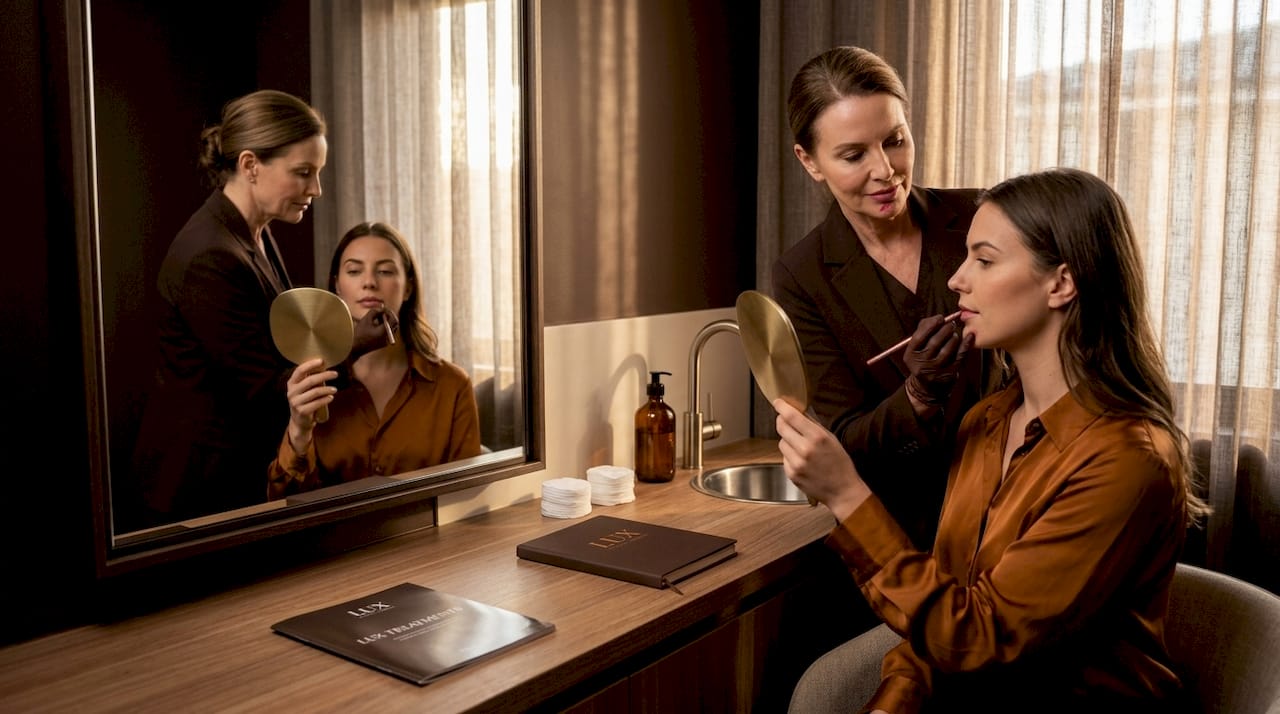
Choosing a practitioner who understands these principles is as important as the product itself. Knowing how to choose the best aesthetic clinic will help you identify professionals who treat the whole face rather than just the lips in isolation.
What to expect before, during, and after treatment
Knowing the full treatment journey removes anxiety and helps you plan practically. Here is what a typical lip enhancement experience looks like from start to finish.
Before treatment:
- A mandatory consultation to assess your lips, discuss goals, and review your medical history
- Photographs taken for comparison and record-keeping
- Discussion of product options, volume, and expected outcomes
- Written consent and a cooling-off period before treatment proceeds
During treatment:
- Numbing cream applied and left for 15 to 20 minutes
- Filler injected using a fine needle or cannula at targeted points
- Lips gently massaged to distribute product evenly
- Procedure completed in 15 to 30 minutes
After treatment:
Post-treatment swelling typically peaks at 24 to 48 hours and subsides within five to seven days. Bruising, if it occurs, usually resolves within two to three days. Natural results become visible after one to two weeks once all swelling has settled.
Common aftercare guidelines include:
- Avoid strenuous exercise for 24 to 48 hours
- Do not apply pressure or massage the lips for at least a week
- Stay out of saunas, steam rooms, and direct sun for 48 hours
- Keep well hydrated and avoid alcohol for the first 24 hours
- Attend a follow-up appointment to review results
Understanding why aftercare is essential to your results is something many patients underestimate. The way you treat your lips in the days following treatment directly affects how the filler settles. Supporting your recovery by learning how to boost skin recovery naturally can make a measurable difference to the final outcome.
Comparing non-surgical lip enhancement options and outcomes
Lip fillers dominate the UK market, but they are not the only option. Understanding the alternatives helps you make a genuinely informed decision rather than defaulting to whatever is most familiar.
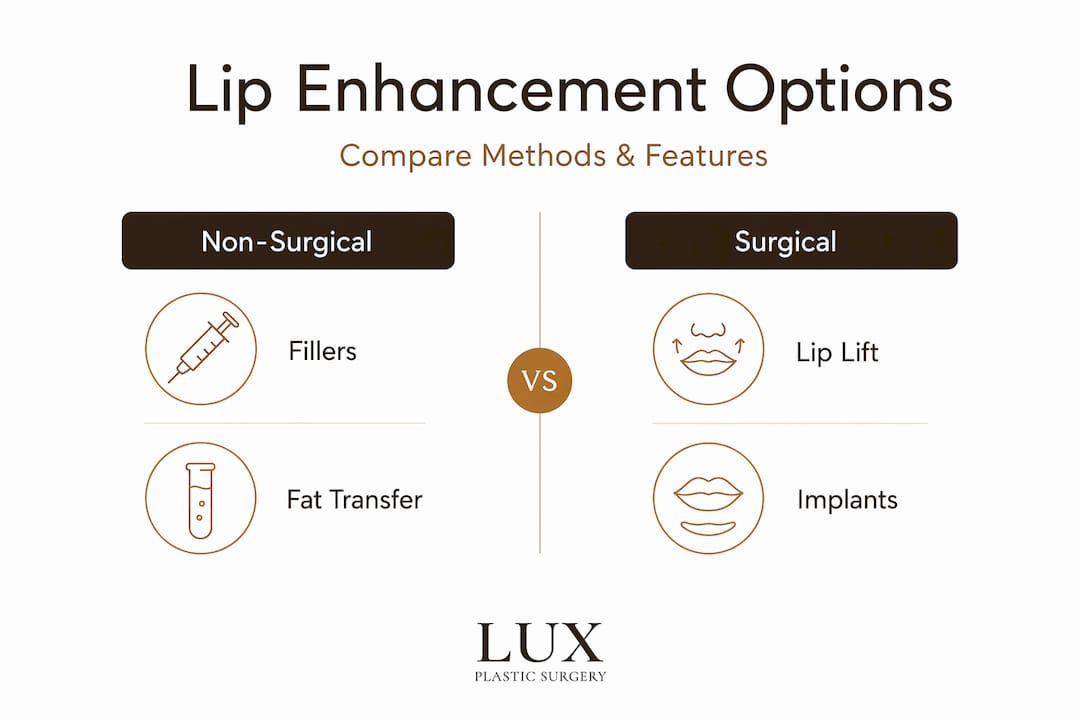
Lip augmentation methods in the UK broadly fall into three categories: hyaluronic acid fillers, fat transfer, and surgical implants. Each carries a different risk profile, recovery time, and degree of permanence.
| Method | Permanence | Invasiveness | Reversibility | Typical recovery |
|---|---|---|---|---|
| Hyaluronic acid filler | 6 to 12 months | Minimal | Yes (dissolve with hyaluronidase) | 1 to 2 weeks |
| Fat transfer | 1 to 3 years | Moderate (liposuction required) | No | 2 to 4 weeks |
| Surgical implants | Permanent | High | Removal surgery required | 4 to 6 weeks |
The key advantages of fillers as a non-surgical lip enhancement method:
- Reversible if you dislike the result
- Adjustable over time as your preferences evolve
- No general anaesthetic required
- Minimal downtime with most people returning to work the same day
- Results can be refined gradually to match changing goals
Surgical options suit patients who want permanence and are comfortable with a more involved recovery. Fat transfer, which uses your own body fat harvested from elsewhere, appeals to those who prefer avoiding synthetic products. However, the results are less predictable than fillers because a percentage of transferred fat is reabsorbed by the body.
For a broader understanding of how lip enhancement sits within the wider landscape of aesthetic options, reviewing the types of plastic surgery options available in the UK helps contextualise where fillers fit relative to surgical alternatives.
A UK expert’s view on achieving safe and natural lip enhancement
Here is something most lip enhancement articles will not tell you directly: the majority of patients who end up dissatisfied did not choose the wrong clinic. They chose the wrong volume. Practitioner experience consistently shows that most patients later wish they had begun more conservatively, because excessive volume is genuinely difficult to reverse and can alter the surrounding tissue over time.
Social media has created a distorted benchmark for what lips should look like. The images that perform well on platforms are often the dramatic ones, not the subtle ones. But in person, in real light, the treatments that go unnoticed are the ones that work. Nobody compliments a stranger on their natural-looking lips because they cannot tell anything was done. That invisibility is the goal.
The UK regulatory landscape is improving. The Health and Care Act 2022 requirements around mandatory consultations are a meaningful step forward, but the law still permits non-medics to inject adults. This means the burden of due diligence remains with the patient. Checking qualifications, asking direct questions about training, and not being swayed by discounts or urgency tactics are not overcaution. They are basic consumer sense.
The advice we would give anyone considering their first treatment: start subtle. One small session, properly assessed, tells you everything you need to know about how your tissue responds, what you actually want, and whether this treatment is right for you. Patience here is not timidity. It is the most effective strategy available.
Find safe, expert lip enhancement with Lux Plastic Surgery
If you have spent time researching what lip enhancement involves and you are ready to take the next step, the quality of your practitioner matters more than any other variable.

At Lux Plastic Surgery, our expert aesthetic services are delivered by medically qualified practitioners with a genuine commitment to natural-looking, personalised results. Every treatment begins with a thorough consultation, and our approach prioritises your safety and long-term satisfaction above all else. Whether you are considering your first 0.5ml treatment or exploring more involved options, our team provides the guidance you need to make a confident, risk-aware decision. Explore our resource on how to achieve natural results with non-surgical treatments, or review our safe cosmetic surgery steps guide before booking your consultation.
FAQ
Are lip enhancement procedures available on the NHS in the UK?
Lip enhancement procedures are cosmetic and not routinely available on the NHS, except in rare cases involving congenital defects or medical necessity. Most adults seeking lip augmentation will need to fund treatment privately.
How long does lip enhancement last?
Hyaluronic acid lip fillers last between six and twelve months before the body breaks the product down naturally. Factors including metabolism, lifestyle, and the volume used can affect how quickly results fade.
What should I expect during lip filler treatment in the UK?
You can expect a consultation beforehand, numbing cream applied for 15 to 20 minutes, then a 15 to 30 minute injection procedure. Mild swelling and bruising are normal for the first few days, with final results settling after one to two weeks.
Why is choosing a medically qualified injector recommended?
Medically qualified practitioners are trained to recognise and manage rare but serious complications such as vascular occlusion quickly, which significantly improves safety outcomes compared with non-medic injectors.
How can I ensure my lip enhancement looks natural?
Starting conservatively with 0.5ml and building volume gradually across sessions, while working with a practitioner who respects your natural lip proportions, is the most reliable way to achieve a subtle, natural result.