Breast reduction surgery, known clinically as reduction mammoplasty, is a surgical procedure that removes excess breast tissue, fat, and skin to reduce breast size and relieve associated physical symptoms. The operation addresses chronic back, shoulder, and neck pain, skin irritation beneath the breast fold, and postural problems caused by disproportionately large breasts. It is one of the most commonly performed breast operations in the UK, carried out under general anaesthesia by a consultant plastic surgeon. This guide covers who is suitable, how the procedure works, what risks to expect, and what recovery involves, drawing on NHS guidance and the clinical expertise of Professor Sandip Hindocha at Lux Plastic Surgery.
What is breast reduction and who does it help?
Reduction mammoplasty is the surgical removal of excess glandular tissue, adipose tissue, and skin from the breast to achieve a smaller, better-proportioned breast shape. The procedure is not purely cosmetic. The primary clinical aim is to relieve symptoms that non-surgical measures have failed to resolve. These symptoms include persistent musculoskeletal pain, chronic intertrigo (skin inflammation beneath the breast fold), shoulder grooving from bra straps, and difficulty with physical activity.
The operation also repositions the nipple-areolar complex to a more anatomically appropriate position on the reduced breast mound. This repositioning is a functional necessity, not an optional aesthetic step. Without it, the nipple would sit too low on the reshaped breast.
Patients who benefit most are those with macromastia, a condition in which breast size causes measurable physical harm. Macromastia is not defined by cup size alone. Surgeons assess the degree of ptosis (drooping), the weight of tissue causing symptoms, and the patient’s overall frame and body proportion.
Who is suitable for breast reduction surgery?
Suitability depends on a combination of physical symptoms, general health, and, for NHS patients, strict eligibility criteria. A thorough preoperative assessment covers all three areas.
Physical and medical criteria
Patients who are suitable for reduction mammoplasty typically present with several of the following:
- Chronic back, neck, or shoulder pain directly attributable to breast weight
- Skin rashes or infections beneath the breast fold that recur despite treatment
- Shoulder grooving caused by bra straps
- Difficulty exercising or carrying out daily activities
- Psychological distress related to breast size
Good general health is a prerequisite. Surgeons assess cardiovascular fitness, diabetes control, and any bleeding disorders before proceeding. Smoking significantly increases surgical risk and most surgeons require patients to stop smoking for at least six weeks before and after the procedure.
NHS eligibility and the postcode lottery
NHS eligibility criteria for funded breast reduction are highly restrictive. Many Integrated Care Boards require patients to maintain a BMI between 20 and 27 for a minimum of one year and to meet tissue removal thresholds, often 500g per breast. These thresholds vary significantly between regions. The result is a well-documented postcode lottery in which a patient declined in one area may qualify in another.
Geographic variability in NHS provisioning has led a growing number of patients to consider private surgery. Private pathways offer more predictable access, shorter waiting times, and greater flexibility in surgical planning. For patients outside NHS criteria, private surgery with a GMC-registered consultant plastic surgeon is the most reliable route to treatment.
Pro Tip: If you have been declined for NHS-funded surgery, request a written explanation of the specific criteria you did not meet. This information is useful when seeking a private consultation and helps your surgeon understand your clinical history from the outset.
What does breast reduction surgery involve?
Reduction mammoplasty follows a structured surgical process. The specific technique varies by patient anatomy, the volume of tissue to be removed, and the surgeon’s clinical judgement.
The surgical process, step by step
- Preoperative assessment and marking. The surgeon examines the breasts, takes measurements, and marks the planned incision lines with the patient standing upright. This step is critical because breast shape changes significantly with position.
- General anaesthesia. The procedure is performed under general anaesthesia and typically takes two to four hours, depending on the volume of tissue removed.
- Incision and tissue resection. The surgeon makes incisions according to the chosen technique, removes the planned volume of breast tissue, fat, and skin, and sends the excised tissue for histological analysis as standard practice.
- Nipple-areolar complex repositioning. The nipple and areola are moved to a higher, anatomically correct position on the breast mound. In most cases, the nipple remains attached to the underlying tissue on a pedicle, preserving blood supply and, where possible, sensation.
- Wound closure and dressing. The incisions are closed in layers, drains may be placed, and a supportive surgical bra is applied.
Surgical techniques
Breast reduction surgery generally involves either the Wise pattern (anchor) incision or the vertical incision technique. The Wise pattern creates an anchor-shaped scar: a circle around the areola, a vertical line from the areola to the breast fold, and a horizontal line along the fold. It allows the greatest degree of tissue removal and reshaping. The vertical incision technique produces a lollipop-shaped scar and is suited to moderate reductions where less skin resection is needed.
Surgical technique selection must balance sufficient tissue removal with preservation of blood supply and aesthetics to minimise complications and the need for revision surgery. No single technique suits every patient. A personalised surgical plan, developed during a detailed consultation, produces the best functional and aesthetic outcomes.
Pro Tip: Ask your surgeon specifically which technique they plan to use and why. A clear explanation of the incision pattern and expected scar position helps you make an informed decision and sets realistic expectations before surgery.
What are the risks and possible complications?
Breast reduction is a major surgical procedure. All patients should receive thorough counselling on the risk profile before consenting to surgery.
Common risks
- Haematoma. A collection of blood beneath the skin, which may require surgical drainage.
- Infection. Treated with antibiotics; severe cases may require wound management.
- Delayed wound healing. Particularly at the T-junction, the point where the vertical and horizontal incisions meet.
- Scarring. All incisions leave permanent scars. Scar appearance improves over 12–18 months but does not disappear.
- Altered nipple sensation. Reduced or heightened sensation is common in the months following surgery.
- Asymmetry. Perfect symmetry is rare. Minor differences in breast shape or nipple position are a normal surgical outcome.
Higher-risk patients
Complications such as wound dehiscence and nipple necrosis are more frequent in patients who smoke or have a BMI above 30. Both factors impair blood supply to healing tissue. Patients with poorly controlled diabetes or other significant comorbidities face similarly elevated risk.
The T-junction is the most common site of delayed healing and requires close monitoring in the postoperative period. Surgeons advise patients to keep the area dry, avoid tension on the wound, and attend all follow-up appointments.
“Surgeons emphasise that success in breast reduction is measured primarily by symptom relief, not by achieving perfect aesthetics. Patients are counselled that scarring is permanent and that some degree of asymmetry is a normal and expected outcome. Realistic expectations, established before surgery, are central to patient satisfaction.”
Sensation and lactation
Nipple-areolar complex sensation typically diminishes after surgery but often recovers within 6–12 months. Permanent loss of sensation is possible and patients must be informed of this risk before consenting. The ability to breastfeed after reduction mammoplasty cannot be guaranteed, as milk ducts may be divided during tissue resection.
What does the breast reduction recovery process look like?
Recovery from reduction mammoplasty follows a predictable pattern, though individual timelines vary based on the volume of tissue removed and the patient’s general health.
What to expect in the first weeks
- Most patients spend one night in hospital following surgery.
- Surgical drains, if placed, are typically removed within 24–48 hours.
- A supportive surgical bra is worn continuously for the first four to six weeks.
- Patients should avoid lifting, strenuous activity, and driving for at least four weeks.
- Wound care involves keeping incisions clean and dry, following the surgeon’s specific instructions.
Signs that require prompt medical attention
- Increasing redness, warmth, or swelling around the wound
- Discharge from the incision sites
- Fever above 38°C
- Sudden increase in pain or a feeling of pressure beneath the skin
Longer-term recovery
Post-operative monitoring and follow-up appointments are critical to achieving good outcomes. Scars mature and fade over 12–18 months. During this period, silicone scar sheets or gels may be recommended to support scar softening. Most patients return to desk-based work within two to three weeks and to full physical activity within six to eight weeks, subject to their surgeon’s advice.
What benefits can patients expect from breast reduction surgery?
The benefits of reduction mammoplasty are well-supported by clinical evidence and extend beyond physical symptom relief.
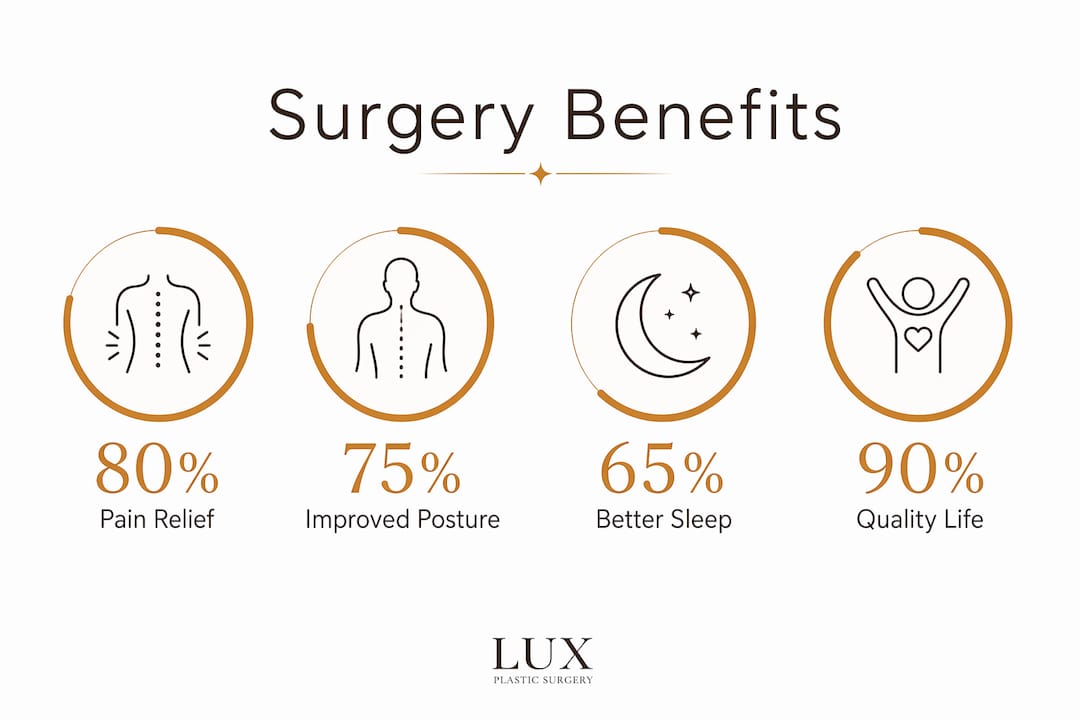
Clinical studies confirm improvements in physical symptoms and quality of life following breast reduction surgery. Patients report relief from chronic pain, improved posture, greater tolerance for physical activity, and significant psychological benefit. The table below summarises the main categories of benefit alongside their limitations.
| Benefit | Clinical evidence | Limitations |
|---|---|---|
| Relief of musculoskeletal pain | Consistently reported reduction in back, neck, and shoulder pain | Residual pain may persist if other causes are present |
| Improved posture | Reduced anterior load allows postural correction | Postural habits may require physiotherapy support |
| Greater physical activity tolerance | Patients report increased ability to exercise | Recovery period restricts activity for 6–8 weeks |
| Psychological well-being | Improved body image and reduced distress | Adjustment to new body shape takes time |
| Skin symptom resolution | Intertrigo and rashes typically resolve | Scarring is a permanent trade-off |
The most consistent finding across patient cohorts is that symptom relief, rather than aesthetic outcome, drives long-term satisfaction. Patients who enter surgery with realistic expectations about scarring and symmetry report the highest satisfaction rates.
Key takeaways
Breast reduction surgery relieves chronic physical symptoms, improves posture and psychological well-being, and produces lasting results when performed by a GMC-registered consultant plastic surgeon with realistic patient expectations established before surgery.
| Point | Details |
|---|---|
| Clinical definition | Reduction mammoplasty removes excess breast tissue, fat, and skin to relieve physical symptoms. |
| NHS access | Strict BMI and tissue removal thresholds create a postcode lottery; private surgery offers a more accessible route. |
| Surgical techniques | Wise pattern and vertical incision are the two main approaches; technique choice depends on anatomy and volume. |
| Key risks | Scarring, altered nipple sensation, and delayed wound healing at the T-junction are the most common complications. |
| Recovery timeline | Most patients return to desk work within 2–3 weeks and full activity within 6–8 weeks. |
What I have learned from years of breast reduction consultations
The question patients ask most often is not about the surgery itself. It is about whether their symptoms are “bad enough” to justify an operation of this scale. My answer is always the same: if your breast size is causing measurable physical harm and non-surgical measures have failed, the procedure is clinically appropriate. The threshold is not about cup size. It is about the impact on your daily life.
The NHS funding situation is genuinely difficult. I see patients who have been managing significant pain for years and who meet every clinical criterion, yet fall outside their local Integrated Care Board’s BMI or tissue removal thresholds. The postcode lottery is real, and it is not a reflection of clinical need. For those patients, a private consultation provides a clear, evidence-based assessment of their options without the administrative barriers.
The conversation I find most important is the one about expectations. Scars from reduction mammoplasty are permanent. Nipple sensation changes in the months after surgery and, in some cases, does not fully return. I discuss both of these realities at every consultation, not to discourage patients, but because informed patients recover better and report higher satisfaction. A patient who understands what the surgery can and cannot achieve is a patient who is genuinely ready for it.
Choosing a surgeon matters enormously. Verify GMC registration, confirm FRCS (Plast) qualification, and ask to see a portfolio of outcomes from patients with a similar anatomy to your own. The quality of your consultation tells you a great deal about the quality of your care.
— Lux
Breast reduction at Lux Plastic Surgery
Lux Plastic Surgery offers a private breast reduction pathway led by Professor Sandip Hindocha, GMC-registered Consultant Plastic Surgeon, NHS Clinical Director, and FRCS (Plast). Every patient receives a detailed consultation covering clinical suitability, technique selection, risk counselling, and a personalised surgical plan.

Professor Hindocha’s experience across Bedford, London, and Manchester means patients receive consultant-led care at every stage, from initial assessment through to post-operative follow-up. For patients who have been declined NHS funding or who prefer a private pathway, Lux Plastic Surgery provides transparent pricing and a structured breast reduction surgery service. Patients interested in understanding the full range of breast surgical options can also review the top breast surgery options guide on the Lux Plastic Surgery website.
To book a consultation, contact Lux Plastic Surgery directly. This article is for informational purposes only and does not constitute medical advice. Consult a GMC-registered specialist before making any decision about surgery.
FAQ
What is breast reduction surgery in simple terms?
Breast reduction surgery, or reduction mammoplasty, removes excess breast tissue, fat, and skin to make the breasts smaller and relieve physical symptoms such as back pain and skin irritation. It is performed under general anaesthesia by a consultant plastic surgeon.
How long does breast reduction recovery take?
Most patients return to desk-based work within 2–3 weeks and resume full physical activity within 6–8 weeks, subject to their surgeon’s guidance. Scars continue to mature and fade for up to 18 months after surgery.
What is male breast reduction?
Male breast reduction, known clinically as gynaecomastia surgery, removes excess glandular tissue and fat from the male chest to reduce breast enlargement. It is a separate procedure from female reduction mammoplasty, though both address excess breast tissue causing physical or psychological distress.
How much does breast reduction cost privately in the UK?
Private breast reduction costs in the UK are not publicly listed as a fixed figure and vary by surgeon, clinic, and the complexity of the procedure. A detailed consultation with a GMC-registered consultant plastic surgeon will provide a personalised cost estimate based on your specific anatomy and surgical plan.
Will breast reduction surgery affect nipple sensation?
Nipple sensation commonly changes after reduction mammoplasty. Sensation typically diminishes post-surgery but often recovers within 6–12 months. Permanent loss of sensation is possible and is discussed with every patient before surgery as part of the consent process.