Medically reviewed by Professor Sandip Hindocha, GMC-registered Consultant Plastic Surgeon and NHS Clinical Director. Articles are reviewed against current UK guidance from the GMC, BAAPS, BAPRAS and NICE.
TL;DR: Excess skin after pregnancy is common and happens because the abdominal skin and muscles were stretched over months, not because of anything you did wrong. Postpartum exercise and skincare can improve muscle tone and mild skin laxity, but they can’t remove skin that’s lost its elasticity or repair separated abdominal muscles. A mummy makeover or tummy tuck, done once you’ve finished having children and your weight is stable, is the only way to remove it for good.
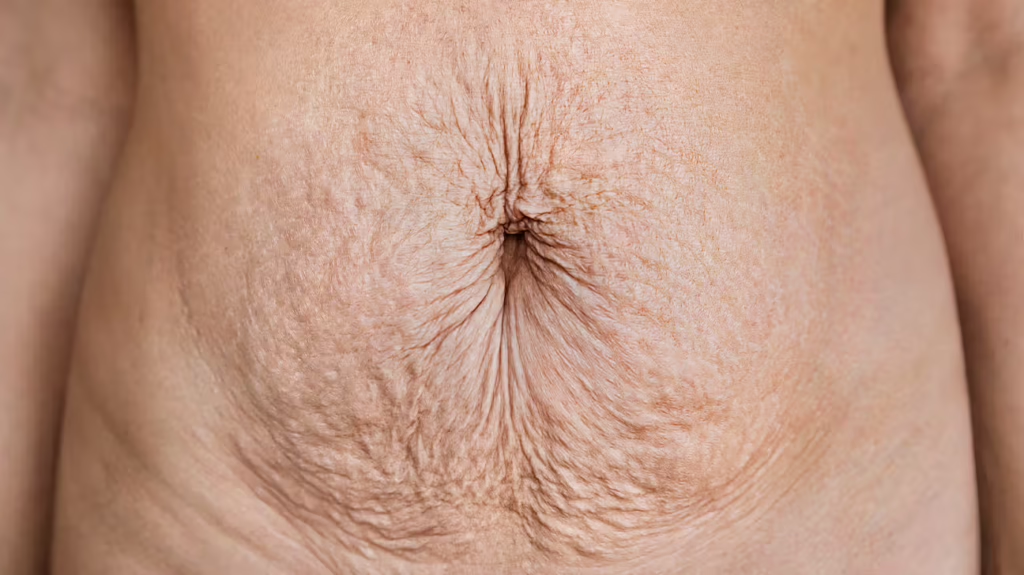
Excess skin after pregnancy is one of the most common concerns we hear, and it’s rarely about vanity. It’s about clothes that don’t sit right, skin that chafes, or simply not recognising your own stomach anymore.
Getting rid of excess skin after pregnancy starts with understanding that it’s a skin and muscle issue, not a fat issue, which is why diet and exercise alone rarely resolve it.
This guide covers why pregnancy leaves the stomach looking different, what postnatal exercise and non-surgical treatments can realistically do, and when a mummy makeover or tummy tuck becomes the only real option.
Key takeaways
| Point | Details |
| It’s skin and muscle, not fat | Pregnancy stretches skin and can separate the abdominal muscles (diastasis recti); losing baby weight doesn’t reverse either. |
| Postnatal exercise has real limits | Core and pelvic floor work rebuilds strength but can’t close a muscle separation or tighten loose skin on its own. |
| Timing matters | Most surgeons recommend waiting until you’ve finished having children and your weight has been stable for several months. |
| Breastfeeding affects timing | Surgery is generally deferred until breastfeeding has stopped and hormone levels have settled. |
| Surgery is the only permanent fix | A tummy tuck or mummy makeover removes the skin and repairs the muscles; nothing non-surgical does both. |
Why pregnancy leaves excess skin on the stomach
During pregnancy, the skin over your abdomen stretches to accommodate a growing baby, sometimes more than one. The collagen and elastin fibres that normally let skin snap back get stretched past their limit, especially with a larger baby, twins, or multiple pregnancies.
At the same time, the two central abdominal muscles often separate along the midline. This is called diastasis recti, and it’s extremely common after pregnancy. It’s a different problem from loose skin, but the two frequently occur together and are often mistaken for one another.
Once you’ve had your baby, that combination, stretched skin plus separated muscles, doesn’t reverse on its own for most women. Weight loss can reduce any extra fat sitting on top, but it won’t restore the skin’s elasticity or bring the muscles back together.
Why postnatal exercise alone won’t fix it
Core exercises and pelvic floor work are genuinely worth doing after pregnancy, and a postnatal physiotherapist can help you rebuild strength safely. But there’s an important limit to what they can achieve.
Exercise strengthens the muscles that sit underneath the skin. If those muscles have separated, targeted core work can sometimes help mild cases, but a significant diastasis often needs to be closed surgically, since crunches and planks can’t pull separated muscle back together on their own.
Loose skin is a separate issue again. However toned your core becomes, skin that has lost its elastic structure will still hang over it. That’s not a fitness problem, and no amount of extra effort in the gym will change it.
Pro Tip: ask your GP or a postnatal physiotherapist to check for diastasis recti before starting intensive core training. Some ab exercises can make a significant separation worse rather than better.
When it’s the right time to consider treatment
Most surgeons advise waiting until you’ve finished having children before considering surgery, since a future pregnancy can undo both the skin removal and the muscle repair. Breastfeeding is usually stopped first too, partly for anaesthetic safety and partly because breast and body shape can still be changing.
Weight is the other factor. Aim to be at a stable, healthy weight for around six to twelve months before your consultation. This gives your surgeon an accurate picture of your anatomy and gives you the most reliable long-term result.
Non-surgical options for mild postpartum skin laxity
If your skin is mildly lax rather than genuinely hanging, a few non-surgical treatments can offer some improvement once you’re cleared to start them:
- Radiofrequency skin tightening. Stimulates collagen remodelling over a course of sessions. Best for early-stage laxity rather than a true overhang.
- Microneedling with radiofrequency. A similar, modest tightening effect through controlled micro-injury and heat.
- Postnatal physiotherapy. Not a skin treatment, but the most effective way to address mild diastasis recti and rebuild core function safely.
- Compression garments. Offer support and a smoother line under clothing without changing the skin itself.
None of these remove a genuine skin overhang or close a significant muscle separation. If your skin still hangs after several months of stable weight and physiotherapy, it’s a sign you’ve reached the limit of what non-surgical treatment can do.
When a tummy tuck or mummy makeover is the answer
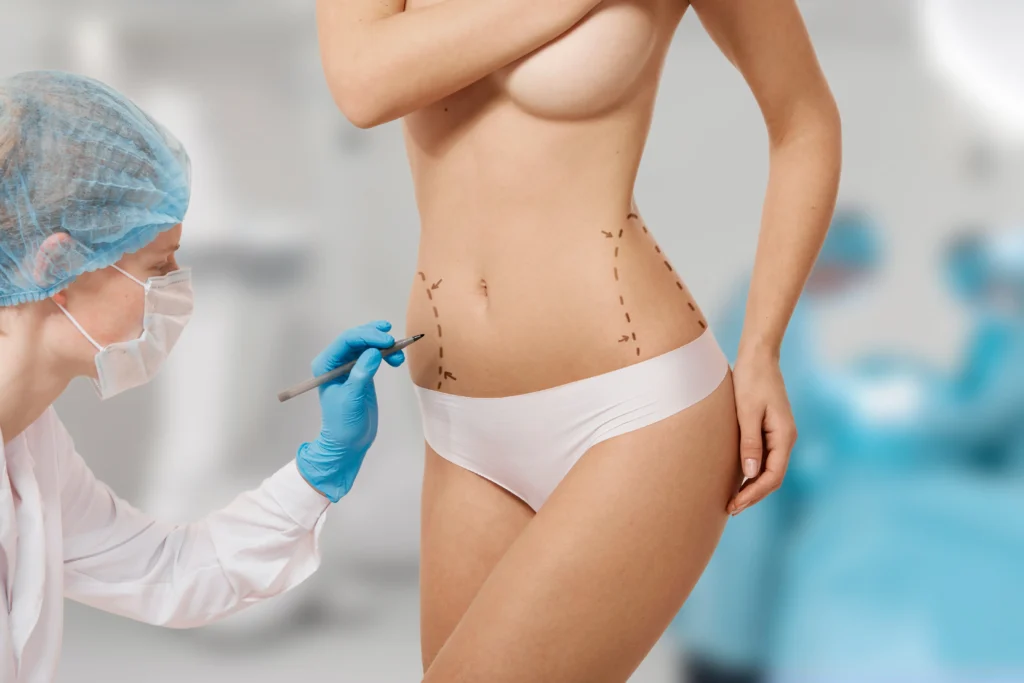
A tummy tuck removes the excess skin, repairs any muscle separation, and repositions the belly button. Surgeons often combine it with liposuction to refine the waist and flanks at the same time, though this depends on your anatomy and goals.
For most postpartum patients, the muscle repair is just as important as the skin removal, since it’s what restores the flatter, more supported look that exercise alone couldn’t achieve.
A mummy makeover combines a tummy tuck with other procedures, often a breast lift to address volume and position changes after breastfeeding, to deal with the whole picture in a single recovery period. It isn’t compulsory to combine procedures, and plenty of patients choose a tummy tuck on its own.
If you’ve had a caesarean, your surgeon can usually plan the tummy tuck incision to sit at a similar height, which for many patients means only one visible scar rather than two. This is worth raising specifically at your consultation.
Non-surgical treatments vs surgery for post-pregnancy skin
| Approach | What it does | Best suited to |
| Postnatal exercise and physio | Rebuilds core strength, helps mild diastasis | Everyone postpartum, but limited on skin or significant separation |
| Radiofrequency / microneedling | Modest collagen stimulation and tightening | Mild skin laxity without a hanging fold |
| Compression garments | Support and a smoother silhouette | Comfort during recovery, not a lasting fix |
| Tummy tuck | Removes excess skin, repairs muscle separation | Moderate to significant excess skin and/or diastasis recti |
| Mummy makeover | Tummy tuck combined with other procedures | Patients wanting several post-pregnancy changes addressed together |
My perspective on post-pregnancy skin
I see a lot of new mothers who feel guilty for even considering surgery, as though wanting their body back somehow undermines everything pregnancy gave them. It doesn’t, and that’s usually one of the first things worth saying out loud in a consultation.
The physical reality is straightforward. Skin that’s been stretched over nine months, sometimes across more than one pregnancy, often doesn’t have the elasticity left to recoil on its own. Muscle separation is common and mechanical, not a sign of insufficient effort at the gym.
What I’d say to anyone weighing this up is to give your body proper time first. Breastfeed for as long as you want to, get your weight stable, and try postnatal physiotherapy. If the skin and muscle separation are still there after that, surgery isn’t a shortcut, it’s simply the only treatment that reaches the actual problem.
— Lux
How Lux Plastic Surgery can help
Lux Plastic Surgery offers consultant-led mummy makeover and tummy tuck surgery for patients across Bedford, London, and Manchester, performed by Professor Sandip Hindocha, GMC-registered Consultant Plastic Surgeon and NHS Clinical Director.
Every consultation includes an honest assessment of your skin, muscle separation, and goals, so you know exactly what non-surgical care, a tummy tuck, or a fuller mummy makeover would each realistically achieve for you. To discuss your options, book a consultation with Lux Plastic Surgery directly.
This article is for informational purposes only and does not constitute medical advice. Consult a GMC-registered specialist before proceeding with any surgical or non-surgical treatment.
FAQ
How can I get rid of excess skin after pregnancy without surgery?
Non-surgical treatments such as radiofrequency and microneedling can modestly improve mild skin laxity, and postnatal physiotherapy helps with mild muscle separation. Neither removes a genuine skin overhang or closes a significant diastasis recti.
How long after having a baby can I get a tummy tuck?
Most surgeons recommend waiting until you’ve finished having children, stopped breastfeeding, and reached a stable weight for around six to twelve months, so the timing varies from person to person.
Will diastasis recti heal on its own after pregnancy?
Mild separations often improve with core and pelvic floor exercises in the first year. Larger separations frequently persist and typically need surgical repair to fully close.
Does a future pregnancy undo tummy tuck results?
Yes, a later pregnancy can re-stretch the skin and re-separate repaired muscles, which is why most surgeons advise waiting until your family is complete before proceeding.
What’s the difference between a tummy tuck and a mummy makeover?
A tummy tuck addresses the abdomen alone. A mummy makeover combines a tummy tuck with other procedures, often breast surgery, to address multiple post-pregnancy changes in one recovery period.
Recommended
- Apron belly: causes, treatments, and surgical options
- What is a tummy tuck? Procedure and results
- Belly buttons: anatomy, health, and cosmetic care
- What is post-weight loss surgery: your complete guide