An apron belly is defined medically as a panniculus: a flap of excess skin and subcutaneous fat that hangs from the lower abdomen, often over the pubic area. Clinically, it is graded on a scale of 1 to 5, from a fold that just covers the pubic hairline at Grade 1 to one that reaches the knees at Grade 5. The condition causes physical problems including intertrigo, back pain, and reduced mobility, not merely cosmetic concern. Understanding its causes and the full range of treatments available, from dietary changes through to panniculectomy and abdominoplasty, is the first step towards making an informed decision about your care.
What causes an apron belly?
An apron belly develops when the skin and subcutaneous fat of the lower abdomen are stretched beyond the point at which the skin can fully retract. The key distinction is between fat that can be reduced through lifestyle changes and skin that has permanently lost its elasticity. Both are usually present, but the skin component is what creates the characteristic overhang.
The most common causes include:
- Pregnancy. Repeated pregnancies stretch the abdominal wall significantly. After delivery, the skin may not return to its pre-pregnancy position, particularly after multiple births or a large baby.
- Significant weight gain followed by weight loss. Rapid or substantial weight gain stretches the skin. Skin elasticity loss after stretching is common, meaning the overhang often persists even after considerable weight loss.
- Ageing. Collagen and elastin production decline with age, reducing the skin’s ability to retract after any degree of stretching.
- Genetics. The distribution of body fat and the skin’s inherent elasticity are partly inherited. Some people are predisposed to storing fat in the lower abdomen and to losing skin tone earlier.
- Rapid weight fluctuations. Yo-yo dieting or repeated cycles of weight gain and loss progressively reduce skin resilience.
The apron belly is composed primarily of subcutaneous fat and overstretched skin, not visceral fat. Visceral fat surrounds the internal organs and responds well to caloric restriction and exercise. Subcutaneous fat in the panniculus responds more slowly, and the stretched skin above it does not shrink regardless of how much weight is lost. This is the biological reason why diet and exercise alone rarely resolve a moderate or severe overhang.
A heavier pannus can weigh between 10 and 30 or more pounds, placing sustained mechanical load on the lumbar spine and hips. That load contributes to chronic back pain, altered gait, and reduced exercise tolerance, creating a cycle that makes further weight management harder.
Which non-surgical methods help manage an apron belly?
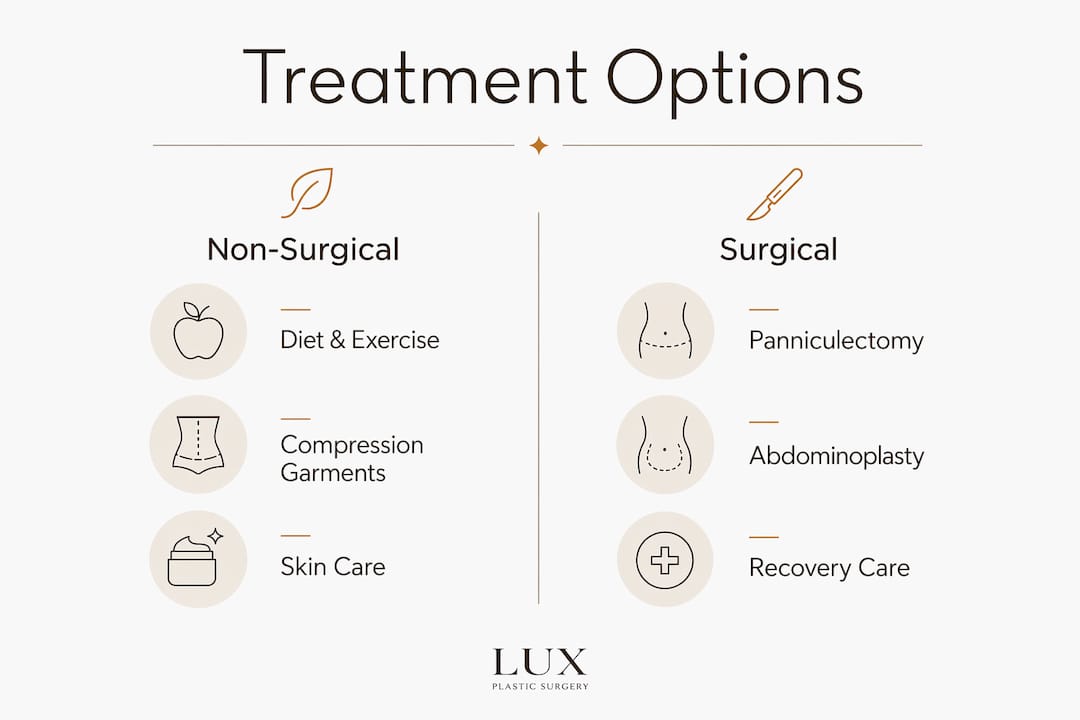
Non-surgical approaches manage symptoms and reduce the fat component of the panniculus. They do not remove excess skin. Setting that expectation clearly matters, because many people invest significant effort in lifestyle changes and are disappointed when the skin overhang remains.
Diet and weight management

Reducing overall body fat lowers the volume of subcutaneous fat within the panniculus, which can reduce its size and weight. A diet adequate in protein supports muscle retention during weight loss. Guidance from nutritional medicine recommends consuming 0.7–1 gram of protein per pound of body weight daily, alongside 25–30 grams of fibre to support digestion and satiety. These targets are achievable through whole foods: lean meat, fish, legumes, vegetables, and wholegrains. GLP-1 receptor agonist medications, now available through regulated prescribers, can support significant weight loss in suitable patients and may reduce the fat component of the panniculus meaningfully. A complete guide to GLP-1 prescriptions is available for those considering this route.
Exercise and its realistic limits
Exercise reduces total body fat and strengthens the abdominal muscles beneath the panniculus. Core strengthening reduces abdominal girth by approximately 10–20%, which is insufficient alone to remove a moderate or severe overhang. That figure matters because it clarifies what exercise can and cannot achieve. Cardiovascular exercise, resistance training, and core work all contribute to general health and fat reduction, but they cannot tighten skin that has lost its structural integrity.
Pro Tip: Combine resistance training with a protein-adequate diet to preserve muscle mass during weight loss. Muscle beneath the panniculus improves posture and reduces back strain even when the skin overhang itself remains.
Compression garments and supportive underwear
High-waisted compression garments provide mechanical support to the panniculus, reducing chafing and improving comfort during daily activity. They do not reduce the size of the overhang but make it more manageable. Many patients find them useful during the period between deciding on surgery and undergoing a procedure.
Skin hygiene
Keeping the skin fold thoroughly dry after washing is the single most effective way to prevent intertrigo and fungal infection. Trapped moisture and heat within the fold create ideal conditions for Candida and bacterial overgrowth. After washing, pat the area dry and use a cool setting on a hair dryer to remove residual moisture. Barrier creams containing zinc oxide can protect the skin surface between washes.
Non-surgical devices
Radiofrequency and collagen-stimulating devices can improve skin laxity modestly in mild cases. Their effect on a true panniculus is limited. They are most appropriate for patients with Grade 1 changes or as adjuncts after surgical treatment to improve skin texture.
What surgical options are available for an apron belly?
Surgery is the only treatment that removes the excess skin flap permanently. Two procedures address the panniculus, and the distinction between them is clinically significant.
Panniculectomy versus abdominoplasty
| Feature | Panniculectomy | Abdominoplasty (tummy tuck) |
|---|---|---|
| Primary goal | Remove overhanging skin and fat | Contour the abdomen aesthetically |
| Muscle repair | No | Yes (diastasis recti correction) |
| Belly button repositioning | No | Yes |
| Incision length | Lower abdomen, variable | Hip to hip, longer |
| Typical indication | Functional relief, hygiene, mobility | Aesthetic improvement plus functional benefit |
| Recovery | Several weeks | Several weeks, often longer |
A panniculectomy removes only the excess hanging skin and fat without tightening the abdominal muscles or repositioning the navel. It is primarily a functional procedure, indicated when the panniculus causes recurrent skin infections, impairs mobility, or creates significant hygiene difficulties. It produces a flatter lower abdomen but does not address muscle separation or upper abdominal laxity.
An abdominoplasty addresses the full abdominal wall. It removes excess skin and fat, repairs the rectus abdominis muscles if they have separated (a condition called diastasis recti), and repositions the navel to a natural anatomical position. The result is both functional and aesthetic. Patients who have completed their families and have both skin laxity and muscle separation are typically better served by abdominoplasty than by panniculectomy alone.
Surgical planning must distinguish clearly between these two procedures based on the patient’s anatomy, severity of the panniculus, and personal goals. A GMC-registered consultant plastic surgeon will assess the grade of the panniculus, the degree of muscle separation, skin quality, and the patient’s overall health before recommending one approach over the other.
The tissue removed during surgery can weigh between 10 and 30 or more pounds in significant cases. That reduction in mechanical load relieves back strain, improves posture, and reduces the skin fold that causes recurrent infections. The physical burden of apron belly tissue substantially affects posture and locomotion, and removing it can markedly improve quality of life beyond cosmetic appeal.
Pro Tip: If you have completed your family and have both a panniculus and muscle separation, discuss abdominoplasty rather than panniculectomy alone with your surgeon. Panniculectomy will not address the muscle layer, and a second procedure may be needed later if muscle repair is not performed at the same time.
Patients considering post weight loss body contouring after bariatric surgery or significant dietary weight loss should be aware that additional procedures, such as flank or thigh lifts, may be appropriate alongside abdominal surgery to address skin laxity in multiple areas.
What should patients expect during recovery?
Recovery from panniculectomy or abdominoplasty follows a predictable pattern, though individual timelines vary based on the extent of surgery and the patient’s general health.
- Week 1–2. Rest is the priority. Patients are mobile but should avoid lifting, bending, or any activity that strains the abdominal wall. Surgical drains may be in place for several days to remove fluid accumulation. Wound care follows the surgeon’s specific instructions.
- Weeks 3–4. Most patients return to light daily activities. Driving is usually possible once the patient can perform an emergency stop without discomfort, typically around week three. Compression garments are worn continuously during this phase.
- Weeks 6–8. Return to desk-based work is common by week four to six. More physically demanding roles require longer absence. Exercise resumes gradually, beginning with walking and progressing to resistance training only after surgical clearance.
- Months 3–6. Swelling resolves progressively. The final result becomes visible as oedema settles and scars mature. Scars are permanent but typically positioned within the bikini line and fade considerably over twelve months.
Possible complications include wound infection, seroma (fluid collection), delayed wound healing, and, rarely, deep vein thrombosis. A GMC-registered surgeon will discuss individual risk factors, including BMI, smoking status, and medical history, during the preoperative consultation. Post-surgical recovery generally spans several weeks and requires careful wound care and gradual return to activity.
Pro Tip: Stop smoking at least six weeks before surgery. Nicotine impairs wound healing and significantly increases the risk of skin necrosis at the wound edges, particularly relevant for the long incision used in abdominoplasty.
Physical benefits reported after surgery include resolution of intertrigo, reduced back pain, improved posture, and greater ease of physical activity. Patients who have struggled with recurrent skin fold infections often describe the relief as transformative in practical terms. Aesthetic outcomes depend on skin quality, the procedure chosen, and adherence to post-operative guidance. Maintaining a stable weight after surgery preserves the result; further significant weight gain can recreate the panniculus.
For patients with residual concerns after primary surgery, further body contouring procedures may address remaining laxity in the flanks, thighs, or upper abdomen.
Key takeaways
An apron belly is a panniculus of excess skin and subcutaneous fat that resists diet and exercise alone, and surgical removal through panniculectomy or abdominoplasty is the only permanent solution for moderate to severe cases.
| Point | Details |
|---|---|
| Surgical removal is the only permanent fix | Diet and exercise reduce fat but cannot remove skin that has lost elasticity. |
| Panniculectomy and abdominoplasty differ significantly | Panniculectomy removes skin only; abdominoplasty also repairs muscle and repositions the navel. |
| Skin hygiene prevents serious complications | Keeping the skin fold dry after washing reduces the risk of intertrigo and fungal infection. |
| Recovery spans several weeks | Patients return to light activity within two to four weeks and full activity by six to eight weeks. |
| Stable weight preserves surgical results | Significant weight gain after surgery can recreate the panniculus and require further treatment. |
A clinical perspective on apron belly treatment
Patients arrive at a consultation having already tried a great deal. They have changed their diet, worked with personal trainers, and worn compression garments for months or years. What they often need to hear first is that their persistence was not misguided. Lifestyle changes are genuinely valuable for reducing the fat component and improving overall health. The difficulty is that no amount of effort will restore elasticity to skin that has been permanently stretched.
The misconception I encounter most frequently is that localised exercise, particularly core work, will eventually shrink the overhang. Persistent overhanging skin requires surgical intervention to remove permanently. Exercise cannot do that. Explaining this clearly, without dismissing the patient’s efforts, is one of the most important parts of a consultation.
The choice between panniculectomy and abdominoplasty is not simply a question of how much the patient wants done. It is a clinical decision based on anatomy. A patient with Grade 3 panniculus and significant diastasis recti who undergoes panniculectomy alone will have a flatter lower abdomen but an unaddressed muscle layer and potentially a residual upper abdominal bulge. That outcome can be disappointing. Surgical planning must be thorough, and patients deserve a frank conversation about what each procedure will and will not achieve.
At Lux Plastic Surgery, the approach is to assess the full abdominal wall, not just the overhang, and to recommend the procedure that addresses the patient’s actual anatomy rather than the one that sounds most straightforward. That sometimes means recommending a more extensive procedure than the patient initially expected. It also means being honest when surgery is not yet appropriate, for example when weight loss is still ongoing or when medical optimisation is needed first.
This is not medical advice. Consult a GMC-registered specialist before making any treatment decision.
— Lux
Apron belly treatment at Lux Plastic Surgery
Lux Plastic Surgery offers consultant-led panniculectomy and abdominoplasty for patients across Bedford, London, and Manchester, performed by Professor Sandip Hindocha, GMC-registered Consultant Plastic Surgeon and NHS Clinical Director.

Every treatment plan begins with a thorough clinical assessment of the panniculus grade, muscle integrity, skin quality, and the patient’s health history. Professor Hindocha advises on the most appropriate procedure for each individual’s anatomy and goals, with full pre- and post-operative support throughout recovery. To learn more about the full range of plastic surgery services available, or to book a consultation, contact Lux Plastic Surgery directly. This article is for informational purposes only and does not constitute medical advice. Consult a GMC-registered specialist before proceeding with any surgical or non-surgical treatment.
FAQ
What is an apron belly?
An apron belly, medically termed a panniculus, is a flap of excess skin and subcutaneous fat that hangs from the lower abdomen. It is graded on a scale of 1 to 5 based on how far the fold extends, from the pubic hairline to the knees.
Is an apron belly caused by genetics?
Genetics influence fat distribution and skin elasticity, making some people more predisposed to developing a panniculus. However, pregnancy, significant weight changes, and ageing are the most common direct causes.
Can exercise and diet remove an apron belly?
Diet and exercise reduce the fat within the panniculus but cannot remove skin that has permanently lost its elasticity. Core strengthening reduces abdominal girth by approximately 10–20%, which is insufficient to eliminate a moderate or severe overhang.
What is the difference between panniculectomy and abdominoplasty?
A panniculectomy removes only the overhanging skin and fat without muscle repair or navel repositioning. An abdominoplasty additionally tightens the abdominal muscles and repositions the navel, producing both functional and aesthetic improvement.
How long is recovery after apron belly surgery?
Recovery typically spans several weeks. Most patients return to light daily activity within two to four weeks and resume more demanding activity after six to eight weeks, following their surgeon’s specific guidance.