A D cup is defined by a 4-inch (10 cm) difference between your full bust measurement and your underbust measurement, within the UK bra sizing system. That single number carries more variation than most people realise. A 30D and a 38D are both technically D cups, yet they differ considerably in actual breast volume, projection, and the support they require. Understanding what the label means, and what it does not mean, matters whether you are shopping for lingerie, choosing a sports bra, or considering breast augmentation. This guide draws on clinical experience at Lux Plastic Surgery and established UK sizing standards to give you a clear, accurate picture.
What are D cups and how is the size defined?
A D cup is defined by a 4-inch bust difference between the full bust circumference and the underbust band measurement. This is the standard used across UK and US sizing systems. The underbust measurement determines your band size; the difference between bust and underbust determines your cup letter.
Cup volume is not fixed across band sizes. Cup volume increases with each band size increase, meaning a 38D holds considerably more breast tissue than a 30D, even though both carry the same cup letter. This is one of the most misunderstood aspects of bra sizing, and it has direct implications for fit, comfort, and surgical planning.
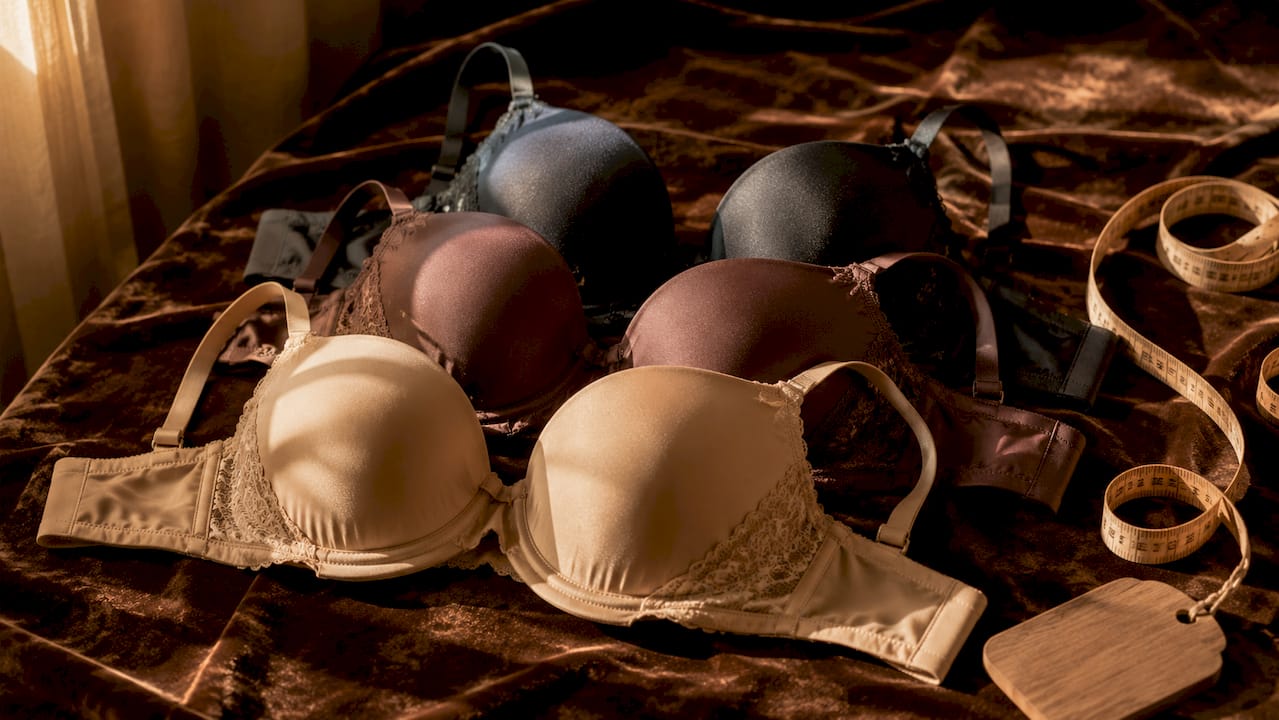
A D cup sits at a meaningful threshold in bra design. At this size, manufacturers begin incorporating wider underwires, reinforced side panels, and stronger bands to manage weight distribution. Below a D cup, many styles can function adequately with lighter construction. At D and above, structural design becomes a clinical necessity rather than a stylistic choice.
For women exploring breast augmentation, the D cup label is a common target size. D cup implants are among the most requested outcomes in UK breast augmentation, though the implant volume required to achieve that result varies significantly with body frame and existing tissue.
How to measure your cup size accurately
Accurate measurement is the foundation of correct fit. Follow these steps using a soft tape measure, measured in inches, with no padding in your bra or wearing a non-padded bra.
- Measure your underbust. Wrap the tape firmly around your ribcage, directly beneath your breasts. Keep the tape level and snug. Round to the nearest whole number. If the number is odd, round up to the next even number for your band size.
- Measure your full bust. Wrap the tape loosely around the fullest part of your bust, keeping it parallel to the floor. Do not compress the tissue.
- Calculate the difference. Subtract your underbust measurement from your full bust measurement. A difference of 4 inches corresponds to a D cup.
- Check your sister sizes. If the band feels too tight but the cup fits, go up one band size and down one cup size. If the band is too loose, go down one band size and up one cup size.
- Try the bra on. Numbers are a starting point. Fit must be confirmed by wearing the bra and checking key markers.
Understanding sister sizes
Sister sizes share similar cup volume but use different band sizes. A 32D, a 30DD, and a 34C all hold approximately the same volume of breast tissue. This matters when a specific band size is unavailable, or when the band of your measured size feels uncomfortable. Many women wear the wrong size simply because they are unaware that sister sizing exists.
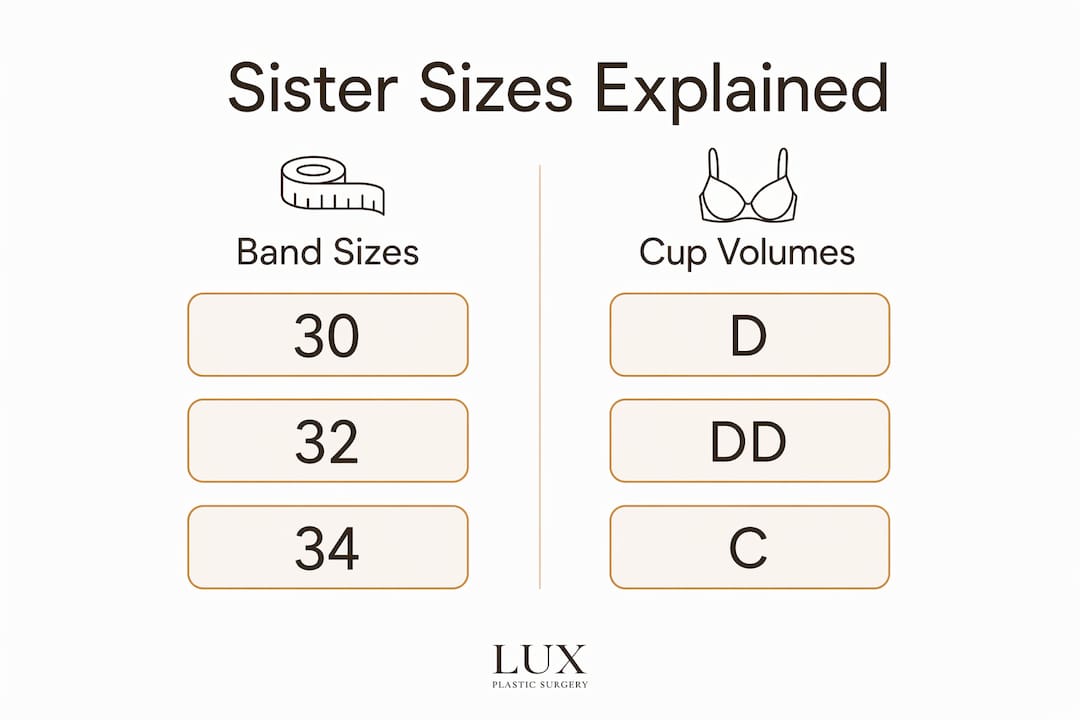
Pro Tip: Expert fitters recommend in-person fittings over tape measure alone. Breast shape, tissue density, and brand construction all affect how a size translates to fit. A professional fitting takes 10 minutes and can resolve years of discomfort.
A common fitting mistake is choosing a band size that is too large and compensating with a larger cup. This shifts weight onto the straps rather than the band, causing shoulder and neck discomfort. The band should provide 80% of the support. If you can pull the band more than two fingers away from your back, it is too loose.
How do D cups look across different body frames?
The appearance of a D cup varies considerably depending on band size, breast shape, and body frame. This is why two women wearing the same cup letter can look entirely different. The cup letter describes a ratio, not a fixed volume or silhouette.
A D65 (European sizing equivalent of approximately a 30D) has a top bust measurement of roughly 81.5–83.5 cm. A D75 (approximately a 34D) has a top bust of 91.5–93.5 cm. Both are D cups by definition, but the D75 presents with noticeably more fullness and softer projection, while the D65 tends to appear more compact and projected on a narrower frame.
| Band size | Approximate underbust | Approximate full bust | Visual impression |
|---|---|---|---|
| 30D | 63–67 cm | 73–77 cm | Compact, projected, sits high |
| 32D | 68–72 cm | 78–82 cm | Moderate projection, defined shape |
| 34D | 73–77 cm | 83–87 cm | Fuller appearance, softer silhouette |
| 36D | 78–82 cm | 88–92 cm | Broad, rounded, substantial volume |
| 38D | 83–87 cm | 93–97 cm | Wide base, significant volume |
Breast shape adds another layer of variation. A woman with projected breasts, where the tissue extends forward from the chest wall, will fill a standard cup differently from a woman with shallow, wide-set breasts of the same cup size. A plunge bra may fit well on projected tissue but gap at the top on shallower breasts. Understanding your shape, not just your size, determines which styles work for you.
Frame size also affects how a D cup reads visually. On a petite frame with a 30-inch band, a D cup is proportionally significant. On a broader frame with a 38-inch band, the same cup letter represents a much larger volume but may appear proportionate to the body. This distinction is particularly relevant in surgical consultations, where the goal is balance with the patient’s overall frame rather than achieving a specific letter.
What should you look for in D cup lingerie and sports bras?
Supportive construction is not optional at D cup size. The weight of breast tissue at this volume requires specific design features to distribute load correctly and prevent long-term discomfort.
Key features to look for in everyday D cup lingerie:
- Underwired cups. Underwires define the cup shape and anchor the bra to the chest wall, preventing the breast from migrating outward or downward.
- Wider shoulder straps. Narrow straps concentrate pressure on a small area of the shoulder. Wider straps spread the load and reduce the risk of grooving.
- A firm, wide band. The band carries the majority of the support. It should sit level around the body and not ride up at the back.
- Full or three-part cup construction. Seamed cups provide more structure and shape than moulded foam cups, particularly for larger or more projected breasts.
- Side boning or side panels. These prevent the cup from collapsing inward and help contain tissue that migrates laterally.
For D cup sports bras, encapsulation design outperforms compression-only styles. Compression bras flatten the breast against the chest; encapsulation bras support each breast individually within a structured cup. For high-impact activity, a combination of both offers the most effective support.
Gaping or spillage at cup edges indicates incorrect size rather than breast size alone. Spillage over the top of the cup means the cup is too small. Gaping at the top means the cup is too large or the shape does not match your breast profile.
Pro Tip: The centre gore should sit flat against your sternum. If it lifts away from your body, the cup is too small regardless of how the rest of the bra appears to fit. This is the single most reliable indicator of correct cup size.
D cup swimwear follows the same principles. Look for underwired swimsuit tops or bikini tops with structured cups, wide side panels, and adjustable straps. Soft triangle styles do not provide adequate support at this cup size for most women.
What are the surgical options for achieving a D cup?
Breast augmentation to achieve a D cup outcome is one of the most commonly requested procedures in the UK. The implant volume required to reach a D cup result varies with the patient’s existing breast tissue, chest width, skin elasticity, and body frame. There is no single implant size that produces a D cup across all patients.
Key considerations for women exploring augmentation to a D cup size:
- Frame and chest width. A narrower chest requires a narrower implant profile to avoid an unnatural appearance. A wider chest can accommodate a broader base width. The implant must match the chest dimensions, not simply the desired cup size.
- Existing tissue. Women with minimal existing breast tissue may need a larger implant volume to reach a D cup than women with moderate existing tissue. The implant adds to what is already present.
- Implant profile. High-profile implants project further forward from a narrower base. Moderate-profile implants spread over a wider base. The choice affects both the final appearance and the bra size achieved.
- Realistic expectations. A D cup outcome is achievable for most patients, but the precise letter cannot be guaranteed. Bra sizing after augmentation depends on the same measurement principles as natural sizing.
- UK regulatory standards. All breast implants used in the UK must meet the standards set by the Medicines and Healthcare products Regulatory Agency (MHRA). BAAPS and BAPRAS both publish guidance on safe augmentation practice, and patients should confirm their surgeon holds GMC registration and full specialist registration in plastic surgery.
Lux Plastic Surgery offers a detailed guide to breast surgery options for patients considering augmentation, lift, or reshaping procedures. A personalised consultation with Professor Hindocha, GMC-registered Consultant Plastic Surgeon and FRCS (Plast), is the appropriate starting point for any surgical decision. Professor Hindocha assesses each patient’s anatomy individually and discusses implant selection based on frame, tissue, and the patient’s stated goals.
For patients who want to understand the broader context of breast enhancement before committing to surgery, the Lux Plastic Surgery guide to natural breast enhancement covers non-surgical options and the factors that influence breast appearance over time.
Pro Tip: Always consult a GMC-registered consultant plastic surgeon, not a cosmetic surgeon or aesthetic practitioner, for breast augmentation. The GMC specialist register in plastic surgery is the relevant credential. Professor Hindocha holds full specialist registration and has published over 100 peer-reviewed papers in the field.
Key takeaways
A D cup is defined by a 4-inch measurement difference, but cup volume, appearance, and support needs vary significantly with band size, breast shape, and body frame.
| Point | Details |
|---|---|
| D cup definition | A 4-inch difference between full bust and underbust measurements determines a D cup in UK sizing. |
| Cup volume varies with band | A 38D holds considerably more volume than a 30D; the cup letter alone does not indicate absolute size. |
| Sister sizing improves fit | A 32D, 30DD, and 34C share similar cup volume; switching between them resolves band comfort issues. |
| Structural support is necessary | D cup bras require underwires, wider straps, and firm bands to distribute weight correctly. |
| Surgical planning is individual | Implant volume for a D cup outcome depends on frame, existing tissue, and chest width, not a fixed number. |
A clinician’s view on D cup sizing and what it actually means
The D cup label is one of the most misread measurements in women’s health. Patients arrive at consultation having spent years in the wrong size, not because they measured incorrectly, but because they assumed the letter told the whole story. It does not.
What I see consistently in practice is that women with a 30D and women with a 38D share a cup letter and almost nothing else. The volume difference between those two sizes is substantial. The support requirements are different. The surgical approach, if augmentation is the goal, is different. The bra styles that work are different. Treating them as equivalent because the letter matches is the source of most fitting frustration.
The sister sizing concept resolves a large proportion of fit complaints without any change in actual breast size. A woman who finds her 34D band too loose but her 34C cup too small is almost certainly a 32D. That adjustment costs nothing and changes everything about daily comfort. Yet the majority of women I speak with have never heard of sister sizing. That gap in basic education is worth closing.
On the surgical side, the D cup is a reasonable and achievable goal for most augmentation patients. What I caution against is treating it as a fixed target independent of anatomy. The right outcome is one that is proportionate to your frame, achievable within your tissue constraints, and sustainable over time. A D cup on a 30-inch band frame looks and feels very different from a D cup on a 38-inch band frame. Both can be beautiful results. Neither is better than the other. The question is always what is right for you specifically.
— Lux
Considering breast augmentation at Lux Plastic Surgery
Women who want to achieve a D cup outcome through breast augmentation benefit from a consultation that addresses anatomy, implant selection, and realistic expectations in equal measure.

Lux Plastic Surgery, led by Professor Sandip Hindocha in Bedford, London, and Manchester, offers consultant-led breast augmentation with a focus on proportionate, natural-looking results. Professor Hindocha holds GMC specialist registration in plastic surgery and has over 100 published papers to his name. For a clear overview of what breast augmentation involves, the Lux Plastic Surgery guide to plastic surgery options and safety is a useful starting point. To discuss your individual anatomy and goals, book a consultation directly through the Lux Plastic Surgery website.
This article is for informational purposes only and does not constitute medical advice. Consult a GMC-registered specialist before making any surgical decision.
FAQ
What is a D cup bra size?
A D cup is defined by a 4-inch difference between the full bust measurement and the underbust measurement. It is a medium-full cup size within the UK and US bra sizing systems.
Does a D cup look the same on everyone?
No. A D cup on a 30-inch band is compact and projected, while a D cup on a 38-inch band is broader and fuller. Breast shape also affects appearance significantly.
What is a sister size in bra fitting?
A sister size is a bra size that shares approximately the same cup volume but uses a different band size. For example, 32D, 30DD, and 34C are sister sizes.
How much does breast augmentation to a D cup cost in the UK?
Breast augmentation costs in the UK vary by clinic, surgeon, and implant type. Lux Plastic Surgery does not publish a fixed price list publicly; a personalised quote is provided following consultation with Professor Hindocha.
How do I know if my D cup bra fits correctly?
The centre gore should sit flat against your sternum, the band should sit level around your body, and there should be no spillage over or gaping at the top of the cups. If the centre gore lifts away, the cup size is too small.