Abdominoplasty cost in the UK typically ranges from £4,000 for a mini procedure to over £9,000 for an extended tummy tuck, with full abdominoplasty sitting between £6,500 and £8,500. These figures vary considerably depending on procedure type, surgical complexity, hospital setting, and geographic location. What many patients do not realise is that advertised prices often reflect the surgeon’s fee alone. Understanding the full cost of abdominoplasty, including anaesthesia, facility charges, and aftercare, is the only way to budget accurately and avoid financial surprises. Professor Hindocha’s fee is quoted individually in writing after consultation.
What factors determine the total abdominoplasty cost?
The procedure type is the single largest driver of tummy tuck pricing in the UK. A mini abdominoplasty addresses only the lower abdomen below the navel, requires less operating time, and typically costs £4,000–£6,000. A full abdominoplasty involves muscle repair, navel repositioning, and removal of excess skin across the entire abdominal wall, which is why it costs more and sits in the £6,500–£8,500 range. An extended abdominoplasty, which also addresses the flanks and lower back, starts at £9,000 and rises further depending on complexity.
Surgeon’s fee and credentials
A consultant plastic surgeon’s fee reflects training, experience, and professional standing. Surgeons registered with the GMC and holding Fellowship of the Royal College of Surgeons in Plastic Surgery (FRCS Plast) command higher fees than those without specialist accreditation. Choosing a surgeon based on price alone carries real clinical risk. The British Association of Aesthetic Plastic Surgeons (BAAPS) and the British Association of Plastic, Reconstructive and Aesthetic Surgeons (BAPRAS) both advise patients to verify credentials before committing to any procedure.
Hospital setting and geographic location
Private hospital facilities in London and other major metropolitan areas carry higher overhead costs, and those costs pass directly to the patient. London pricing for the same procedure can be £1,000–£2,000 higher than equivalent care in Bedford or Manchester. The type of facility also matters. A purpose-built private surgical hospital with overnight recovery suites will charge more than a day-surgery unit, and that difference is legitimate. Overnight stays, when required, are frequently charged separately.
Anaesthesia and surgical complexity
Anaesthesia is billed as a separate professional fee in most UK private settings. The anaesthetist’s charge depends on the duration of the procedure. A full abdominoplasty typically takes 2–4 hours under general anaesthetic, and the anaesthetist’s fee reflects that time. Muscle repair and navel repositioning extend operating time and increase both the surgical and anaesthetic components of the bill.

Pro Tip: Always request an itemised, fixed-price quote in writing before booking. Ask for each fee to be listed separately: surgeon, anaesthetist, theatre, overnight stay if applicable, garments, and follow-up appointments. This prevents any ambiguity about what you owe.
How to compare abdominoplasty quotes and avoid hidden fees
Advertised tummy tuck prices are frequently surgeon fees only. Quotes often exclude laboratory work, compression garments, prescription medications, overnight stays, and any revision procedures. A quote of £6,500 can become £8,000 or more once these items are added. Comparing quotes without a line-by-line breakdown is not a reliable way to assess value.
The table below shows which cost components are commonly included or excluded in standard UK abdominoplasty quotes.
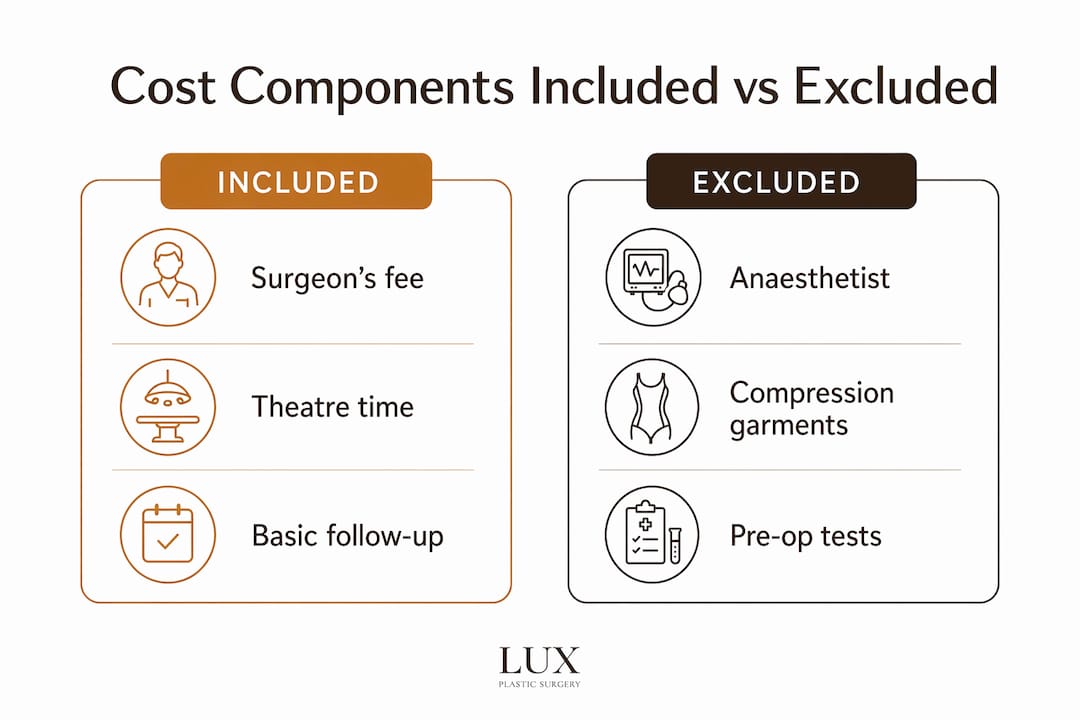
| Cost Component | Commonly Included | Commonly Excluded |
|---|---|---|
| Surgeon’s fee | Yes | |
| Anaesthetist’s fee | Sometimes | Often separate |
| Theatre and facility fee | Sometimes | Often separate |
| Pre-operative blood tests | Rarely | Usually charged separately |
| Compression garment | Sometimes | Often charged separately |
| Prescription medications | Rarely | Usually charged separately |
| Overnight stay | Sometimes | Often charged separately |
| Post-operative follow-up | 1–2 appointments often included | Extended follow-up may cost extra |
| Revision surgery | No | Almost always excluded |
When you receive a quote, ask the clinic to confirm in writing whether each item in the table above is included. Pre-op and post-op appointments vary significantly between providers. Some include 90 days of follow-up care; others charge per appointment after the first review. Knowing this before you sign a consent form protects you financially and clinically.
Pro Tip: Ask specifically how long post-operative follow-up is included and what happens if you need an unplanned review. A reputable clinic will answer this clearly and in writing.
UK private healthcare fixed-price packages consolidate most of these components into a single figure, which makes budgeting more straightforward. If a clinic cannot provide a fixed-price package or refuses to itemise its quote, treat that as a warning sign.
Does insurance cover abdominoplasty in the UK?
Health insurance does not cover abdominoplasty in the vast majority of cases because it is classified as a cosmetic procedure. Insurers including Bupa and AXA Health apply this exclusion consistently. The NHS will not fund abdominoplasty for cosmetic reasons either. Rare exceptions exist when there is documented medical necessity, such as significant skin fold infections following major weight loss, but these cases require clinical evidence and formal referral, and approval is not routine.
Most patients fund abdominoplasty through self-pay. The common financing options available in the UK include:
- Fixed monthly instalments through the clinic’s own payment plan, often interest-free for shorter terms
- Personal loans from high street banks or specialist medical finance providers such as Chrysalis Finance
- Credit facilities arranged at the point of booking, subject to credit checks
- Savings-based self-pay, where patients plan and save over 12–24 months before proceeding
- Combined procedure packages, where clinics offer a reduced total cost when abdominoplasty is combined with liposuction or another body contouring procedure
Financing makes the procedure accessible, but it adds to the total amount paid over time if interest applies. Read the terms of any finance agreement carefully before signing. A GMC-registered surgeon will not pressure you to commit before you have reviewed all financial terms.
What should you budget beyond the surgeon’s fee?
The surgeon’s fee is only one part of the total cost of abdominoplasty. Advertised averages typically reflect the surgical fee alone, not the full financial picture. Patients who plan only for the headline figure frequently find themselves underprepared. A realistic budget accounts for every stage of the process.
The following items should be costed in full before you proceed:
- Anaesthetist’s fee. This is a separate professional charge and is not negotiable. Budget £800–£1,500 depending on procedure length.
- Surgical facility and theatre fees. These cover the operating theatre, nursing staff, and recovery room. Expect £1,000–£2,500 depending on the hospital and whether an overnight stay is required.
- Pre-operative tests. Blood tests, an ECG, and a medical assessment are standard requirements. These typically cost £150–£400 and are rarely included in the headline quote.
- Compression garment. A medical-grade abdominal binder is worn for 6–8 weeks post-operatively. Cost: £50–£150, sometimes provided by the clinic.
- Prescription medications. Antibiotics and pain relief are prescribed post-operatively. Budget £30–£80 unless included in the package.
- Time off work. Most patients require 2–4 weeks away from desk-based work and up to 6 weeks if their role involves physical activity. Factor in lost earnings or the cost of sick cover.
- Childcare and domestic support. Lifting restrictions apply for 4–6 weeks. If you have young children or live alone, practical support during recovery has a real cost.
- Contingency fund. Set aside 10–15% of the total quoted cost for unplanned expenses, including extended follow-up, additional medications, or, in rare cases, a revision procedure. Surgeon fees are only part of the financial responsibility; a contingency fund covers what quotes do not.
Understanding the full cost of liposuction and similar body contouring procedures follows the same principle. The headline figure is always a starting point, not a ceiling.
Key takeaways
Abdominoplasty cost in the UK ranges from £4,000 for a mini procedure to over £9,000 for an extended tummy tuck, and the total bill consistently exceeds the advertised surgeon’s fee once facility, anaesthesia, and aftercare costs are included.
| Point | Details |
|---|---|
| UK price ranges by type | Mini: £4,000–£6,000; Full: £6,500–£8,500; Extended: £9,000 and above. |
| Quotes often exclude key costs | Lab tests, compression garments, overnight stays, and revisions are frequently not included. |
| Insurance rarely applies | Abdominoplasty is cosmetic; most patients self-pay or use a finance plan. |
| Budget beyond the surgeon’s fee | Anaesthesia, theatre, garments, and recovery costs add £2,000–£4,000 to the total. |
| Fixed-price packages offer clarity | All-inclusive packages from reputable clinics make accurate budgeting more reliable. |
What i have learned about abdominoplasty pricing after years in practice
Patients arrive at consultations having researched prices online, and almost all of them have seen a figure that is lower than what a comprehensive, safe procedure actually costs. That gap is not dishonesty on the part of the internet. It reflects the way surgical fees are traditionally quoted, with the surgeon’s component presented as the total. My view is that this practice does patients a disservice.
At Lux Plastic Surgery, Professor Hindocha insists on full financial transparency from the first consultation. Every patient receives an itemised breakdown before they make any decision. The reason is straightforward: a patient who understands exactly what they are paying for is a patient who can give genuinely informed consent. Financial pressure during recovery is a real clinical risk. Patients who are surprised by costs they did not anticipate are more likely to skip follow-up appointments or delay purchasing compression garments, both of which affect outcomes.
The other point I would make firmly is this: the cheapest quote is rarely the safest option. Surgical skill, theatre standards, and post-operative care all cost money. A surgeon who quotes significantly below the market rate is cutting costs somewhere, and in surgery, that matters. BAAPS and BAPRAS both publish guidance on choosing a qualified surgeon, and I would encourage every patient to read it before comparing prices. The right surgeon is not the cheapest one. The right surgeon is the one whose credentials, transparency, and clinical approach give you confidence.
— Lux
Plan your abdominoplasty with lux plastic surgery
Lux Plastic Surgery offers abdominoplasty consultations with Professor Sandip Hindocha, a GMC-registered Consultant Plastic Surgeon, NHS Clinical Director, and FRCS (Plast) with over 100 published papers. Every patient receives a personalised, itemised quote covering all cost components before any commitment is made. Lux Plastic Surgery operates across Bedford, London, and Manchester, with fixed-price packages designed to give you a clear picture of your total investment from the outset.

To understand your options and receive a transparent cost breakdown, explore our plastic surgery services or book a consultation directly. This article is for informational purposes only and does not constitute medical advice. Consult a GMC-registered specialist before making any decisions about surgical treatment.
FAQ
How much does a tummy tuck cost in the UK in 2026?
A tummy tuck in the UK costs £4,000–£9,000 depending on procedure type, with mini abdominoplasty at the lower end and extended procedures above £9,000. These figures do not always include anaesthesia, facility fees, or aftercare.
What is included in a typical abdominoplasty quote?
Most quotes include the surgeon’s fee and basic theatre time, but commonly exclude pre-operative tests, compression garments, prescription medications, overnight stays, and revision procedures. Always request a full itemised breakdown in writing.
Will the NHS or private insurance pay for abdominoplasty?
The NHS does not fund cosmetic abdominoplasty, and private health insurers classify it as a cosmetic procedure and exclude it from cover. Rare medical necessity exceptions exist but require documented clinical evidence and formal approval.
How can i finance a tummy tuck in the UK?
Most patients self-pay using savings, personal loans, or clinic-arranged instalment plans. Some clinics offer interest-free credit for shorter terms. Read all finance terms carefully before signing, and confirm the total repayable amount.
Does the surgeon’s location affect the cost of abdominoplasty?
Yes. Clinics in London and other large cities typically charge more than those in smaller towns, reflecting higher facility and overhead costs. The same procedure can cost £1,000–£2,000 more in London than in comparable private settings elsewhere in the UK.