Tuberous breast deformity is a congenital structural condition in which a fibrous ring restricts breast base expansion during puberty, producing a narrow, tubular shape, an elevated inframammary fold, and often enlarged or herniated areolas. The clinical terms “tuberous breast,” “tubular breast,” and “constricted breast” are used interchangeably; “tuberous” is the formal medical designation, while “tubular” is more common in patient conversations. This condition is anatomical in origin, not merely cosmetic, and correction requires structural reshaping rather than simple volume addition. Professor Sandip Hindocha, GMC-registered Consultant Plastic Surgeon and NHS Clinical Director at Lux Plastic Surgery, assesses and treats this condition in line with BAAPS and NICE clinical standards.
What causes tuberous breast deformity and how is it classified?
Tuberous breast deformity is caused by a fibrous ring limiting base expansion during puberty. This ring tethers the breast tissue, preventing normal lower pole development and forcing the gland to project forward rather than spread outward. The result is a characteristic narrow base, lack of lower pole fullness, and areolar herniation. Both sexes can be affected, though the condition is more frequently identified in women during adolescence.
The physical presentation varies considerably between patients. Common features include a narrow breast base, a high inframammary fold, an enlarged or puffy areola, and noticeable asymmetry between the two sides. In profile, the breast can appear to project forward with little lower pole support, sometimes described clinically as a “snoopy dog” appearance. Asymmetry is present in the majority of cases, which adds complexity to surgical planning.
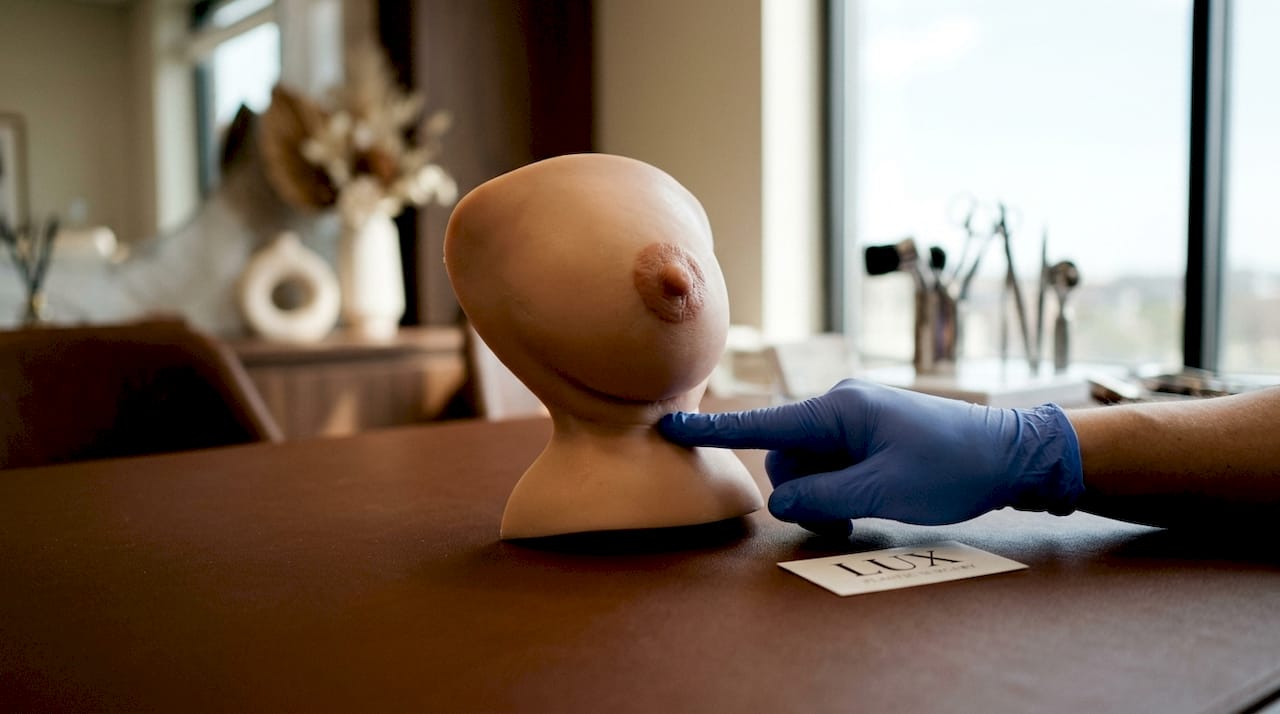
The Grolleau classification system
The Grolleau classification divides tuberous breasts into three types based on the extent of base constriction and lower pole deficiency. Understanding this system is central to planning the correct surgical approach.
| Grolleau Type | Features | Surgical complexity |
|---|---|---|
| Type I | Constriction of lower medial quadrant only | Lower complexity; implant with ring release |
| Type II | Constriction of both lower quadrants | Moderate complexity; fold repositioning required |
| Type III | Constriction of all quadrants; severe herniation | High complexity; glandular remodelling and mastopexy often needed |
Type I is the most common presentation. In the study supporting this classification, 62% of cases were Grolleau Type I. Type III cases require the most extensive reconstruction, often combining implant placement with mastopexy and full glandular reshaping. The classification directly determines which surgical techniques a surgeon will use and how many stages of correction may be needed.
Tuberous breast deformity is a developmental anomaly, not a disease. It carries no health risk in itself, but it frequently causes significant psychological distress, particularly during adolescence and early adulthood. Patients often report difficulties with body image, clothing fit, and breastfeeding capacity. Recognising the condition early and understanding its anatomical basis helps patients approach treatment with realistic expectations.
What surgical correction options exist for tuberous breasts?
Surgical correction of tuberous breasts is a structural procedure, not a standard augmentation. The goal is to release constricted tissue and rebuild the breast’s foundation, creating balanced lower pole fullness, improved symmetry, and natural projection. Volume addition is secondary to this structural work.
Core surgical steps
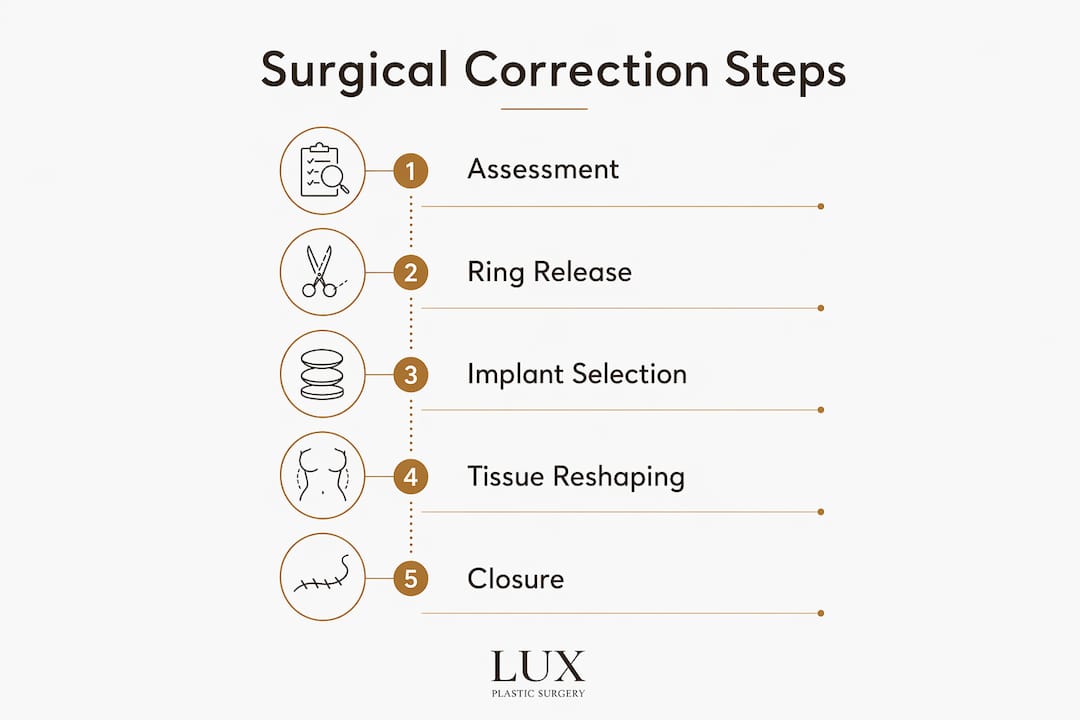
A standardised reconstructive protocol typically follows these steps:
- Glandular ring release. The surgeon scores or releases the fibrous ring at the breast base, allowing the constricted tissue to expand. Without this step, any implant placed will simply accentuate the tubular shape rather than correct it.
- Inframammary fold repositioning. The fold is lowered to a more anatomically appropriate position, creating space for lower pole development and a more natural breast contour.
- Lower pole expansion. The released tissue is redistributed to fill the lower pole. This may involve glandular flaps or scoring techniques to encourage even tissue spread.
- Implant placement. An implant is introduced to support the expanded lower pole and provide projection. The choice of implant shape is critical at this stage.
- Areola reduction (where indicated). Enlarged or herniated areolas are reduced and repositioned as part of the same procedure, particularly in Type II and Type III cases.
- Mastopexy (where indicated). Type III cases frequently require a breast lift alongside implant placement to address excess skin and achieve symmetry.
Implant selection: why shape matters
Conical polyurethane implants are particularly suited to tuberous breast correction. Their tapered shape mirrors the natural projection required in the lower pole, and the polyurethane surface reduces the risk of implant rotation and capsular contracture. A clinical study of 50 patients with a mean age of 29.8 years and a follow-up of 17 months reported a 10% overall complication rate using this protocol. Patient satisfaction in the same study reached a mean score of 92%, with an 8% reoperation rate recorded. These figures reflect early to mid-term outcomes and should be discussed in the context of individual risk during consultation.
Pro Tip: Ask your surgeon specifically whether they plan to release the glandular ring before placing an implant. A surgeon who focuses only on implant size without addressing the fibrous constriction is not treating the underlying deformity.
Recovery expectations
Most patients return to light activity within two weeks. Swelling and bruising are expected for four to six weeks. Final results, including full lower pole settling, typically become visible at three to six months. Strenuous exercise and heavy lifting should be avoided for six weeks post-operatively. Patients with Type III corrections involving mastopexy may require a longer recovery period and should plan accordingly.
For a detailed overview of the augmentation process, the breast augmentation step by step guide from Lux Plastic Surgery covers implant placement choices and what to expect at each stage.
What non-surgical options exist for tuberous breast correction?
No effective non-surgical option resolves the fibrous constriction at the root of tuberous breast deformity. Massage and external devices cannot address the dense fibrous ring that restricts breast base expansion. Patients who pursue these approaches before seeking surgical advice typically experience no meaningful change in breast shape or base width.
Autologous fat grafting as an adjunct or alternative
Autologous fat grafting, also called lipofilling, is an increasingly used option for selected patients. The technique involves harvesting fat from another area of the body, processing it, and injecting it into the breast to improve contour and volume. Its key advantages are:
- Natural results. Fat grafting uses the patient’s own tissue, avoiding implant-related complications such as capsular contracture or implant visibility.
- Contour refinement. It is particularly effective for correcting residual asymmetry or minor contour irregularities after primary surgical correction.
- Reduced surgical complexity. In mild cases, fat grafting alone may provide sufficient improvement without the need for implants.
- Combination use. Fat grafting is frequently used alongside implant-based correction to refine the final result, particularly in the upper pole or around the areola.
Fat grafting is used as the sole treatment in approximately 9% of tuberous breast cases. This figure reflects its role as a selective rather than universal option. It is most appropriate for patients with mild deformity, adequate donor fat, and a preference for avoiding implants. Patients with Grolleau Type II or III deformity generally require surgical correction as the primary intervention, with fat grafting as an adjunct.
Pro Tip: Fat grafting results depend heavily on graft survival, which varies between patients. Discuss realistic volume retention expectations with your surgeon before choosing this as a standalone option.
The fat transfer to body service at Lux Plastic Surgery provides further detail on autologous fat grafting techniques and patient suitability.
What should patients consider before tuberous breast surgery?
Realistic expectations are the foundation of a successful outcome. Tuberous breast surgery corrects structural anatomy; it does not produce identical twins from asymmetric breasts. Some degree of residual asymmetry is common and should be discussed openly before any procedure.
Key patient considerations
- Surgeon qualifications. Choose a GMC-registered Consultant Plastic Surgeon with specific experience in tuberous breast correction. BAAPS and BAPRAS maintain registers of accredited surgeons in the UK.
- Classification assessment. A thorough preoperative assessment should include Grolleau classification, measurement of base width, fold height, and areola diameter. This determines the correct surgical plan.
- Complication awareness. Risks include capsular contracture, infection, altered nipple sensation, implant-related complications, and the possibility of reoperation. The 8% reoperation rate reported in clinical studies reflects real-world outcomes and should be factored into decision-making.
- Cost in the UK. Tuberous breast correction is not available on the NHS as an elective cosmetic procedure. Private costs vary depending on surgical complexity, but patients should expect to budget for a procedure that is more involved than standard breast augmentation. Costs are not publicly listed for all providers; a formal consultation is required for an accurate quote.
- Psychological readiness. Patients should feel informed and settled in their decision before proceeding. Reputable surgeons will not pressure patients to book quickly or offer discounts for immediate decisions.
- Post-operative planning. Arrange at least two weeks off work for desk-based roles, and longer for physical jobs. Plan for support at home during the first week.
BAAPS recommends that patients allow a minimum cooling-off period between consultation and surgery. NICE guidance on cosmetic procedures emphasises the importance of written information, independent reflection time, and the right to withdraw consent at any stage. These standards apply to all reputable UK providers.
For guidance on making safe, informed decisions, the top breast surgery options guide from Lux Plastic Surgery covers surgical approaches, implant types, and what to ask during consultation.
Key takeaways
Tuberous breast deformity requires structural correction of the fibrous constriction, not simply volume addition, and surgical outcomes depend on accurate Grolleau classification and experienced technique.
| Point | Details |
|---|---|
| Structural cause | A fibrous ring restricts breast base expansion during puberty, producing the tubular shape. |
| Grolleau classification | Types I, II, and III determine surgical complexity; Type III requires glandular remodelling and mastopexy. |
| Surgical outcomes | A standardised protocol with conical polyurethane implants achieved 92% patient satisfaction and a 10% complication rate. |
| Fat grafting role | Autologous fat grafting is used as a primary treatment in 9% of cases and as an adjunct for contour refinement. |
| Non-surgical limits | Massage and external devices cannot address the dense fibrous constriction and produce no meaningful correction. |
Professor Hindocha’s perspective on tuberous breast correction
The most common misconception I encounter is that tuberous breast correction is simply a breast augmentation with a different name. It is not. The implant is almost incidental to the real work, which is releasing the fibrous ring, repositioning the fold, and rebuilding the lower pole from the inside out. A patient who receives an implant without ring release will often look worse, not better, because the implant fills a constricted space and exaggerates the tubular projection.
What has changed most in my practice over the past decade is the shift toward conical polyurethane implants for this indication. Their shape is genuinely suited to the lower pole deficit we are trying to correct, and the surface reduces rotation risk in a pocket that has been surgically altered. The satisfaction data from recent clinical studies aligns with what I observe in practice: patients who understand the structural nature of the correction, and who have been classified accurately preoperatively, report the most consistent outcomes.
Fat grafting has also matured as an adjunct. I use it regularly to refine upper pole contour and address residual asymmetry after primary correction. As a standalone treatment, it suits a narrow group of patients with mild deformity and realistic expectations about volume retention. For the majority of patients with Type II or Type III deformity, it is a complement to surgery, not a replacement for it.
The psychological dimension of this condition is frequently underestimated. Many patients have lived with significant distress for years before seeking advice, often because they did not know the condition had a name or a solution. A clear diagnosis, an honest conversation about what surgery can and cannot achieve, and a structured recovery plan make a material difference to how patients experience the process and the outcome.
— Lux
Tuberous breast correction at Lux Plastic Surgery
Lux Plastic Surgery offers consultant-led assessment and surgical correction of tuberous breast deformity at its clinics in Bedford, London, and Manchester. Professor Sandip Hindocha, FRCS (Plast), GMC-registered, and NHS Clinical Director, leads all surgical planning and performs procedures personally. Every patient receives a thorough preoperative assessment including Grolleau classification, detailed anatomical measurements, and a written treatment plan before any decision is made.

Surgical and non-surgical options, including implant-based correction and autologous fat grafting, are available and tailored to each patient’s anatomy and goals. Lux Plastic Surgery follows BAAPS and NICE standards on cooling-off periods, written consent, and patient information. To book a consultation or learn more about safe cosmetic surgery steps, visit the Lux Plastic Surgery website. This article is for informational purposes only and does not constitute medical advice. Consult a GMC-registered specialist before making any treatment decision.
FAQ
What is tuberous breast deformity?
Tuberous breast deformity is a congenital condition caused by a fibrous ring that restricts breast base expansion during puberty, resulting in a narrow, tubular shape, a high inframammary fold, and often enlarged areolas. It is also referred to as tubular breast or constricted breast deformity.
Can tuberous breasts be corrected without surgery?
No effective non-surgical treatment exists for tuberous breast deformity. Massage and external devices cannot address the dense fibrous constriction ring, and autologous fat grafting alone is suitable only for mild cases in selected patients.
What is the Grolleau classification and why does it matter?
The Grolleau classification divides tuberous breasts into Types I, II, and III based on the extent of base constriction. It matters because each type requires a different surgical approach; Type III cases need glandular remodelling and mastopexy in addition to implant placement.
What are the typical outcomes of tuberous breast surgery?
A clinical study using a standardised protocol with conical polyurethane implants reported a mean patient satisfaction score of 92% and a 10% overall complication rate at 17 months follow-up, with an 8% reoperation rate.
Is tuberous breast correction available on the NHS?
Tuberous breast correction is not routinely available on the NHS as an elective cosmetic procedure. Patients in the UK typically access treatment through private providers. Costs vary by surgical complexity and should be confirmed during a formal consultation with a GMC-registered surgeon.