Search “how to get rid of skin tags and warts” and most results treat them as two names for the same annoying little bump. They aren’t. One is just skin rubbing against itself. The other is a virus.
That difference changes what actually works to remove them, whether they can spread, and whether you need to worry about passing them on to someone else.
Here’s how to tell them apart, what the evidence says about removal methods, and when either one is worth a proper look rather than a home remedy.
Key takeaways
| Point | Details |
|---|---|
| They’re not the same thing | Skin tags come from friction, warts come from a virus, and treating them the same way can fail. |
| Only warts are contagious | Warts can spread to other parts of your body or to other people; skin tags cannot. |
| Home remedies have thin evidence | Salicylic acid has some support for warts; duct tape and vinegar largely don’t. |
| NHS removal is criteria-based | Cosmetic removal isn’t funded; bleeding, obstruction, or infection can qualify. |
| Changing lesions need a proper look | Anything growing, bleeding, or changing shape should be checked rather than self-treated. |
Skin tag or wart? Why it’s not the same question
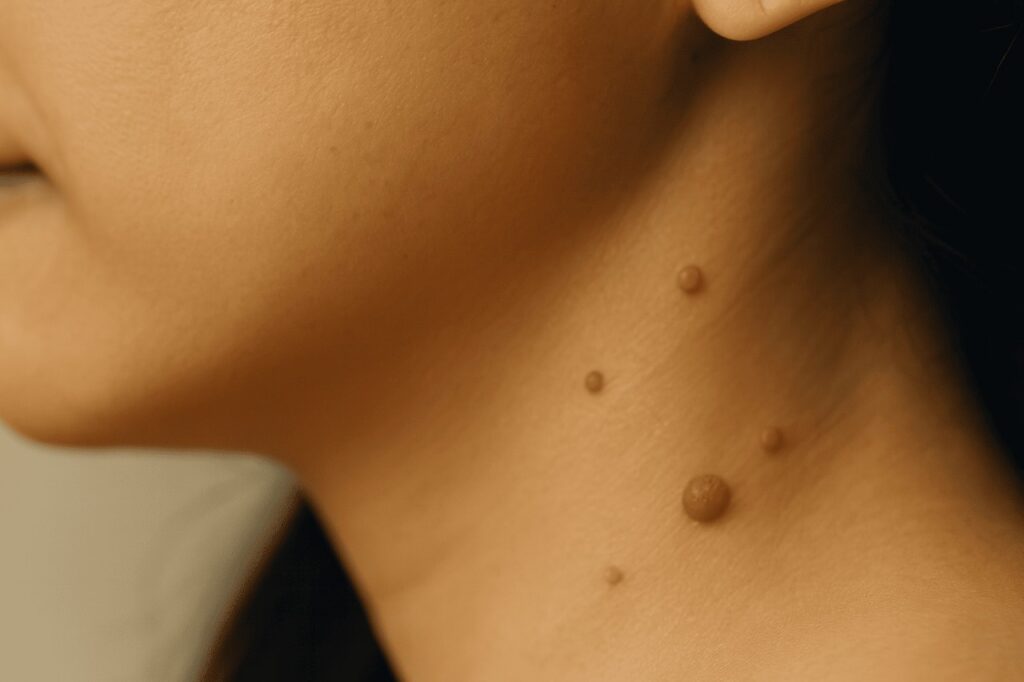
A skin tag, medically called an acrochordon, is a small flap of ordinary skin hanging from a thin stalk. It forms where skin repeatedly rubs against skin or clothing, commonly the neck, armpits, groin, and eyelids.
A wart is caused by the human papillomavirus entering the skin through a small break in the surface. It isn’t friction-related at all, and that distinction is the reason the two need different approaches. Both sit among the many minor skin procedures covered in a broader overview of plastic surgery types, alongside other everyday lesion removals.
What causes skin tags
Skin tags aren’t fully understood, but friction, hormonal changes, and insulin resistance all appear linked to their development. They become more common with age and during pregnancy, and tend to run in families.
They are not caused by a virus and cannot spread to other people or other parts of your body, which is the single biggest practical difference from a wart.
What causes warts
Warts are caused by one of over a hundred strains of HPV, which infects the outer layer of skin and triggers rapid, rough overgrowth. The virus spreads through direct contact or shared surfaces like pool floors and towels.
Warts can also spread to new sites on your own skin through a process called autoinoculation, usually from picking or shaving over an existing wart. This is why covering a wart matters more than covering a skin tag.
How to tell them apart at a glance
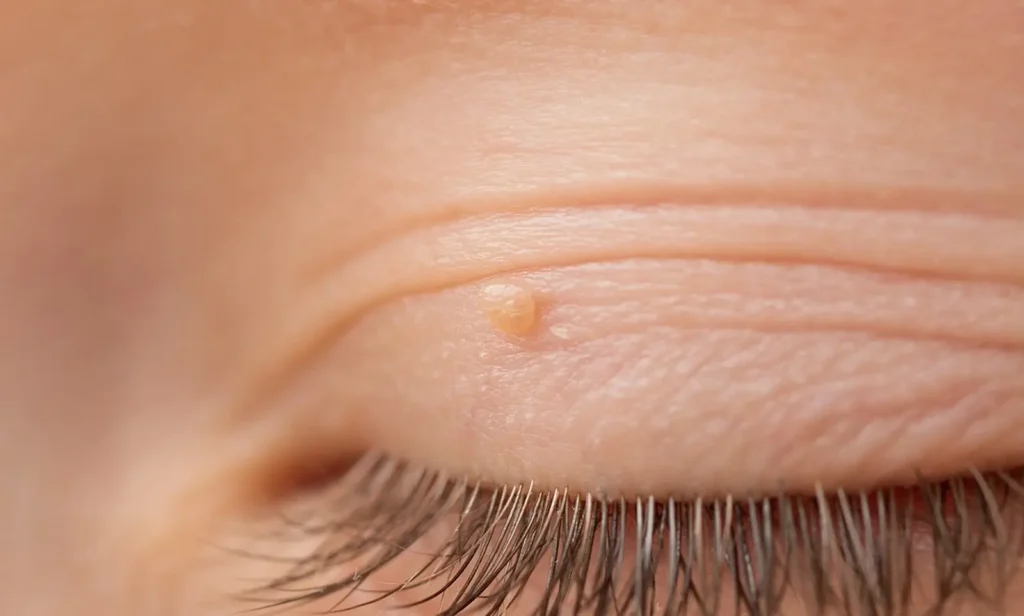
Skin tags are soft, smooth, and the same colour as the surrounding skin, hanging from a narrow stalk. Warts are rougher, firmer, and often have a slightly bumpy or speckled surface, sitting flatter against the skin rather than dangling.
Location is also a clue. Skin tags cluster in skin folds. Warts turn up anywhere, including hands, feet, and knees, places that rarely develop skin tags from friction alone.
Does duct tape or apple cider vinegar actually work?
Salicylic acid has reasonable evidence behind it for warts specifically. A Cochrane review of topical wart treatments found salicylic acid clearly outperforms placebo, though it works slowly and needs consistent daily use over weeks.
The same review found no meaningful difference between cryotherapy and salicylic acid overall, and flagged that the evidence base for many popular home remedies, including duct tape occlusion, is considerably weaker than the anecdotes suggest. None of this applies to skin tags, since they aren’t viral and don’t respond to antiviral treatments at all.
Clinical removal methods that actually work
Cryotherapy
Freezing the lesion with liquid nitrogen works for both skin tags and warts, though more aggressive freezing tends to be more effective for warts specifically, at the cost of more discomfort and a higher chance of blistering.
Excision and snipping
Snipping the tag at its base is the standard approach for skin tags, since they hang from a narrow stalk with minimal blood supply. It’s rarely used for warts, which are embedded rather than stalked.
Cauterisation
Burning off the lesion with heat seals the area as it removes it, which suits larger skin tags well and can also treat stubborn warts that haven’t responded to simpler methods.
Salicylic acid
This topical treatment is specific to warts and works by gradually breaking down the thickened, infected skin layer by layer. It has no role in treating skin tags, which have no equivalent layer to dissolve.
Is skin tag or wart removal available on the NHS?
Rarely, and only under specific criteria. A Gloucestershire ICB commissioning policy on benign skin lesions lists both warts and skin tags as conditions not routinely funded for cosmetic removal.
Funding becomes possible where the lesion obstructs an orifice, causes ongoing pain from pressure, bleeds repeatedly from unavoidable trauma, or shows documented recurrent infection. Outside those criteria, removal is self-funded.
When it’s not a skin tag or wart at all
Not every new bump is one of these two things. A lesion that’s changing colour, growing quickly, bleeding without being knocked, or has an irregular border needs a proper assessment rather than a home removal attempt, since these are features that warrant ruling out a mole-related concern.
Mole removal involves a different assessment process entirely, and it’s worth understanding the distinction before assuming any new growth is simply a tag or a wart.
Why warts can come back, and tags usually don’t
Because warts are viral, the virus can persist in surrounding skin even after the visible wart is removed, which is why recurrence is common and multiple treatment rounds are often needed.
Skin tags don’t carry this risk. Once a tag is removed, it’s gone, though the same friction or hormonal factors that caused it can produce new ones elsewhere over time.
Minor procedure in clinic vs trying it yourself at home
Over-the-counter freezing kits and acid treatments exist for a reason, but they’re weaker than clinical versions and carry a real risk of burning healthy skin if misapplied. A guide to minimally invasive procedures explains how a short in-clinic appointment compares to attempting removal unsupervised.
Self-removal with scissors or thread is also common for skin tags specifically, but it carries a genuine infection and bleeding risk, which is lower when a tag is removed in clinic with sterile instruments.
Another commonly confused benign lump
Skin tags and warts aren’t the only everyday lumps that get mislabelled. Cysts in the earlobe are frequently called something else entirely, and the same lesson applies: the wrong label can lead to the wrong treatment attempt.
How to compare removal options
Ask whether the practitioner is treating a skin tag or a wart specifically, not a generic “lump,” since the method should differ. For warts, ask how many sessions are typically needed, since one visit rarely finishes the job.
For multiple skin tags, ask whether pricing is per lesion or banded by quantity, since costs can add up quickly if you have several in one area.
How Lux Plastic Surgery approaches skin tag and wart removal
Our team, headed by Professor Sandip Hindocha, FRCS (Plast), GMC-registered Consultant Plastic Surgeon and NHS Clinical Director, offers skin tag removal at clinics in Bedford, London, and Manchester. Every consultation starts by confirming exactly what the lesion is before recommending how to treat it.
To arrange a consultation, contact the team through the website.
This article is for general information only and does not constitute medical advice. If a lesion is changing, bleeding, or you’re unsure what it is, see a doctor rather than relying on this guide to self-diagnose.
FAQ
Are warts contagious to other people?
Yes, through direct skin contact or shared surfaces such as pool floors and towels. Skin tags are not contagious under any circumstances.
Is it safe to remove a skin tag myself at home?
It carries a real infection and bleeding risk. Removal in clinic with sterile instruments lowers that risk compared with DIY removal using scissors or thread, though any removal can occasionally leave a small mark.
Why do my warts keep coming back after treatment?
The virus can persist in surrounding skin even after the visible wart is removed, which is why multiple treatment rounds are often needed for full clearance.
Should I see a doctor about a new skin growth?
If it’s changing shape or colour, growing quickly, bleeding without being knocked, or you simply aren’t sure what it is, get it checked rather than guessing.