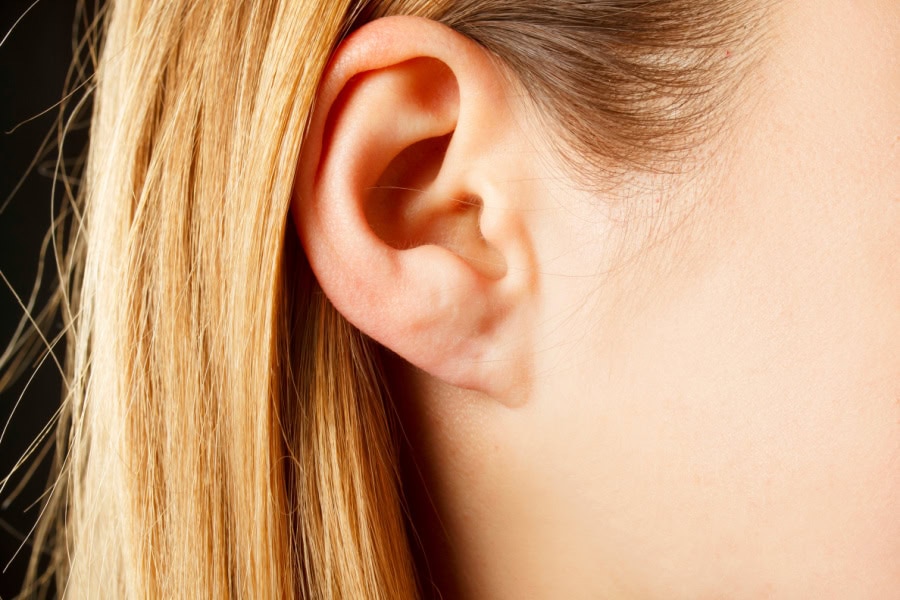
Most people who find a lump in their earlobe call it a “sebaceous cyst.” Almost always, that’s the wrong name. What’s actually there is nearly always an epidermoid or pilar cyst, a pocket of keratin rather than the oily sebum a true sebaceous cyst would contain.
The mix-up doesn’t change how it’s treated, but it does explain why “shrinking the oil gland” style advice online rarely does anything useful.
Here’s what’s actually going on, and what to do about it.
Key takeaways
| Point | Details |
|---|---|
| It’s usually not a “sebaceous” cyst | Almost always an epidermoid or pilar cyst, filled with keratin, not sebum. |
| Piercings are a common trigger | Trauma to the follicle can push skin cells into the deeper tissue, forming a cyst over time. |
| Squeezing it makes things worse | Popping it yourself raises the risk of infection and a worse scar than proper removal. |
| Drainage alone doesn’t fix it | Only removing the full cyst wall prevents it coming back. |
| NHS funding needs a medical reason | Cosmetic removal alone usually isn’t funded; repeated infection or pain can qualify. |
What is a cyst in the earlobe, exactly?
An epidermoid cyst is a small, enclosed sac that forms just under the skin, lined with the same cells that make up the skin’s surface. Inside, it fills with keratin, the same protein that makes up skin and nails, which often has a thick, cheesy texture rather than the oily consistency people expect from something labelled “sebaceous.”
A pilar cyst, sometimes confused with the same thing, forms from a hair follicle rather than general skin cells and behaves almost identically in practice. For most patients, the distinction between epidermoid and pilar barely matters, since the treatment is the same either way.
Per StatPearls clinical guidance, the term “sebaceous cyst” is a widely used misnomer even in clinical settings, since these cysts don’t originate from sebaceous glands at all.
What causes a cyst to form on the earlobe
A cyst forms when the follicle’s opening becomes blocked, or when skin cells end up trapped beneath the surface instead of shedding normally.
Ear piercings
Piercing trauma is one of the more common triggers on the earlobe specifically. The injury can push follicular skin cells into the deeper tissue instead of them shedding normally, and a cyst can form around that trapped tissue weeks, months, or even years later.
Acne-prone skin and general blockage
People with acne-prone skin form these cysts more often, since the same blocked-pore process that causes spots elsewhere can happen on the ear. They’re also roughly twice as common in men as women, and most often appear between someone’s twenties and forties.
How to tell if it’s actually a cyst
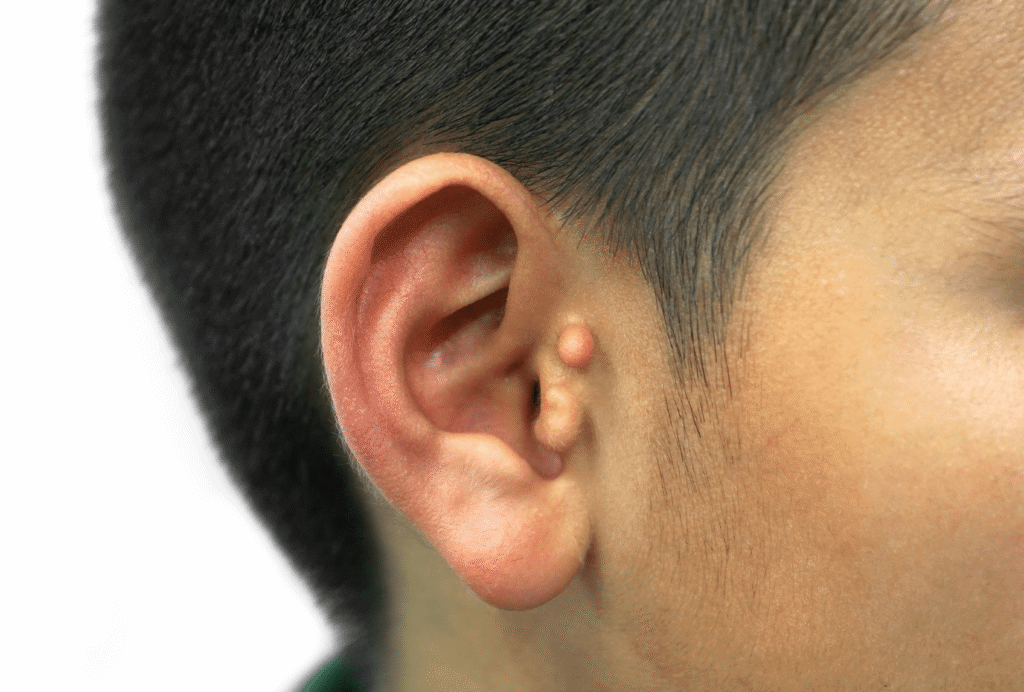
A typical epidermoid cyst is a smooth, round lump that moves freely under the skin when you press it, usually painless, and often has a tiny visible pore, called a punctum, at its centre. Sizes range from a few millimetres to a few centimetres.
There’s no reliable way to predict whether a given cyst will stay the same size for years or gradually grow, which is part of why many people leave them alone until something changes.
When it becomes a problem: signs of infection or inflammation
Most cysts sit quietly for years. Trouble usually starts when one becomes inflamed or infected, which tends to show up as sudden growth, redness, tenderness, or a softer, fluid-filled feel rather than the firm lump you had before.
Common skin bacteria are usually behind an infected cyst, and this is generally the point at which people finally seek treatment rather than living with something painless in the background.
Why you shouldn’t squeeze or pop it yourself
Squeezing an earlobe cyst can rupture the sac without removing it, spreading keratin into the surrounding tissue and triggering exactly the inflammation and infection you were trying to avoid. It also makes later surgical removal harder, since the cyst wall is more fragile and difficult to extract cleanly once it’s been disturbed.
If it’s already ruptured or draining on its own, that’s a reason to get it looked at promptly rather than a sign it’s resolving.
Does it ever need urgent attention?
Almost never, but two situations are worth knowing about. Malignant transformation of an epidermoid cyst is rare, affecting under 1% of cases, so it’s not something to lose sleep over, though a cyst that changes rapidly, bleeds, or looks unusual is still worth a proper assessment.
Separately, unusually numerous cysts, particularly if some sit behind the ears, can occasionally be an early sign of a rare inherited condition. It’s an uncommon scenario, but worth mentioning to your GP if it applies rather than assuming every cyst is identical in origin.
Treatment: why draining alone isn’t the fix
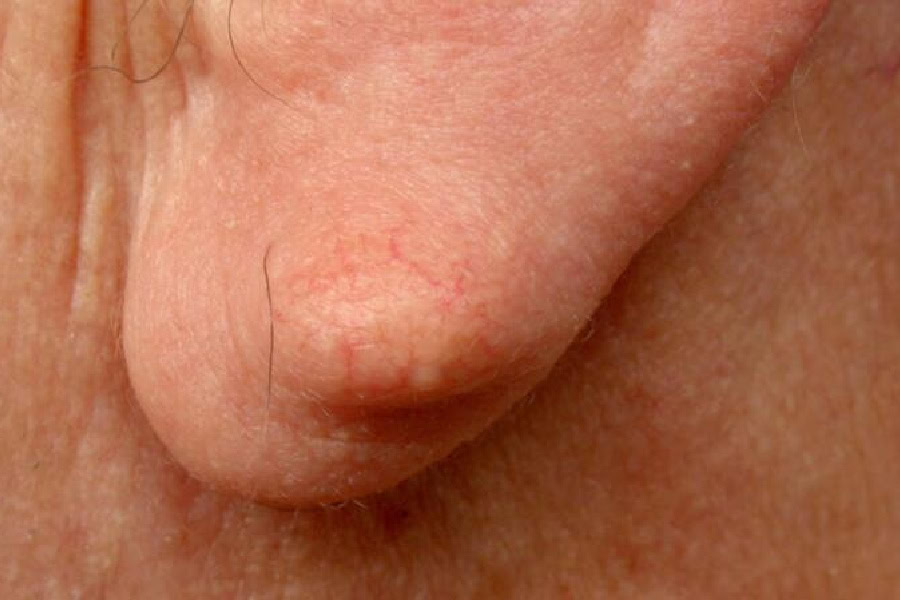
Draining a cyst empties its contents but leaves the sac itself, the actual source of the problem, behind. Without removing that wall completely, the cyst reliably refills and comes back, sometimes within weeks.
Complete surgical excision, removing the cyst and its wall intact, is the only treatment that reliably prevents recurrence. Done well, recurrence rates sit somewhere between 1% and 8%, which is a meaningfully different outcome to drainage alone.
What surgical removal actually involves
Removal is done under local anaesthetic through a small incision, positioned along the earlobe’s natural skin lines where possible to keep the resulting scar as inconspicuous as it can be. The whole cyst, including the wall, is then carefully freed from the surrounding tissue and removed.
This kind of small, targeted procedure sits at the low-intervention end of what surgery can involve; what counts as minimally invasive surgery covers how procedures like this compare to bigger operations.
Timing matters. Removing a cyst while it’s acutely inflamed makes the tissue planes harder to see and the wall more fragile, which raises the chance of leaving fragments behind. Where possible, surgeons prefer to calm inflammation first, sometimes with a course of antibiotics, and remove the cyst once things have settled.
Can you get earlobe cyst removal on the NHS?
Sometimes, but only where a specific clinical reason applies. Per NHS commissioning policy on benign skin lesions, which explicitly names epidermoid and pilar cysts, funding generally requires at least one of the following: repeated infection needing two or more courses of antibiotics a year, regular bleeding from everyday trauma, ongoing pain, or the cyst obstructing something or causing pressure symptoms.
Wanting it gone simply because it’s there and you’d rather not have it isn’t, on its own, a funded reason. Most simple, symptom-free cysts are treated as a private matter.
How much does earlobe cyst removal cost privately?
Private cyst removal in the UK typically costs £300 to £1,500, depending on the provider, location, and how simple or complex the cyst is. Minor surgery clinics often sit toward the lower end, from roughly £300 to £600, while consultant-led plastic surgery care, particularly in London, tends to run higher.
An initial consultation is sometimes charged separately, often £50 to £100, and is occasionally deducted from the final bill if you go ahead with treatment at the same clinic.
What drives the price
A handful of specific factors shape where your own quote lands within that range.
Whether it’s inflamed or infected
An acutely inflamed cyst is technically harder to remove cleanly and may need a staged approach, drainage and antibiotics first, excision later, which adds a second appointment to the overall cost.
Size and depth
A larger or deeper cyst takes longer to remove intact and needs a more careful closure, both of which add to theatre time and therefore the fee.
Single vs multiple cysts
Clinics commonly charge a lower per-cyst fee for additional lesions removed during the same visit, so mentioning any other cysts at consultation can meaningfully change the total.
Recovery and scarring
Recovery from a simple excision is generally quick: stitches typically come out within a week to ten days, and most people return to normal activity almost immediately, avoiding only direct pressure or trauma to the area while it heals.
Because the earlobe heals visibly and sits in plain sight, how the resulting scar is cared for in the first few months makes a real difference; effective skin scar treatments covers what’s actually worth doing during that window.
If your lump turns out to be trauma-related swelling rather than a true cyst, it’s worth ruling out the other common ear lump people confuse it with; cauliflower ear has a completely different cause and treatment window, despite sometimes being described in similar terms.
Talk to a Specialist About Earlobe Cyst Removal

Lux Plastic Surgery’s consultant-led team, headed by Professor Sandip Hindocha, FRCS (Plast), GMC-registered Consultant Plastic Surgeon and NHS Clinical Director, offers skin lesion removal at clinics in Bedford, London, and Manchester. Consultations include a clear look at whether removal now or after any inflammation settles is the better route for your specific cyst.
To arrange a consultation, contact the team through the website.
This article is for general information only and does not constitute medical advice. If a lump changes rapidly, bleeds, or looks unusual, get it assessed by a doctor rather than relying on information here.
FAQ
Is a cyst in the earlobe a sebaceous cyst?
Almost never technically. Most are epidermoid or pilar cysts filled with keratin rather than sebum, though “sebaceous cyst” is commonly used as an informal, slightly inaccurate umbrella term.
Can an earlobe cyst go away on its own?
Rarely, and not reliably. Some settle down after an inflamed episode resolves, but the sac itself usually remains and can flare up again unless it’s surgically removed.
How much does it cost to remove a cyst from the earlobe?
Typically £300 to £1,500 privately in the UK, depending on the provider, whether the cyst is inflamed, and its size. A separate consultation fee sometimes applies.
Can I get earlobe cyst removal on the NHS?
Only where a specific clinical reason applies, such as repeated infection, regular bleeding, ongoing pain, or pressure symptoms. Cosmetic removal alone usually isn’t funded.
Will the cyst come back after removal?
Recurrence is uncommon, roughly 1% to 8%, provided the entire cyst wall is removed intact. Draining without removing the wall has a much higher chance of the cyst returning.