Why patient safety sits at the heart of cosmetic surgery
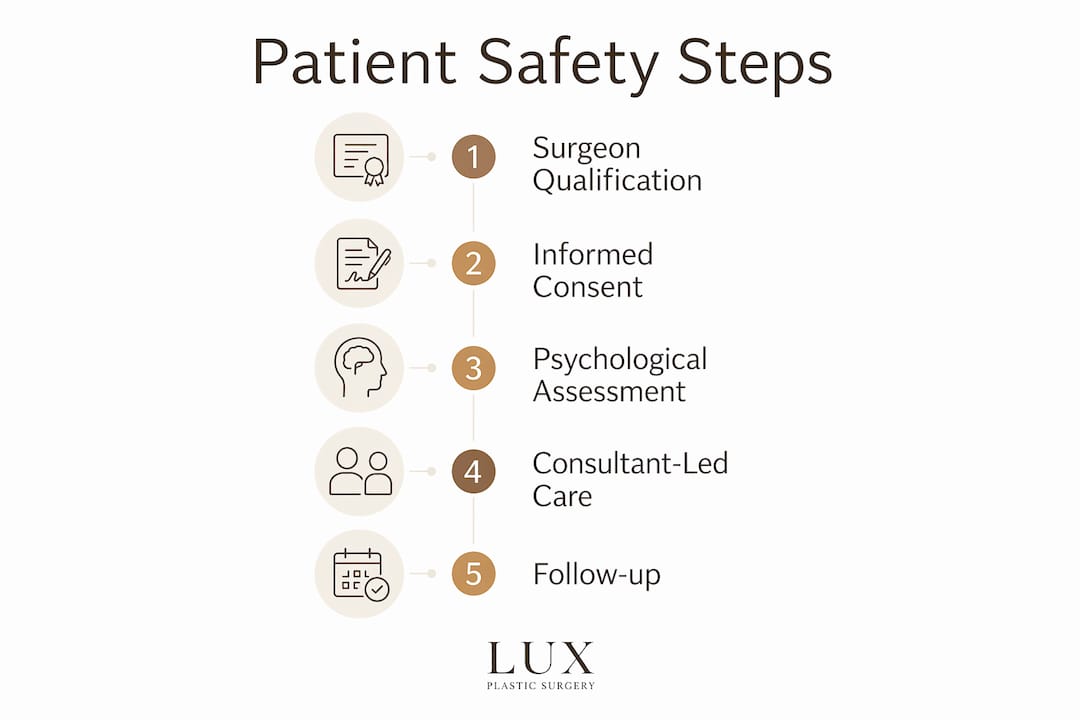
Patient safety in surgery means preventing harm and protecting your wellbeing at every stage: before, during, and after your procedure. In cosmetic plastic surgery, that definition carries particular weight because the procedures are elective. You are choosing to accept surgical risk, which makes the quality of the clinical framework around you all the more consequential.
The core components of surgical patient safety in the UK include:
- Specialist surgeon qualifications, verified against the GMC Specialist Register
- Informed consent, obtained by the operating surgeon personally, covering all risks including psychological impacts
- A minimum two-week cooling-off period after consultation, as recommended by BAAPS consumer safety guidelines
- Pre-operative assessment of medical history, co-morbidities, and psychological suitability
- Intraoperative protocols, including infection control and surgical checklists
- Post-operative monitoring, with written information about medicines, devices, and follow-up
The GMC’s professional standards for cosmetic interventions require surgeons to provide honest information about all risks, free from commercial pressure. The Royal College of Surgeons and BAAPS reinforce this through their own patient safety frameworks, creating a layered system of accountability. Lux Plastic Surgery operates within all of these standards, with every procedure led by Professor Sandip Hindocha, GMC-registered Consultant Plastic Surgeon and FRCS(Plast).
Pro Tip: Before any consultation, write down your questions and concerns. BAAPS recommends patients bring a list to every appointment so nothing important goes unasked.
How surgeon qualifications directly protect you
The single most consequential safety decision you make is choosing who operates on you. UK plastic surgeons must pass the FRCS(Plast) exit exams and maintain competency through annual continuing professional development and five-year GMC revalidation. That process is not a formality. It requires documented audit data, peer review, and evidence of reflective practice.
The regulatory gap here is stark. Any doctor on the GMC medical register can legally perform invasive cosmetic surgery in the UK private sector, regardless of specialist training. The Royal College of Surgeons has campaigned actively to close this gap, but as of 2026, participation in the Intercollegiate Cosmetic Surgery Certification Scheme remains voluntary.
What this means for you practically:
- Verify your surgeon’s entry on the GMC Specialist Register for plastic surgery
- Confirm membership of BAAPS or BAPRAS, both of which require adherence to patient safety standards and offer independent complaints processes
- Ask whether the surgeon who consults you will also perform your operation. BAAPS patient care standards are clear: the operating surgeon must conduct the initial consultation, the surgery, and primary follow-up. Delegating any of these to unqualified staff contravenes UK safety standards
GMC guidance also requires surgeons to identify psychologically vulnerable patients and, where concerns exist, defer surgery pending a formal psychological assessment. A parliamentary inquiry into cosmetic procedures concluded that mandatory psychological screening would reduce harm, particularly for patients with conditions such as Body Dysmorphic Disorder. Choosing a surgeon who takes this seriously is part of verifying their qualifications before you commit.
Professor Hindocha holds FRCS(Plast) and sits on the GMC Specialist Register, with over 150 published papers and an NHS Clinical Director role. At Lux Plastic Surgery, no procedure proceeds without a thorough pre-operative assessment and a genuine cooling-off period.
Lux Plastic Surgery: consultant-led care from first consultation to recovery
Choosing a surgeon with the right credentials is one thing. Finding a practice where those credentials translate into consistent, personalised care at every stage is another.

Lux Plastic Surgery, led by Professor Hindocha, offers consultant-led cosmetic and reconstructive procedures across Bedford, London, and Manchester. Every consultation, every operation, and every post-operative review is conducted by Professor Hindocha himself, not delegated to a representative or junior clinician. That continuity is not a marketing point; it is a patient safety requirement under BAAPS standards, and it is built into how the practice operates.
Patients considering elective surgery can book a consultation with Professor Hindocha to discuss their goals, receive an honest assessment of suitability, and take the time they need before making any decision. This is not medical advice; please consult a GMC-registered specialist before proceeding with any surgical procedure.
FAQ
What is the cooling-off period in UK cosmetic surgery?
BAAPS recommends a minimum two-week cooling-off period after your consultation before committing to surgery. This protects you from pressure-selling and gives you time to consider risks fully.
Does GMC registration alone mean a surgeon is qualified for cosmetic surgery?
No. Any doctor on the GMC medical register can legally perform cosmetic surgery in the UK private sector, regardless of specialist training. You should verify that your surgeon appears on the GMC Specialist Register for plastic surgery and holds FRCS(Plast).
What should informed consent cover before cosmetic surgery?
GMC guidance requires the operating surgeon to discuss all risks personally, including psychological impacts, alternative treatments, and what happens if the outcome does not meet your expectations. Signing a form alone does not constitute informed consent.
How does Lux Plastic Surgery approach patient safety?
Professor Hindocha conducts every consultation, operation, and primary follow-up personally, in line with BAAPS patient care standards. All procedures include pre-operative assessment, a two-week cooling-off period, and written post-operative information.
Patient safety in cosmetic surgery depends on specialist qualifications, genuine informed consent, and continuity of care from a single GMC-registered surgeon throughout the entire process.