Scarring is one of the most common concerns for anyone considering cosmetic surgery. Even when your procedure goes perfectly, a visible scar can undermine your confidence and the result you worked hard to achieve. The good news is that the majority of cosmetic scars respond well to consistent, informed aftercare. This guide draws on evidence from UK NHS sources and surgical expertise to walk you through every stage of scar minimisation, from the first days after your operation through to advanced interventions if you need them. Whether you are preparing for surgery or already in recovery, these steps can make a genuine difference.
Key Takeaways
| Point | Details |
|---|---|
| Start with gentle aftercare | Begin massage and silicone products once your wound is fully healed for the best results. |
| Protect scars from sunlight | Use SPF50+ and clothing for at least a year after surgery to prevent permanent darkening. |
| Act quickly if results lag | Escalate to professional advice if scars thicken, darken, or restrict movement after several months. |
| Combine proven methods | Massage, silicone, and sun safety work best together rather than alone. |
| Patience pays off | Visible improvement continues for 12–24 months, so maintain your routine and track progress. |
Understanding scar formation and healing timelines
Knowing what is happening beneath your skin gives you a real advantage in managing your recovery. Scarring is not simply a skin blemish; it is the result of a complex biological repair process unfolding in three overlapping phases.
The three phases of scar healing:
- Inflammation (days 1–10): Your body sends blood flow and healing cells to the wound. The area looks red, feels warm, and may be swollen. This is normal and necessary.
- Proliferation (weeks 2–6): New collagen fibres are laid down. The scar may thicken, feel firm, or become slightly raised during this stage.
- Maturation (months 2–24): Collagen remodels and the scar gradually softens, flattens, and fades. Scars mature over 12–24 months and improvement is gradual throughout.
This maturation timeline is important to keep in mind. Many patients panic when a scar looks worse at six weeks than it did at two weeks. That is entirely normal during the proliferation phase. Progress is rarely linear.
Factors that influence your final scar appearance:
| Factor | Effect on scarring |
|---|---|
| Skin tone | Darker skin tones carry a higher risk of hyperpigmentation and keloid formation |
| Wound location | High-tension areas (chest, shoulders) tend to produce wider scars |
| Age | Younger skin heals with more collagen activity, sometimes causing thicker scars |
| Genetics | Family history of keloid or hypertrophic scarring significantly increases your own risk |
| Aftercare consistency | Consistent use of silicone and sun protection dramatically improves outcomes |
Consistency in aftercare is where you have the most control. Research shows that silicone gel or sheets used for two to six months can reduce scar thickness by up to 2mm. That is a clinically meaningful difference in how a scar looks and feels. For deeper guidance on the treatment options available, the team at Lux Plastic Surgery provides detailed information on skin scar treatments including what works at each stage of healing.
Essential tools and preparations for scar minimisation
Being well-prepared before you even reach the aftercare phase puts you ahead. Sourcing the right products and understanding their purpose means you can act quickly once your surgeon gives the go-ahead.
What to have ready before you start:
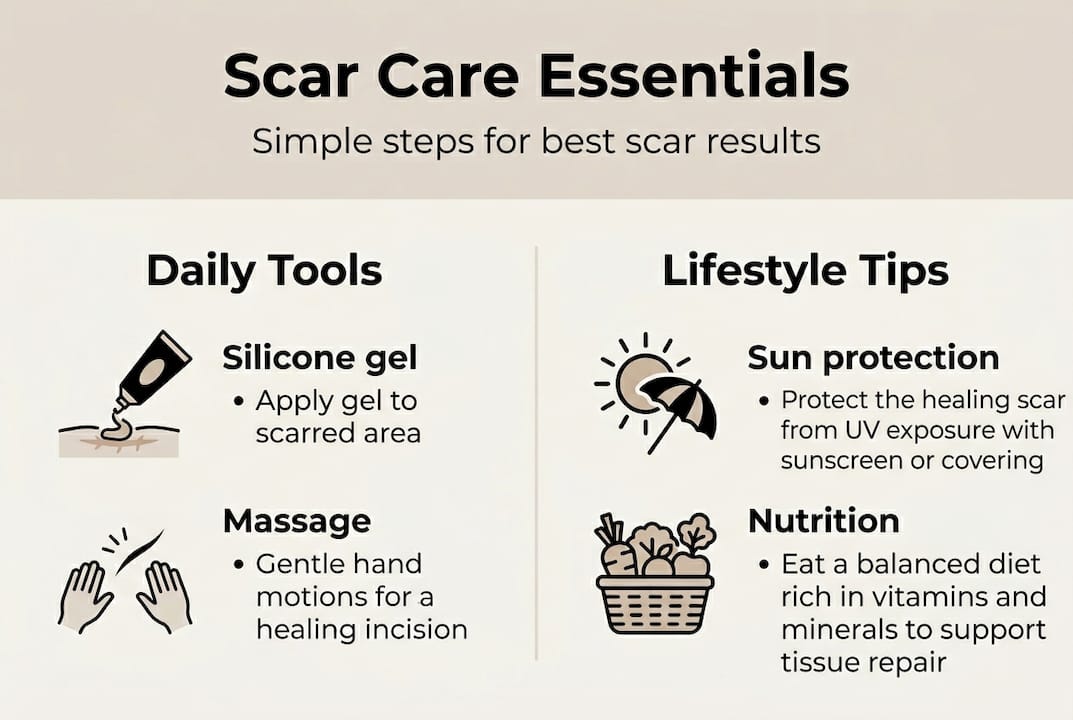
- Silicone gel or sheets: The single most evidence-backed topical option. Look for medical-grade products rather than generic pharmacy alternatives.
- Hypoallergenic moisturiser: Used as the medium for scar massage. Avoid fragranced creams, which can irritate healing skin.
- SPF 50+ sunscreen: Essential for any exposed scar, every single day, for at least one to two years.
- Gentle cleanser: To keep the area clean without disrupting fragile new tissue.
Medical-grade vs standard products:
| Product type | Medical-grade | Standard pharmacy |
|---|---|---|
| Silicone concentration | Higher, more consistent | Variable, often lower |
| Evidence base | Clinically tested formulations | Limited or none |
| Cost | Higher upfront | Lower upfront, often less effective |
| Recommended for | Surgical scars | Minor cuts and grazes |
Diet also plays a supporting role that is easy to overlook. Vitamin C supports collagen synthesis, zinc aids tissue repair, and adequate protein gives your body the raw materials it needs. Gentle mobility, once cleared by your surgeon, prevents the scar tissue from tightening and adhering to underlying structures.

Pro Tip: Set a daily alarm on your phone for silicone application and scar massage. Consistency, not intensity, is what drives results. Missing a few days each week adds up to weeks of lost progress over a six-month period.
Combining massage, silicone products, and sun protection together is optimal for scar outcomes, according to NHS scar care guidance. No single product does the job alone. For a broader look at how to support your recovery across all areas, our surgery recovery tips cover practical advice for the weeks following your procedure.
Step-by-step methods to minimise scarring after surgery
This is where preparation becomes action. Each intervention has an optimal window, and starting too early or too late reduces its effectiveness.
- Week 1–2: Keep it clean and protected. Gently cleanse the wound with mild, non-fragranced soap and water as directed by your surgical team. Keep the area moist but do not apply anything other than prescribed ointments.
- Week 2–3: Introduce silicone. Once sutures are removed and the wound surface is closed, begin applying silicone gel or sheets. Apply silicone gel or sheets for at least three months for major improvement, and up to twelve months for raised or stubborn scars.
- Week 2–3: Begin massage. Massage the scar with hypoallergenic moisturiser once the wound has fully healed, typically two to three weeks post-op, starting gently before progressing to firmer pressure. Use two fingers in small circular motions for two to three minutes, twice daily.
- From week 3 onwards: Sun protection every day. Strict sun protection (SPF 50+) for one to two years is essential, as new scars darken irreversibly when exposed to UV light. If the scar is on a covered area, use clothing as your first line of defence.
- Ongoing: Support collagen health through diet. Eat sufficient protein, include vitamin C-rich foods, and stay well-hydrated. These factors provide the biological foundation for the maturation phase.
“The window between two and twelve weeks post-surgery is the most critical period for influencing scar appearance. What you do consistently during this time matters more than any single product or treatment.”
Pro Tip: When massaging, always work along the length of the scar first, then across it. Cross-fibre massage helps break up collagen bundles that cause thickening, and it is particularly useful from six weeks onward.
For a broader look at which scar treatment options suit different types of scars, including raised and post-surgical marks, expert guidance can help you prioritise.
Advanced interventions and what to do if scars worsen
Even patients who follow every aftercare step can develop problematic scars. Genetics, wound tension, and infection all influence outcomes in ways that lie outside your control.
When to consider escalating your care:
- The scar is raised, red, or firm beyond three months post-op
- It is growing wider or becoming more prominent over time
- You experience itching, pain, or restricted movement around the scar
- There is no visible improvement after six months of consistent aftercare
Advanced treatment options and timelines:
| Treatment | Best suited for | Typical timing |
|---|---|---|
| Steroid injections (triamcinolone) | Hypertrophic and keloid scars | From 6–8 weeks post-op |
| Laser therapy | Redness, surface texture | From 3–6 months post-op |
| Surgical revision | Wide, poorly positioned scars | After 12–24 months maturation |
| Dermal fillers | Depressed or atrophic scars | Case by case |
Steroid injections using triamcinolone reduce raised scars by up to 82%, making them the most effective first-line medical treatment for hypertrophic scarring. Laser therapies are useful for improving colour and surface texture but are less effective at reducing scar height.
Surgical revision is always a last resort and should not be considered until the scar has fully matured, which means waiting the full 12 to 24 months. Operating earlier risks recreating the same healing environment that caused the original problem. If movement is limited or the scar crosses a joint, your surgeon may refer you to physiotherapy as an interim step.
If you are concerned about your current results, information on scar revision options is available, including what the procedure involves and when it is appropriate.
Common mistakes to avoid and expert troubleshooting
Most setbacks in scar care come down to a handful of predictable errors. Recognising them early can get your recovery back on track.
Mistakes that undermine your results:
- Starting too early: Applying silicone or beginning massage before the wound is fully closed increases infection risk and can reopen the incision.
- Stopping too soon: Many patients stop their routine at six to eight weeks when the scar looks good. The maturation phase continues for up to two years. Stopping early leaves results on the table.
- Skipping sunscreen on cloudy days: UV rays penetrate cloud cover. Scars burn and darken even in overcast British weather.
- Relying on one method alone: Evidence quality on massage alone is weak; combining silicone with massage and sun protection consistently delivers superior results.
- Using fragranced or vitamin E creams: Despite being widely sold as scar treatments, there is no reliable evidence that vitamin E improves cosmetic scars. Some patients experience contact dermatitis, which worsens the appearance.
“Patience is not passive. It means doing the right things consistently over months, even when you cannot see obvious improvement week to week.”
Pro Tip: Take a photograph of your scar every four weeks under consistent lighting. Progress over a long healing timeline is very hard to perceive day to day, but a monthly photo comparison makes gradual improvement visible and keeps you motivated.
If you are struggling with your recovery in a wider sense, our guide on cosmetic surgery recovery addresses what is normal and when to seek advice.
What your surgeon won’t tell you about scar care: hard truths and best-practice shortcuts
Here is the honest perspective from a surgical team: no product, regardless of price or marketing, can override your biology. Scar healing is fundamentally genetic, and some patients will always form more visible scars than others with identical care. Accepting this early prevents wasted money and frustration.
What does make a measurable difference is the combination of methods applied consistently over months, not days. The patients who achieve the best results are rarely those who found a noticeable improvement product. They are the ones who massaged every morning, wore their SPF religiously, and kept their silicone on for the full recommended period. Small, repeated actions outperform expensive one-off treatments every time.
Knowing when to stop self-treating and push for a specialist referral is equally important. If a scar is still raised, spreading, or symptomatic at six months, that is not a failure of your aftercare. It is a sign that your scar needs clinical input. Waiting longer in hope rarely helps. Review our guidance on recovery shortcuts and skin scar expert perspective for a fuller picture of how to approach each phase with confidence.
Get expert surgical care and personal scar advice
If you are finding that home aftercare is not delivering the results you hoped for, or if you simply want professional reassurance at each stage of your recovery, specialist input can make a real difference.

At Lux Plastic Surgery, Professor Sandip Hindocha and his team provide personalised scar assessments and access to the full range of clinical interventions, from early silicone protocols through to scar revision consultations for more complex cases. Whether you are considering a new procedure or managing the aftermath of an existing one, the team can advise on the right approach for your skin type and goals. Explore the full range of cosmetic surgery options and book a consultation to get personalised guidance from an experienced specialist.
FAQ
When should I start scar massage after surgery?
Begin gentle massage around two to three weeks post-op, once the wound is fully healed and closed. Starting too early risks reopening the incision and increasing infection risk.
How long should I use silicone gel or sheets on my scar?
Most NHS guidance recommends a minimum of three months, and up to 12 months for raised or stubborn scars that are slow to flatten and pale.
Why is sun protection so important for new scars?
Fresh scars have no UV defence of their own and darken very easily. As new scars darken irreversibly with UV exposure, this colour change cannot be reversed without clinical treatment.
What are the signs that I need professional help for a scar?
If your scar is raised, expanding, painful, or limiting movement after six months, seek a review. Scars may need steroid or surgical intervention when home care alone has not produced improvement.
Is massaging the only method I need for a good scar result?
No. No strong evidence for massage efficacy alone exists in isolation. Combining massage with silicone products and consistent sun protection produces significantly better outcomes than any single method.