Abdominoplasty, the clinical term for a tummy tuck, typically costs between £5,000 and £12,000 in the UK, with the final figure shaped by procedure type, surgeon experience, facility fees, and anaesthesia. The cost of abdominoplasty tummy tuck surgery is not a single fixed price. It is a composite of several distinct expenses, each of which varies according to your anatomy, your chosen surgeon, and where in the UK you are treated. This guide breaks down every component of that total, compares procedure types side by side, and explains how to plan your budget accurately before you book a consultation with a GMC-registered specialist such as Professor Sandip Hindocha at Lux Plastic Surgery.
What factors influence the cost of a tummy tuck?
The tummy tuck price you receive at consultation reflects a combination of clinical, logistical, and geographic variables. Understanding each one prevents unwelcome surprises when you receive your final quote.
Surgeon’s fee
The surgeon’s fee is the single largest component of the total bill. Surgeon fees account for 50–60% of the overall cost of tummy tuck surgery. That proportion reflects the surgeon’s training, reputation, and the complexity of the procedure they are performing. A consultant plastic surgeon who is a Fellow of the Royal College of Surgeons (Plast) and holds NHS clinical appointments will typically charge more than a less experienced practitioner. That premium is justified by lower complication rates and more consistent outcomes.

Procedure complexity
A straightforward skin excision costs less than a procedure that also involves rectus abdominis muscle repair, known clinically as diastasis recti correction. Muscle repair increases surgical time and complexity considerably, which drives both the surgeon’s fee and the anaesthesia cost upward. Patients who require significant muscle tightening alongside skin removal should expect a higher total than those needing skin excision alone.
Facility and anaesthesia fees
Operating theatre hire and anaesthesia are charged separately from the surgeon’s fee in most UK private hospitals. Anaesthesia fees range from approximately £800 to £3,000, and facility fees add a further £1,500 to £4,000. Together, these two items can add 30–50% on top of the surgeon’s fee alone.
Geographic location
London and other major metropolitan centres command higher prices than clinics in smaller cities. Metropolitan areas charge 20–30% more on average, reflecting higher operating costs, property overheads, and market demand. Lux Plastic Surgery operates across Bedford, London, and Manchester, offering patients a choice of location that can influence the overall abdominoplasty cost breakdown.
Pro Tip: Ask your clinic whether the quoted price is all-inclusive or whether facility, anaesthesia, and post-operative care are billed separately. A lower headline figure can become a higher total once these items are added.
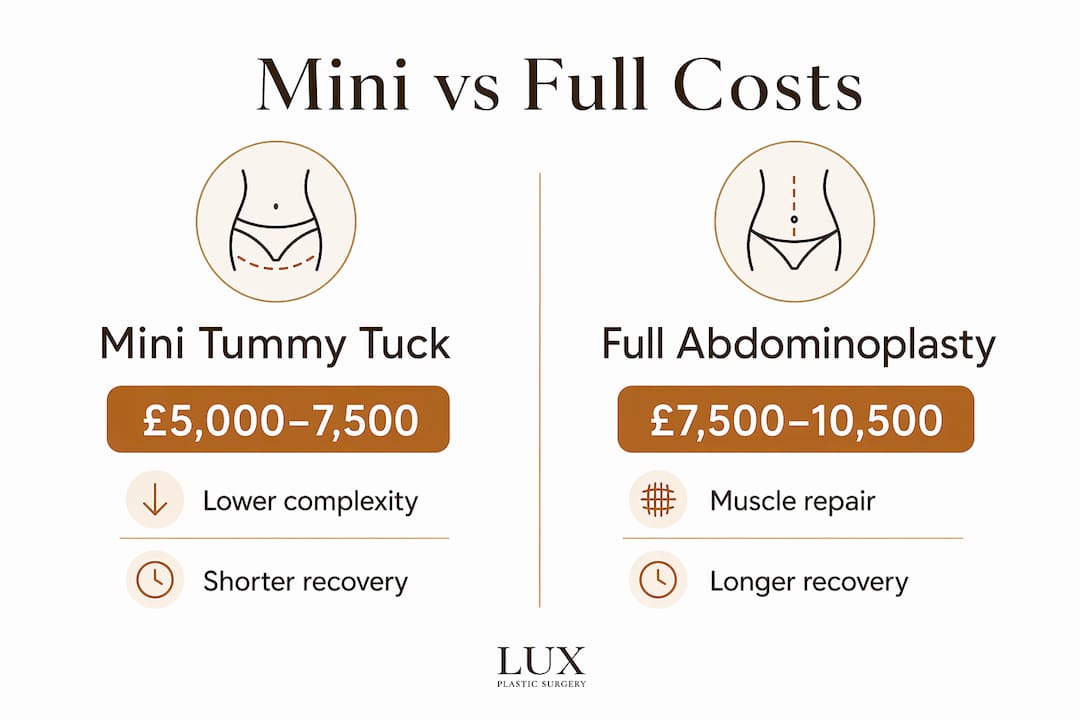
How do mini tummy tuck and full abdominoplasty costs compare?
The type of procedure you need is the most significant single driver of the tummy tuck price. Surgeons classify abdominoplasty into several categories, each with a different scope and a corresponding cost range.
| Procedure type | Typical UK price range | Key features |
|---|---|---|
| Mini abdominoplasty | £5,000–£7,500 | Limited skin excision below the navel; no muscle repair |
| Full abdominoplasty | £7,500–£10,500 | Skin and muscle repair; navel repositioning |
| Extended abdominoplasty | £9,000–£12,000 | Addresses flanks and lower back in addition to abdomen |
| Fleur-de-lis abdominoplasty | £10,000–£13,000 | Vertical and horizontal incisions; significant skin excess |
A mini tummy tuck addresses excess skin and fat below the navel only. It suits patients with mild laxity and no significant muscle separation. Because the operative time is shorter and the anaesthesia duration is reduced, the cost of tummy tuck surgery at this level is the lowest of the four categories.
A full abdominoplasty repositions the navel, tightens the abdominal muscles from sternum to pubis, and removes a larger panel of skin. Full abdominoplasty costs 40–60% more than a mini procedure because of the increased operative complexity and longer theatre time. That differential is meaningful: a patient quoted £6,000 for a mini procedure might face a bill of £8,400 to £9,600 for a full abdominoplasty with muscle repair.
Extended and fleur-de-lis variants are reserved for patients with substantial skin excess, often following significant weight loss. These procedures involve longer incisions, greater tissue removal, and extended operating times, all of which push the abdominoplasty expenses toward the upper end of the UK price range.
Recovery duration also correlates with cost. A mini tummy tuck typically requires two to three weeks off work, whereas a full or extended abdominoplasty may require four to six weeks. That additional recovery time has a direct financial implication, which is addressed in the next section.
Pro Tip: Do not choose a mini tummy tuck on cost grounds alone if your anatomy requires a full procedure. An undercorrected result may require revision surgery, which costs more in total than doing the correct operation first time.
You can read more about procedure scope and results on the Lux Plastic Surgery website before your consultation.
What additional costs should patients budget for beyond the surgeon’s fee?
The abdominoplasty cost breakdown extends well beyond the operating theatre. Patients who budget only for the surgeon’s fee routinely find themselves underprepared for the full financial commitment.
Additional expenses frequently overlooked include the following:
- Compression garments: A medical-grade abdominal binder or compression garment is worn for six to eight weeks post-operatively. Quality garments cost £80–£250 and are not always included in the surgical package.
- Prescription medications: Post-operative antibiotics, pain relief, and anticoagulants are prescribed routinely. Expect to spend £50–£150 on prescriptions during the first two weeks of recovery.
- Follow-up appointments: Most surgeons include two or three post-operative reviews in their fee, but additional appointments, scar management consultations, or treatment for minor complications may be charged separately.
- Scar treatment: Silicone sheets, topical gels, or laser scar therapy are often recommended from six weeks post-operatively. These are rarely included in the surgical fee and can cost £100–£400 over six months.
- Time off work: This is the most frequently underestimated cost. Recovery often requires budgeting for time off work, pain management, and recovery aids that patients underestimate in their planning. For a full abdominoplasty, four to six weeks away from a physically demanding role represents a significant income loss for self-employed patients.
- Domestic support: Patients are advised not to lift, drive, or perform strenuous household tasks for several weeks. Childcare, cleaning, or shopping assistance adds a real but often unquantified cost.
One area where patients can achieve genuine savings is by combining procedures. Combining a tummy tuck with liposuction adds to the upfront cost but is more affordable than having the two procedures separately, because anaesthesia and facility fees are shared across both operations. If you are considering liposuction to address the flanks or thighs alongside your abdominoplasty, discuss this with your surgeon at the outset.
Regarding insurance: cosmetic abdominoplasty is almost never covered by private health insurance or the NHS. The sole exception is panniculectomy, which is the surgical removal of a hanging skin apron (pannus) causing documented skin infections or functional impairment. Panniculectomy requires rigorous pre-authorisation and is assessed on strict clinical criteria. Do not assume your procedure qualifies without a formal assessment from a GMC-registered specialist.
How to plan and budget effectively for an abdominoplasty procedure
Accurate financial planning for abdominoplasty requires more than a Google search. The steps below reflect the approach recommended by experienced consultant plastic surgeons.
Book an in-person consultation. An in-person consultation is the most accurate way to determine your tummy tuck price, because anatomy and surgical needs cannot be fully assessed online. A photograph or video call cannot replace a physical examination of skin quality, muscle separation, and fat distribution.
Request an itemised quote. Ask your surgeon to separate the surgeon’s fee, anaesthesia fee, facility fee, and post-operative care costs. This allows you to compare quotes from different providers on a like-for-like basis rather than comparing headline figures that may include different items.
Ask specific questions. Confirm whether the quote includes: pre-operative blood tests, compression garments, all follow-up appointments within the first year, and the cost of managing minor complications such as wound dehiscence or seroma drainage.
Evaluate financing options. Many UK private clinics offer payment plans through third-party finance providers. Tummy tuck financing options typically involve 0% interest for 12 months or longer-term plans at a fixed APR. Read the terms carefully and confirm the total repayable amount before signing. Finance is a legitimate tool for managing the cost of tummy tuck surgery, but it should be factored into your overall budget rather than treated as a way to afford a procedure you cannot otherwise fund.
Plan your recovery budget separately. Calculate your expected income loss during recovery, the cost of any domestic support you will need, and the likely spend on garments and medications. Add this figure to your surgical quote to arrive at the true total investment.
Verify credentials. Confirm that your surgeon is on the GMC Specialist Register for plastic surgery and that the facility is registered with the Care Quality Commission (CQC). You can read more about candidacy and recovery to understand whether you are a suitable candidate before committing to a consultation.
Pro Tip: Ask whether your surgeon performs revision procedures and, if so, whether there is a fee for revisions within the first 12 months. A surgeon confident in their results will have a clear policy on this.
Common misconceptions about tummy tuck costs
Several persistent misunderstandings lead patients to either overestimate or underestimate the true cost of abdominoplasty tummy tuck surgery.
- “A lower quote means a worse surgeon.” Price alone does not determine quality. A lower quote may simply reflect lower facility overheads or a less central location. What matters is the surgeon’s GMC registration, specialist training in plastic surgery, and their documented outcomes.
- “My insurance will cover it if I have a medical reason.” Insurance rarely covers cosmetic abdominoplasty, even when patients have genuine functional concerns. Only panniculectomy with documented medical necessity and pre-authorisation qualifies for coverage, and the criteria are strict.
- “The recovery is quick, so I won’t lose much income.” A full abdominoplasty with muscle repair requires four to six weeks of restricted activity. Patients in physically demanding roles or self-employment should budget for this period explicitly.
- “All-in pricing means no further costs.” Even genuinely all-inclusive packages rarely cover scar treatment, additional garments, or the cost of managing minor complications beyond the first few weeks.
- “I can get an accurate quote online.” Online price calculators provide a useful starting range, but the how much is abdominoplasty question can only be answered accurately after a physical examination by a qualified surgeon.
The consultation process itself is where accurate, personalised pricing is established. Treat any figure provided before a physical assessment as an estimate only.
Key takeaways
The total cost of abdominoplasty tummy tuck surgery in the UK ranges from £5,000 to £13,000 depending on procedure type, surgeon expertise, facility location, and the full scope of post-operative expenses.
| Point | Details |
|---|---|
| UK price range | Abdominoplasty costs £5,000–£13,000 in the UK; the final figure depends on procedure type and location. |
| Surgeon’s fee proportion | The surgeon’s fee accounts for 50–60% of the total; anaesthesia and facility fees add 30–50% on top. |
| Procedure type matters | A full abdominoplasty costs 40–60% more than a mini tummy tuck due to muscle repair and longer theatre time. |
| Hidden costs are significant | Compression garments, prescriptions, scar treatment, and time off work frequently add £500–£2,000 to the total. |
| Insurance rarely applies | Cosmetic abdominoplasty is not covered by insurance; only panniculectomy with documented medical necessity may qualify. |
What I have learned from years of abdominoplasty consultations
Patients arrive at consultation with a figure in mind. That figure is almost always lower than the realistic total, not because clinics are opaque, but because the true cost of abdominoplasty tummy tuck surgery extends well beyond the operating theatre.
The most common gap I see is the failure to account for recovery. A patient who is self-employed and takes six weeks off work has effectively added thousands of pounds to their total investment, none of which appears on the surgical invoice. When I discuss this openly at consultation, patients consistently tell me that no one had raised it before.
The second gap is the assumption that a cheaper quote represents equivalent value. A lower headline price sometimes reflects a less experienced surgeon, a less well-equipped facility, or a quote that excludes items that will be charged later. I always recommend requesting a fully itemised breakdown and comparing those breakdowns rather than the totals.
What I find most useful for patients is separating the decision into two distinct questions. First: is this the right procedure for my anatomy and my goals? Second: can I fund the full investment, including recovery, without financial strain? Both questions deserve honest answers before any commitment is made.
Choosing a GMC-registered consultant plastic surgeon with a documented record in abdominoplasty is not a premium option. It is the baseline standard for safe, satisfying outcomes. The cost of revision surgery, or of managing a complication from an underskilled procedure, invariably exceeds the saving made on the original quote.
— Lux
Plan your abdominoplasty with Lux Plastic Surgery
Lux Plastic Surgery offers consultant-led abdominoplasty across Bedford, London, and Manchester, with all procedures directed by Professor Sandip Hindocha, GMC-registered Consultant Plastic Surgeon and NHS Clinical Director.

At your in-person consultation, Professor Hindocha will assess your anatomy, discuss the appropriate procedure type, and provide a fully itemised cost breakdown with no hidden charges. Lux Plastic Surgery’s approach to plastic surgery options and safety prioritises clinical accuracy and transparent pricing at every stage. Whether you are considering a mini or full abdominoplasty, or wish to explore combining procedures for greater efficiency, the consultation is where your personalised plan begins. Contact Lux Plastic Surgery to book your assessment.
This article is for informational purposes only and does not constitute medical advice. Consult a GMC-registered specialist for personal clinical guidance.
FAQ
How much does a tummy tuck cost in the UK in 2026?
A tummy tuck in the UK costs between £5,000 and £13,000 in 2026, depending on procedure type, surgeon experience, and geographic location. A full abdominoplasty with muscle repair sits at the higher end of this range.
Is abdominoplasty covered by the NHS or private insurance?
Cosmetic abdominoplasty is not covered by the NHS or private health insurance. Panniculectomy may qualify for coverage where there is documented medical necessity, but this requires formal pre-authorisation and strict clinical criteria.
What is the difference between a mini and full tummy tuck in terms of cost?
A mini tummy tuck typically costs £5,000–£7,500, while a full abdominoplasty ranges from £7,500 to £10,500. The cost differential of 40–60% reflects the greater operative complexity, longer theatre time, and muscle repair involved in a full procedure.
How do I get an accurate quote for abdominoplasty?
An accurate quote requires an in-person consultation with a GMC-registered consultant plastic surgeon. Online estimates provide a useful range, but your anatomy, the extent of muscle repair required, and your chosen facility all affect the final figure in ways that cannot be assessed remotely.