Cellulite isn’t caused by toxins, poor circulation, or carrying extra weight, even though most products marketed to treat it imply exactly that. It’s a structural feature of how fat and connective tissue connect to the skin.
That structural cause is also why some very lean, fit people have visible cellulite, and why losing weight doesn’t reliably make it disappear. The dimpling comes from tension in fibrous bands under the skin, not simply from how much fat sits underneath.
Here’s what’s actually happening under the skin, which treatments have real evidence behind them, and which popular claims don’t hold up.
Key takeaways
| Point | Details |
|---|---|
| Cellulite is structural, not toxic | Fibrous bands pulling on the skin cause the dimpling, not trapped toxins. |
| Weight loss doesn’t reliably fix it | Lean, fit people can still have visible cellulite; it can even look more obvious with less fat cushioning it. |
| Creams and massage have weak evidence | Caffeine cream shows modest short-term improvement; dry brushing and massage lack good evidence. |
| Subcision has the strongest evidence | Releasing the fibrous bands directly, with or without laser or vacuum assistance, shows the most durable results. |
| Not available on the NHS | Cellulite treatment is considered cosmetic, so it’s self-funded. |
What actually causes cellulite
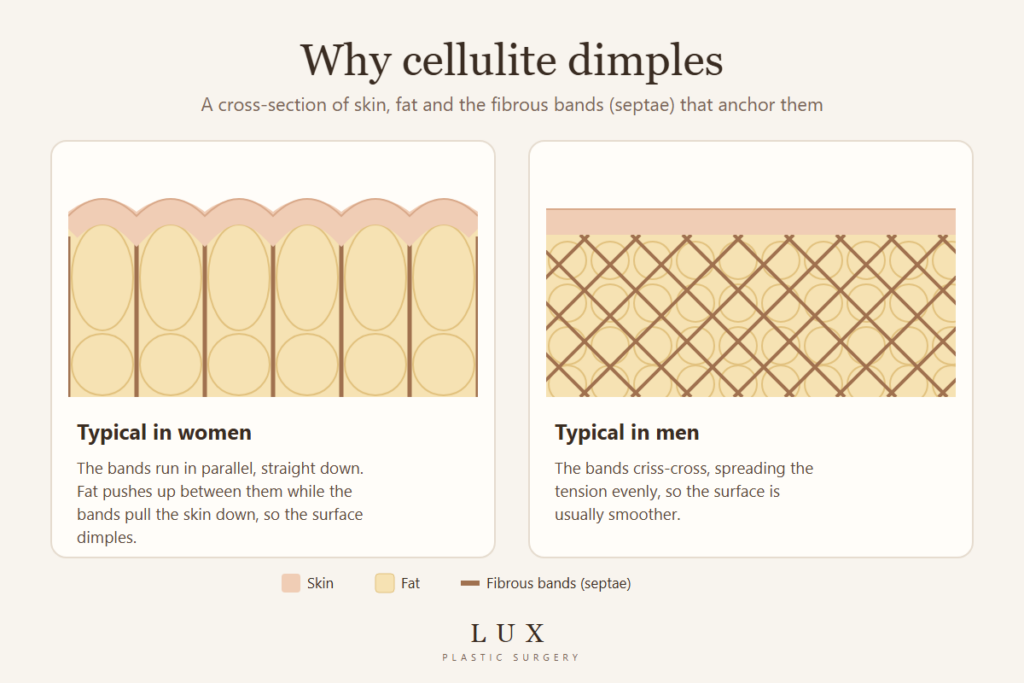
Underneath the skin sits a mesh of fibrous bands called septae, which anchor the skin to deeper tissue. Where fat pushes up between these bands while the bands themselves pull down, the surface dimples. According to a clinical review of cellulite’s underlying structure, this combination, not the amount of fat alone, is what produces the dimpled appearance.
Nothing about this involves trapped toxins or poor lymphatic drainage, despite how often those explanations appear in marketing copy.
Why women get cellulite far more often than men
The same review notes that men’s septae are typically arranged in a crisscrossed pattern, which distributes tension evenly, while women’s septae tend to run in parallel, perpendicular to the skin. That structural difference, reinforced by oestrogen and progesterone, is why cellulite is overwhelmingly more common in women regardless of fitness level.
It also explains why cellulite can appear even in women who exercise regularly and carry very little body fat. The anatomy, not the lifestyle, is doing most of the work, a point a wider look at body sculpting options covers in more depth.
Does losing weight get rid of cellulite?
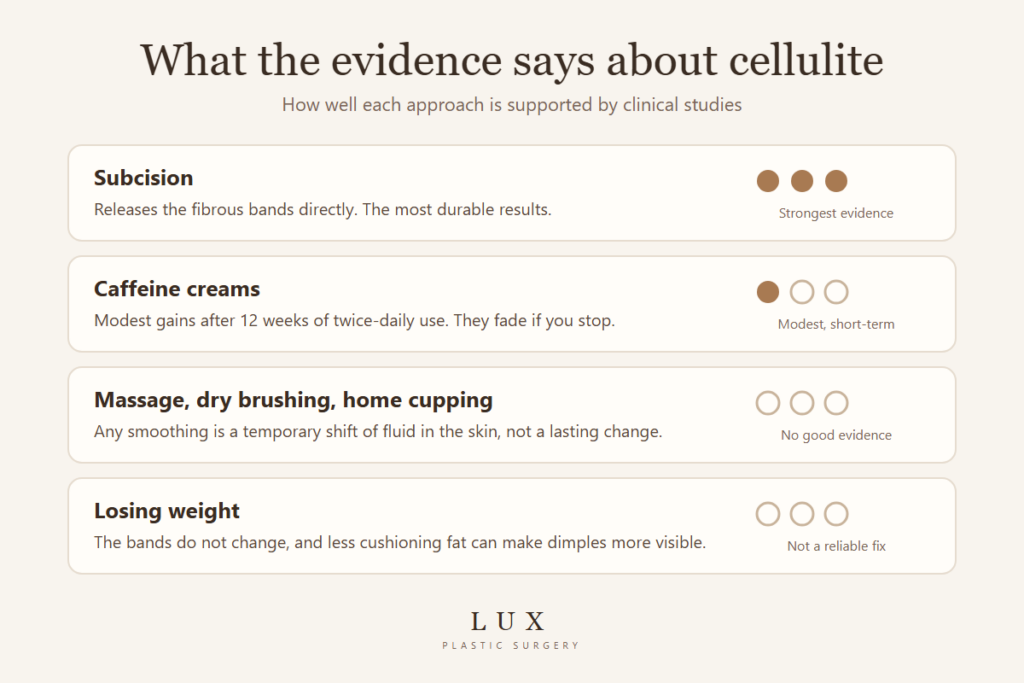
Not reliably. Since the fibrous bands themselves don’t change with weight loss, the dimpling can persist, and losing the fat that was cushioning the skin can occasionally make the texture more noticeable rather than less.
Weight loss is worth pursuing for its own health benefits, but it isn’t a reliable cellulite treatment on its own.
Do creams, massage, and dry brushing actually work?
Caffeine-based creams have shown a modest, measurable improvement in cellulite severity after around 12 weeks of consistent twice-daily use, per the treatment-evidence summary below. Results are real but limited, and stop once you stop applying the product.
Massage, dry brushing, and vacuum-cupping sold for home use haven’t shown comparable evidence. Any short-term smoothing effect tends to come from temporary fluid shifts in the skin rather than any lasting change to the fibrous bands causing the dimpling.
Clinical treatments that actually have evidence behind them
Subcision
Subcision releases the fibrous bands directly using a needle or small device inserted under the skin. A review of current cellulite treatment evidence describes subcision as the approach with the most durable results, with high satisfaction rates persisting at one to two years after a single treatment.
Laser-assisted subcision
Adding laser energy to the subcision process targets fat cells and stimulates collagen alongside releasing the septae. The same review reports sustained improvement at 12 months with this combined approach.
Radiofrequency and acoustic wave therapy
These non-invasive options show measurable short-term improvement but generally need repeat sessions to maintain results, unlike subcision’s one-off approach.
What about liposuction?
Liposuction removes fat volume rather than releasing the fibrous bands responsible for dimpling, so it isn’t a direct cellulite treatment in the way subcision is. Vaser liposuction uses ultrasound energy that has some supporting evidence for mild skin tightening as a secondary effect, but treating cellulite specifically calls for a technique that addresses the septae themselves.
Worth asking directly, if cellulite is your main concern: does this procedure target the fibrous bands, or just the fat around them?
Is cellulite treatment available on the NHS?
No. Cellulite is considered a cosmetic concern rather than a medical one, so treatment of any kind is self-funded privately.
Setting realistic expectations
Even the most effective treatments improve the appearance of cellulite rather than eliminating it completely. Setting realistic expectations around natural-looking results before booking anything helps avoid disappointment with a condition that responds gradually rather than dramatically.
Skin type, the severity of dimpling, and the specific area treated all affect how much visible change is realistic.
How non-invasive options fit into a broader plan
Cellulite treatments are often one part of a wider approach to body shape and skin quality, rather than something tackled entirely in isolation. Thinking about the broader picture first tends to produce a more coherent plan than chasing one device at a time.
How to compare cellulite treatment options
Ask what mechanism the treatment actually uses: does it release the fibrous bands, stimulate collagen, or simply improve circulation temporarily? That answer tells you far more than a before-and-after photo alone.
A roundup of current body contouring trends is worth reading before committing to any single device or technique, since new options enter the market regularly with varying levels of supporting evidence.
Who isn’t a good candidate
Anyone with significant skin laxity may see less benefit from subcision alone, since loose skin can make dimpling more visible once fat volume changes. A proper assessment should factor in skin quality, not just the cellulite itself.
How Lux Plastic Surgery approaches cellulite concerns
Our team, headed by Professor Sandip Hindocha, FRCS (Plast), GMC-registered Consultant Plastic Surgeon and NHS Clinical Director, offers consultations at clinics in Bedford, London, and Manchester to assess which approach, if any, actually suits your skin and goals, rather than defaulting to whichever treatment is being marketed hardest.
To arrange a consultation, contact the team through the website.
This article is for general information only and does not constitute medical advice. Results vary by individual anatomy and skin quality, so treat all information here as general guidance rather than a personal prediction.
FAQ
Can exercise alone get rid of cellulite?
Not reliably. Exercise can improve muscle tone and overall body composition, but it doesn’t change the fibrous bands under the skin that actually cause the dimpling.
Is cellulite a sign of poor health?
No. It’s a normal anatomical feature affecting most women to some degree, regardless of fitness or overall health, and isn’t linked to toxins or circulation problems.
How long do cellulite treatment results last?
Subcision-based treatments have shown results persisting one to two years after a single session, while non-invasive options like radiofrequency typically need repeat sessions to maintain results.
Does cellulite get worse with age?
Often, yes, since skin thins and loses elasticity over time, which can make existing dimpling more visible even without any change in fat levels.
Can men get cellulite?
Yes, though far less commonly, since men’s fibrous bands are typically arranged in a crisscrossed pattern that distributes tension more evenly than the parallel arrangement seen in women.