Jawline surgery is a set of surgical procedures that permanently reshape the jaw’s bone or surrounding soft tissue to improve facial contour and balance. The term covers several distinct operations, including genioplasty (surgical repositioning of the chin bone), chin implant placement, and mandibular angle reduction, each targeting a different anatomical structure. Professor Sandip Hindocha, GMC-registered Consultant Plastic Surgeon and NHS Clinical Director at Lux Plastic Surgery, emphasises that the right procedure depends entirely on whether the underlying issue is skeletal, muscular, or fatty in origin. Understanding that distinction is the single most important step before any consultation.
What are the main jawline surgery options?
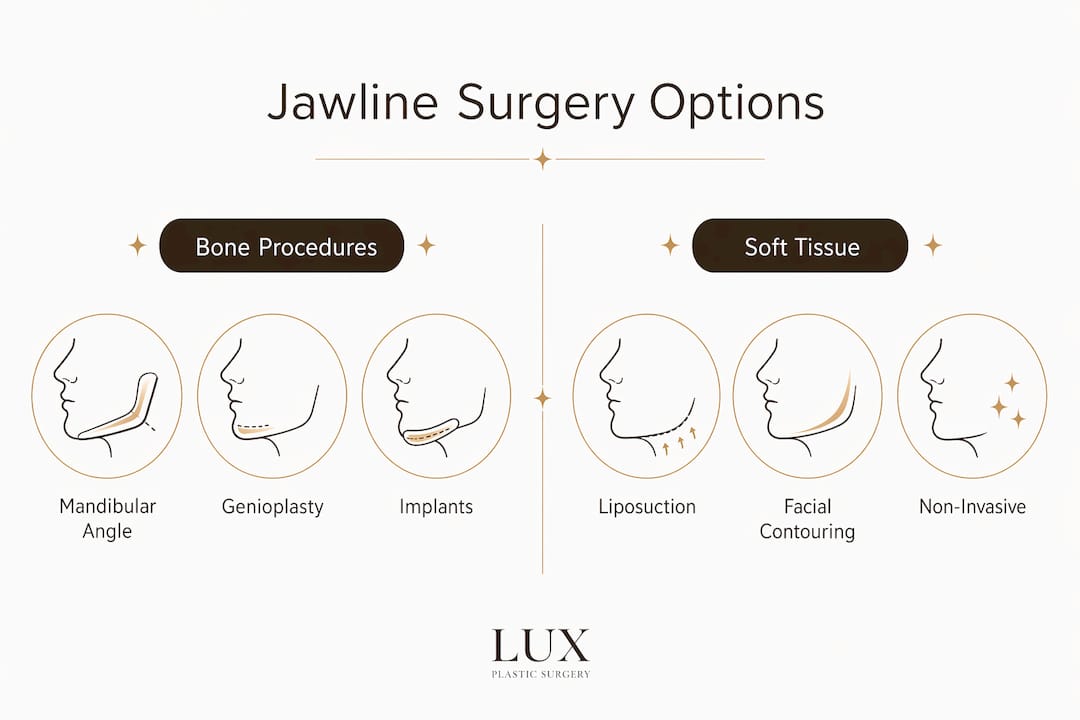
Jawline surgery divides into three broad categories: bone procedures, soft tissue procedures, and implant-based augmentation. Each addresses a different anatomical target, and choosing the right approach requires a clear diagnosis before any surgical plan is drawn up.
Bone contouring: mandibular angle reduction
Mandibular angle ostectomy and cortical shaving permanently reduce bony jaw width in patients with prominent gonial angles. The surgeon removes or reshapes the outer cortex of the mandibular angle through an intraoral incision, leaving no visible external scar. This procedure is irreversible and carries a risk of malunion and sensory nerve disturbance, so patient selection is critical. It is most appropriate for individuals with genuinely wide skeletal jaw angles rather than those with soft tissue bulk creating the appearance of width.
Genioplasty and chin implants
Genioplasty involves cutting and repositioning the chin bone (the symphysis) to advance, set back, or vertically alter the chin’s position. It offers three-dimensional control that no implant can replicate. Chin implants, typically made from silicone or Medpor, are placed via an intraoral or submental incision and enhance chin projection permanently. A 2026 systematic review covering 56 studies and 4,844 patients confirmed that surgical chin augmentation delivers durable lower-face balance with high patient satisfaction, though risks include infection, hardware complications, and persistent nerve sensitivity. Genioplasty suits patients needing complex repositioning; implants suit those requiring straightforward projection increase.
Soft tissue procedures
Submandibular and jowl liposuction reduce soft tissue volume around the jaw in patients with good underlying bone structure but excess fat that blurs the jawline. Buccal fat removal addresses fullness in the mid-face and lower cheek, which can indirectly sharpen the jaw’s appearance. These procedures carry shorter recovery times than bone surgery and lower complication rates, but they do not alter skeletal width or chin projection.
The table below summarises the main surgical options side by side.
| Procedure | Target Tissue | Invasiveness | Recovery | Permanence |
|---|---|---|---|---|
| Mandibular angle ostectomy | Bone | High | 4–6 weeks | Permanent |
| Genioplasty | Bone | High | 4–6 weeks | Permanent |
| Chin implant | Soft tissue/implant | Moderate | 2–3 weeks | Permanent (removable) |
| Submandibular liposuction | Fat | Low to moderate | 1–2 weeks | Permanent |
| Buccal fat removal | Fat | Low to moderate | 1–2 weeks | Permanent |
How do non-surgical alternatives compare?
Non-surgical jawline contouring uses injectables and energy-based devices to reshape the jaw without incisions. These treatments suit patients who want visible improvement with minimal downtime, or who wish to assess a result before committing to surgery. The non-surgical jawline options available in 2026 fall into four main categories.
Dermal fillers. Hyaluronic acid (HA) or calcium hydroxylapatite (CaHA) filler is injected along the mandibular body and ramus to add projection and definition. Clinical guidelines recommend 1.5–3 mL of CaHA or HA filler combined with 20–30 units of masseter Botox per side to achieve target gonial angles of 115° in men and 125° in women. Results typically last 12–18 months and require repeat treatment. Filler placement demands precise anatomical knowledge: injectors must avoid the mental foramen and facial artery to prevent rare but serious vascular complications.
Masseter Botox. Neurotoxin injected into the masseter muscle slims a wide jaw caused by muscle bulk, making it a first-line option for patients whose jaw width is muscular rather than skeletal. Results appear over 4–6 weeks and last approximately 4–6 months before retreatment is needed. This approach is commonly used in facial feminisation protocols and requires no recovery time.
Kybella (deoxycholic acid). Kybella injections permanently eliminate submental fat beneath the chin, reducing the soft tissue that obscures the jaw angle. Multiple treatment sessions are typically required, and temporary swelling and numbness are expected after each. Unlike fillers, the fat cells destroyed by Kybella do not return, making this the closest non-surgical option to a permanent result.
PDO thread lifts and skin tightening. Polydioxanone threads are inserted under the skin to mechanically lift and tighten lax tissue along the jawline. Results are modest and last 12–18 months. Radiofrequency and ultrasound devices such as Thermage and Ultherapy stimulate collagen production but produce gradual, limited structural change.
Non-surgical treatments carry lower risk and zero downtime, but surgery remains the only method for permanent, structurally significant changes such as bone reduction or major projection adjustments. Fillers and threads cannot alter the skeleton or reverse significant collagen loss. Patients who have tried injectables and remain dissatisfied with the degree of change are typically the strongest candidates for surgical consultation.
Pro Tip: If you are uncertain whether your concern is skeletal, muscular, or fatty, request a consultation with a consultant plastic surgeon before booking any injectable treatment. Treating the wrong tissue layer wastes money and delays the result you actually need.
What does the jawline surgery process involve?
The patient journey from first enquiry to final result follows a structured sequence. Understanding each stage reduces anxiety and sets realistic expectations.
Consultation and imaging
A thorough consultation begins with a full facial assessment, including photographs taken in standardised views and, where bone surgery is planned, CT imaging to map the three-dimensional skeletal anatomy. Professor Hindocha uses this data to identify whether the patient’s concern is driven by fat, muscle hypertrophy, or skeletal structure, since each requires a different surgical approach. Generic shape goals such as “V-line” are not a surgical plan. A detailed anatomical map is.
Patient suitability criteria include:
- Completed facial growth (typically age 18 or over for bone procedures)
- Stable weight and general health suitable for general anaesthesia
- Realistic expectations aligned with the patient’s own anatomy
- No active dental or periodontal infection for intraoral approaches
- Non-smoker status, or willingness to cease smoking at least six weeks before surgery
The procedure
Bone contouring procedures are performed under general anaesthesia, typically taking 1.5–3 hours depending on complexity. Intraoral incisions are standard for mandibular angle reduction and genioplasty, avoiding external scars entirely. Chin implants may use a small submental incision instead. Soft tissue procedures such as liposuction are often performed under local anaesthesia with sedation and take under an hour.

Recovery timeline
Recovery varies by procedure type. Bone surgery patients should expect:
- Days 1–3: Significant swelling and jaw stiffness; liquid diet required
- Week 1–2: Swelling peaks then begins to resolve; soft diet continues
- Week 3–4: Most social activities resume; strenuous exercise remains restricted
- Months 3–6: Final contour becomes visible as residual swelling fully settles
Soft tissue procedures allow a return to desk work within 5–7 days. Compression garments are worn for 2–4 weeks after liposuction to support healing.
Pro Tip: Photograph your face in the same lighting and angle every two weeks after surgery. Swelling resolves unevenly, and a photographic record helps you track genuine progress rather than reacting to day-to-day variation.
What outcomes and risks should patients expect?
Jawline surgery produces permanent structural change that no injectable treatment can replicate. The 2026 systematic review of 4,844 patients confirmed high satisfaction rates for surgical chin augmentation, with durable improvements in lower-face balance and facial proportion. That permanence is the procedure’s greatest advantage and its most significant responsibility.
Expected aesthetic improvements
Successful jawline contouring produces a more defined jaw angle, improved chin projection relative to the nose and forehead, and better overall facial symmetry. These changes are visible in profile and frontal views and remain stable over decades, unlike filler results that require ongoing maintenance. Patients who have undergone mandibular angle reduction report a measurable narrowing of facial width that cannot be achieved through any non-surgical method.
Risks and complications
Every surgical procedure carries risk. The specific risks associated with jawline surgery include:
- Infection: Intraoral incisions carry a higher infection risk than external ones. Prophylactic antibiotics are standard.
- Nerve injury: The inferior alveolar nerve and mental nerve run close to the surgical field. Temporary numbness of the lower lip and chin is common; permanent sensory loss is rare but possible.
- Asymmetry: Minor asymmetry is normal in all faces. Surgical asymmetry requiring revision occurs in a small proportion of cases.
- Hardware complications: Chin implants can shift, become infected, or cause bone resorption over time. Implant removal or replacement is occasionally necessary.
- Malunion: After osteotomy procedures, the repositioned bone must heal correctly. Malunion is uncommon but requires further intervention if it occurs.
“The most common mistake patients make is selecting a procedure based on a marketing label rather than a clinical diagnosis. ‘V-line surgery’ is not a single operation. It is a category of procedures, and the appropriate one depends entirely on what the anatomy shows.” Professor Sandip Hindocha, FRCS (Plast), Lux Plastic Surgery.
Surgical results differ from non-surgical enhancements in one fundamental way: surgery provides permanent contour changes that minimally invasive methods cannot deliver. That permanence demands proportionally greater care in planning and surgeon selection. Patients should verify that their surgeon holds full GMC registration and is listed on the Specialist Register for Plastic Surgery, as recommended by BAAPS and BAPRAS.
Key takeaways
Jawline surgery delivers permanent facial contour changes that non-surgical treatments cannot replicate, making precise anatomical diagnosis and specialist surgeon selection the two most critical factors in achieving a safe and satisfying outcome.
| Point | Details |
|---|---|
| Diagnosis before treatment | Identify whether the concern is skeletal, muscular, or fatty before choosing any procedure. |
| Surgical permanence | Bone procedures such as genioplasty and mandibular angle reduction produce irreversible structural change. |
| Non-surgical limitations | Fillers and Botox improve appearance but cannot alter bone or provide permanent structural correction. |
| Recovery varies by procedure | Bone surgery requires 4–6 weeks; soft tissue procedures allow return to work within 5–7 days. |
| Surgeon credentials matter | Verify GMC registration and Specialist Register listing before proceeding with any facial aesthetic surgery. |
A surgeon’s perspective on jawline surgery decisions
The most revealing part of any jawline consultation is not the patient’s request. It is the anatomy that greets me when I examine them properly.
A significant proportion of patients arrive asking for bone surgery when their primary issue is submental fat or masseter hypertrophy. Conversely, some patients have been offered filler for years when their underlying skeletal deficit means they will never achieve the result they want without surgery. Neither group is well served by a practitioner who defaults to their preferred technique rather than the patient’s actual anatomy.
The term “V-line surgery” concerns me in particular. It is a marketing phrase, not a surgical diagnosis. When a patient says they want a V-line, what they usually mean is that they want a more refined, tapered lower face. Achieving that may require bone reduction, chin advancement, liposuction, or a combination of all three. It may also require nothing more than masseter Botox. The answer lies in the anatomy, not the label.
What I find patients genuinely value, once they move past the initial consultation, is honesty about what their face will and will not tolerate. Facial harmony is not about imposing a shape. It is about working with the proportions already present and making targeted corrections that look natural at every angle. That requires time, imaging, and a surgeon who is willing to say “this procedure is not right for you” when the anatomy demands it.
My advice to anyone considering facial aesthetic surgery of this kind: prioritise the consultation over the procedure. A thorough assessment with a consultant plastic surgeon on the GMC Specialist Register will tell you more in one hour than months of online research. This article is for information only and does not constitute medical advice. Please consult a GMC-registered specialist before making any treatment decision.
— Lux
Considering jawline surgery at lux plastic surgery?
Lux Plastic Surgery offers consultant-led assessment for both surgical and non-surgical facial contouring across Bedford, London, and Manchester. Professor Sandip Hindocha, FRCS (Plast), conducts every initial consultation personally, combining CT-based anatomical assessment with a treatment plan built around your specific facial structure rather than a generic outcome.

Whether you are exploring genioplasty, mandibular angle reduction, or non-surgical alternatives, the starting point is a detailed clinical conversation. Read our plastic surgery options and safety guide to understand what to expect from the process, then book a consultation to discuss your individual anatomy and goals. This content is for informational purposes only and does not constitute medical advice. Consult a GMC-registered specialist before proceeding with any treatment.
FAQ
What is jawline surgery?
Jawline surgery is a collective term for surgical procedures that reshape the jaw’s bone or soft tissue, including genioplasty, chin implants, and mandibular angle reduction, to improve facial contour and balance permanently.
How long does recovery from jawline surgery take?
Bone procedures such as genioplasty and mandibular angle reduction typically require 4–6 weeks before most normal activities resume, with final results visible at 3–6 months once swelling fully resolves.
What are the main risks of jawline surgery?
The principal risks include infection, temporary or permanent nerve sensory changes, implant-related complications, asymmetry, and, in osteotomy procedures, malunion of the repositioned bone.
How does jawline surgery differ from jawline fillers?
Surgery produces permanent structural change to bone or fat that fillers cannot replicate. Dermal fillers add temporary volume lasting 12–18 months and require ongoing maintenance, whereas surgical results are durable over decades.
How much does jawline surgery cost in the UK?
Costs vary by procedure: chin implants typically range from £3,000 to £5,000, genioplasty from £5,000 to £8,000, and mandibular angle reduction from £6,000 to £10,000, depending on surgeon experience, facility, and complexity. Always obtain a written quote that includes anaesthesia and aftercare fees.