Facial contouring covers a broad range of surgical and non-surgical procedures designed to reshape, define, or rejuvenate the face. The main categories are surgical methods, including facelifts, brow lifts, genioplasty, and jaw reduction, and non-surgical approaches such as botulinum toxin (Type A) and dermal fillers. Choosing between them depends on your anatomy, goals, budget, and tolerance for recovery time.
Here is a concise overview of the primary options:
- Surgical procedures: facelift (rhytidectomy), brow lift, chin augmentation or genioplasty, jaw contouring, and fat transfer to the face
- Non-surgical procedures: botulinum toxin injections, temporary dermal fillers, and energy-based treatments such as Ultherapy
- Typical treatment durations: surgery ranges from 2–5 hours with an overnight hospital stay; injectable treatments take 15–45 minutes with minimal downtime
- Recovery: surgical patients typically return to normal life after 10–14 days, with final results visible at 6–9 months; injectables carry little to no recovery period
- Costs: surgical procedures in the UK generally run from £4,000 to over £12,000 privately; non-surgical treatments range from approximately £200 to £800 per session
- Maintenance: botulinum toxin requires top-ups every 2–3 months; temporary fillers last 6 months to 2 years; surgical results are longer-lasting but do not stop ageing permanently
Almost all facial contouring procedures are privately funded, as the NHS covers cosmetic facial work only in exceptional clinical circumstances.
Surgical facial contouring: what are the main procedures?

Surgery remains the most definitive route for structural change. Each procedure targets a specific anatomical area, and results are measured in years rather than months.
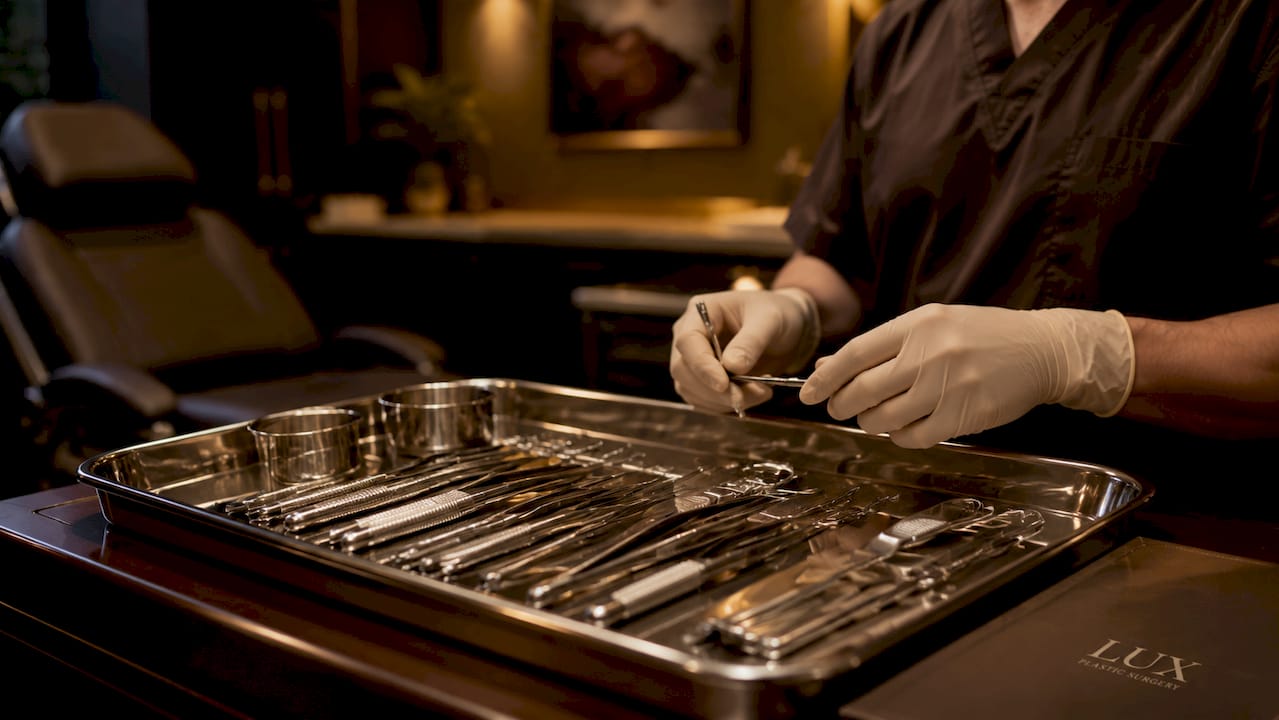
Facelift (rhytidectomy)
A facelift addresses laxity in the mid and lower face, jowls, and neck by lifting and repositioning the underlying SMAS (superficial musculoaponeurotic system) layer, not just the skin. This distinction matters: surgeons who work only on skin produce results that look pulled and fade faster. According to BAPRAS, the procedure typically takes 2–5 hours and usually requires an overnight hospital stay, with most patients resuming work after 10–14 days. Full results are assessed at 6–9 months once swelling has fully resolved.
Facelifts suit patients with moderate to significant skin laxity, typically from their mid-forties onwards, who want a lasting structural improvement rather than a subtle refresh. Lux Plastic Surgery offers facelift surgery in Bedford under the care of Professor Hindocha, whose approach prioritises natural-looking outcomes over dramatic change.
Brow lift
A brow lift repositions a descended brow line, opening the upper face and reducing the appearance of horizontal forehead lines. It is often performed alongside a facelift or upper blepharoplasty (eyelid surgery) when the brow and upper eyelid both contribute to a tired or heavy appearance. The procedure can be performed endoscopically through small incisions or via a coronal approach for more significant correction. Recovery is broadly similar to a facelift, with most swelling settling within two weeks.
Patients with a naturally low brow position or significant forehead laxity tend to see the most benefit. Those whose concern is primarily skin texture or fine lines are usually better served by non-surgical options. For detailed information on candidacy and technique, Lux Plastic Surgery’s brow lift surgery page covers the procedure in full.
Genioplasty and chin augmentation
The chin anchors the lower third of the face and has a disproportionate effect on how balanced a profile appears. Genioplasty involves surgically repositioning the chin bone itself, while chin augmentation uses an implant placed over the existing bone. Genioplasty allows three-dimensional movement, making it the preferred option when the chin needs to move forward, backward, or vertically. Implants are simpler and carry a shorter recovery, but they cannot correct vertical deficiency.
Both procedures are performed under general anaesthesia, usually as day cases, and suit patients whose chin projection is noticeably deficient relative to the nose and forehead.
Jaw contouring
Jaw contouring surgery targets the mandible, either reducing a prominent jaw angle through bone shaving or augmenting a weak jawline with implants or fat transfer. It is more commonly requested by patients seeking a softer, more oval facial outline, and by those wanting a sharper, more defined angle. The procedure requires general anaesthesia and carries a longer swelling period than soft-tissue surgery, sometimes several months before the final shape is apparent.
Fat transfer to the face
Fat transfer, or lipofilling, harvests fat from another area of the body, processes it, and injects it into facial areas that have lost volume, typically the cheeks, temples, and tear troughs. Unlike synthetic fillers, transferred fat is the patient’s own tissue, and a proportion of it integrates permanently. Results vary: typically 40–60% of transferred fat survives long-term, and a second session is sometimes needed to refine the outcome.
| Procedure | Typical duration | Hospital stay | UK cost range | Results longevity |
|---|---|---|---|---|
| Facelift | 2–5 hours | Overnight | £4,000 to over £12,000 | 7–10 years |
| Brow lift | 2–5 hours | Day case or overnight | £4,000 to over £12,000 | 5–10 years |
| Genioplasty | 2–5 hours | Day case | £4,000 to over £12,000 | Permanent (structural) |
| Jaw contouring | 2–3 hours | Overnight | £4,000 to over £12,000 | Long-term |
| Fat transfer | 2–5 hours | Day case | £4,000 to over £12,000 | Partial permanence |
Cost ranges are indicative private UK figures. Individual quotes depend on surgeon, clinic, anaesthesia, and complexity.
Non-surgical facial contouring options
Non-surgical approaches reshape and refresh the face without incisions or general anaesthesia. They suit patients who want a measured improvement, have early-stage laxity or volume loss, or are not yet ready for surgery. The trade-off is that results are temporary and require ongoing maintenance.
Botulinum toxin (Type A)
Botulinum toxin inhibits the nerve signals that cause muscle contraction, smoothing dynamic wrinkles in the forehead, between the brows, and around the eyes. In a contouring context, it can also slim a wide jaw by relaxing the masseter muscle, lift the brow slightly, and soften a downturned mouth. As BAPRAS notes, effects last 2–3 months, after which top-up treatment is needed to maintain the result.
Botulinum toxin is a prescription-only medicine in the UK. It must be prescribed following a face-to-face consultation with a qualified prescriber, and administered by a trained clinician. Patients should verify that whoever treats them holds the appropriate prescribing authority and is registered with a relevant regulatory body.
- Typical UK cost: £150–£350 per treatment area
- Onset: visible within 3–7 days, full effect at two weeks
- Suitable for: dynamic wrinkles, masseter reduction, brow lifting, lip flip
Temporary dermal fillers
Hyaluronic acid fillers are the most widely used temporary filler in the UK. Injected into the cheeks, jawline, chin, temples, or lips, they restore volume and sharpen definition without surgery. BAPRAS advises that temporary fillers last 6 months to 2 years depending on the product and the area treated, and they carry lower complication rates than permanent alternatives.
Hyaluronic acid fillers have an important safety advantage: they can be dissolved with hyaluronidase if a complication arises or the patient is unhappy with the result. Permanent fillers do not offer this option, and BAPRAS cautions that late-onset complications from permanent fillers can be difficult to treat.
- Typical UK cost: £300–£800 per syringe
- Longevity: 6 months to 2 years
- Suitable for: cheek projection, jawline definition, chin projection, lip volume, tear trough correction
Energy-based treatments
Ultherapy uses focused ultrasound energy to stimulate collagen production in the deeper layers of the skin, producing a gradual lift over three to six months. It suits patients with mild to moderate laxity who want a non-invasive option with no downtime. Results are subtler than surgery and typically last 12–18 months. Radiofrequency treatments work on a similar principle and are often combined with microneedling for skin tightening.
These treatments are best understood as maintenance tools or early-intervention options rather than alternatives to surgery for significant laxity.
- Typical UK cost: £800–£2,500 per session (Ultherapy)
- Downtime: none to minimal
- Suitable for: mild skin laxity, brow lifting, neck tightening
For a detailed walkthrough of the non-surgical pathway, Lux Plastic Surgery’s non-surgical facelift guide covers the process from consultation to aftercare.
Benefits, risks, and recovery: what to expect
Benefits
Facial contouring, whether surgical or non-surgical, can produce meaningful improvements in facial balance, proportion, and the appearance of age. BAPRAS reports that facelift surgery can set the clock back by approximately 10 years, a figure that reflects structural repositioning rather than superficial skin tightening. Non-surgical treatments offer a more modest but still visible improvement, particularly for patients in the earlier stages of facial ageing.
Beyond aesthetics, many patients report improved confidence and a greater sense of alignment between how they look and how they feel. These are legitimate motivations, though they should be weighed against realistic expectations about what each procedure can and cannot achieve.
Risks
All procedures carry risk, and facial surgery is no exception. Common risks across surgical procedures include:
- Bruising and swelling (expected and temporary)
- Infection (managed with prophylactic antibiotics)
- Scarring (minimised by surgical technique and aftercare)
- Nerve injury (rare but possible, particularly with facelift and jaw surgery)
- Asymmetry or unsatisfactory result requiring revision
- Anaesthetic complications
Non-surgical treatments carry their own risks: vascular occlusion from filler injected near a blood vessel is a rare but serious complication requiring immediate treatment with hyaluronidase. Botulinum toxin can cause temporary drooping of the eyelid or brow if placed imprecisely. Choosing a clinician with appropriate training and access to reversal agents is not optional.
Recovery
Surgical recovery is often underestimated. Sleeping upright and applying cold compresses in the first 48–72 hours reduces swelling significantly. Most facelift patients feel presentable after 10–14 days, but the face continues to change for months. Strenuous exercise, alcohol, and direct sun exposure should be avoided for at least four weeks post-operatively.
Injectable treatments require little to no downtime. Minor bruising and swelling at injection sites typically resolve within a few days. Patients should avoid intense heat, vigorous exercise, and lying flat for the first 24 hours after filler treatment.
Pro Tip: Keep a photographic record from your consultation onwards. Comparing images at one week, one month, and three months gives you and your surgeon an objective basis for assessing progress and deciding whether any refinement is needed.
Long-term maintenance
No surgical procedure stops ageing permanently. BAPRAS is clear that ongoing non-surgical interventions, such as skin resurfacing and injectables, complement surgical outcomes and help sustain results over time. Patients who combine a facelift with a considered skincare programme and periodic botulinum toxin or filler top-ups tend to maintain their results for longer than those who treat surgery as a one-time fix.
How to choose the right procedure and practitioner in the UK
The procedure matters less than the person performing it. This is not a cliché; it is the single most important variable in your outcome.
Verifying credentials
Any surgeon performing facial surgery in the UK should be on the GMC Specialist Register with a listed specialty in plastic surgery or maxillofacial surgery. Membership of BAAPS (British Association of Aesthetic Plastic Surgeons) or BAPRAS (British Association of Plastic, Reconstructive and Aesthetic Surgeons) indicates that the surgeon has met peer-reviewed standards of training and practice. For non-surgical treatments, practitioners should hold a relevant prescribing qualification and appear on a register accredited by the Professional Standards Authority (PSA), such as the Joint Council of Cosmetic Practitioners (JCCP) or Save Face.
The BAPRAS Think Over guide advises patients to ensure that consultations include a thorough discussion of risks and realistic outcomes, not just aesthetic goals. A surgeon who focuses only on what you want to look like, without discussing what could go wrong, is not giving you the full picture.
What a good consultation looks like
A thorough pre-procedure consultation should cover:
- Your medical history, medications, and any previous facial procedures
- A frank assessment of what your anatomy will and will not support
- A clear explanation of the procedure, anaesthesia, and recovery
- Written information about risks and alternatives
- Realistic before-and-after expectations, not guarantees
- A cooling-off period before you commit
Avoid any clinic that pressures you to book on the day or offers significant discounts for immediate commitment. Reputable practitioners welcome questions and support informed decision-making.
Matching procedure to face shape and goals
Not every procedure suits every face. Patients with significant jowling and neck laxity are unlikely to be satisfied with fillers alone; surgery addresses the underlying structure that injectables cannot reach. Conversely, a patient in their late thirties with early volume loss and good skin quality may achieve excellent results with fillers and botulinum toxin, deferring surgery by several years.
Face shape also guides technique. A round face with a weak chin may benefit most from chin augmentation or jawline filler to add definition. A square face with a prominent jaw angle may prefer masseter botulinum toxin or jaw reduction surgery. A skilled surgeon will map your specific anatomy before recommending anything.
Costs and financial considerations
Surgical facial contouring in the UK is a private expense for the vast majority of patients. Costs vary by procedure, surgeon seniority, clinic location, and whether anaesthesia and aftercare are included in the quoted fee. Always ask for a fully itemised quote that covers the surgeon’s fee, anaesthetist’s fee, hospital or clinic facility costs, and any follow-up appointments. Financing options are available at many private clinics, but borrowing to fund elective surgery warrants careful consideration.
For a broader overview of safe cosmetic procedure selection, Lux Plastic Surgery’s patient guide covers the key questions to ask before committing to any treatment.
Expert perspective: Professor Sandip Hindocha and Lux Plastic Surgery
Professor Hindocha’s clinical philosophy at Lux Plastic Surgery reflects a broader principle that runs through reputable facial surgery practice: the goal is balance and naturalness, not transformation for its own sake. Patients who arrive with a clear sense of what bothers them, rather than a fixed idea of a specific look, tend to have the most satisfying outcomes.
Lux Plastic Surgery operates across Bedford, London, and Manchester, offering both surgical and non-surgical facial contouring under consultant-led care. The clinic’s approach combines surgical precision with a considered programme of non-surgical maintenance, recognising that the best long-term results come from treating facial ageing as an ongoing process rather than a single event. Patients considering any facial contouring procedure are encouraged to book a consultation to discuss their options in full before making any decision.

This article is for informational purposes only and does not constitute medical advice. Consult a GMC-registered specialist before proceeding with any cosmetic procedure.
Key takeaways
Surgical facial contouring produces the most lasting structural change, but non-surgical options offer meaningful results with minimal recovery when matched carefully to the patient’s anatomy and goals.
| Point | Details |
|---|---|
| Surgery vs non-surgery | Surgical procedures address structure; non-surgical options manage volume and surface-level change. |
| Facelift results | BAPRAS reports facelifts can set the clock back by approximately 10 years, with full results visible at 6–9 months. |
| Filler safety | Temporary fillers lasting 6 months to 2 years carry lower complication rates than permanent alternatives. |
| Botulinum toxin maintenance | Effects last 2–3 months, requiring regular top-ups to maintain the result. |
| Practitioner verification | Surgeons should be on the GMC Specialist Register; non-surgical practitioners should appear on a PSA-accredited register. |
FAQ
How much does facial contouring cost in the UK?
Surgical procedures typically range from £4,000 to over £12,000 privately, depending on the procedure and clinic. Non-surgical treatments such as botulinum toxin and dermal fillers generally cost £150–£800 per session.
What procedure takes approximately 10 years off your face?
BAPRAS attributes this result to facelift surgery, which repositions the underlying facial structures rather than simply tightening skin.
What are the different types of face sculpting available?
The main types are surgical, including facelifts, brow lifts, genioplasty, jaw contouring, and fat transfer, and non-surgical, including botulinum toxin, temporary dermal fillers, and energy-based treatments such as Ultherapy.
Which facial contouring approach tends to give the best results?
The most effective approach depends on the individual’s anatomy and goals. Surgical procedures produce the most durable structural change; non-surgical treatments suit patients with early-stage concerns or those wanting to maintain surgical results over time. Combining both, under a consultant’s guidance, often produces the most natural long-term outcome.
Is facial contouring available on the NHS?
Cosmetic facial contouring is not routinely funded by the NHS. Funding is considered only in exceptional clinical circumstances, such as reconstructive needs following illness or injury.