Medically reviewed by Professor Sandip Hindocha, GMC-registered Consultant Plastic Surgeon and NHS Clinical Director. Articles are reviewed against current UK guidance from the GMC, BAAPS, BAPRAS and NICE.
TL;DR:
- Effective scar care requires early wound management, including protection, moisture, and sun avoidance, to influence long-term appearance. Consistent use of silicone, massage, and tension reduction over months enhances healing, while advanced treatments like laser or injections should be timed appropriately based on scar type. Professional assessment and tailored sequencing of therapies optimise results, especially for complex or non-responsive scars.
Scars have a way of overstaying their welcome. Whether yours is from surgery, an accident, or a skin condition, the frustration is often the same: you try something, see little change, and wonder if anything actually works. The truth is that effective scar care is not random. The step by step scar treatment process matters enormously, because what you do in the first days after injury can determine how your skin looks months or even years later. This guide walks you through the full sequence, from early wound care to advanced clinical procedures, so you can approach your scar with a clear plan rather than guesswork.
Key takeaways
| Point | Details |
|---|---|
| Start early with wound care | Cleaning, moisturising, and protecting the wound immediately after injury sets the foundation for better scar outcomes. |
| Silicone is useful but limited | Silicone gel or sheets work best as part of a combined approach, not as a standalone cure for all scar types. |
| Scar type dictates treatment | Matching your therapy to your specific scar morphology, whether hypertrophic, atrophic, or keloid, improves results significantly. |
| Advanced treatments require sequencing | Laser, injection, and resurfacing therapies are most effective when applied in a staged protocol with healing intervals. |
| Patience and consistency are non-negotiable | Most scar improvement programmes require months of adherence to see meaningful, lasting results. |
Step by step scar treatment process: laying the groundwork
The decisions you make immediately after a wound occurs or a surgical incision closes will shape your scar for life. This is not an exaggeration. Sun protection and movement limitation in the early healing phase have an outsized influence on final scar appearance, and this window is one you cannot get back.
Start with the basics: clean the wound gently with mild soap and water once or twice daily to reduce bacterial load and inflammation. Pat dry carefully. Then keep the area moist and covered with a non-stick dressing or wound gel. Moisture is often misunderstood here. The old advice to “let it air out” is not supported by modern wound care evidence. A moist environment speeds up cell migration and reduces the risk of a thick, uneven scar forming.
Here is what to avoid during this phase:
- Picking at scabs. Leaving scabs untouched allows the skin to repair in an organised fashion.
- Exposing the area to direct sunlight. UV radiation stimulates melanin production in healing tissue, which darkens scars permanently.
- Stretching or putting tension on the wound. Movement across a healing incision encourages wider, thicker scar formation.
- Applying harsh antiseptics like hydrogen peroxide or neat alcohol, which damage new tissue rather than protect it.
“The most common mistake I see is patients doing too much too soon. Cleanliness and protection, nothing more, in those first critical days.”
Pro Tip: Start using a broad-spectrum SPF 30 or higher on and around the scar as soon as the wound has closed. Continue this for at least six months, even in winter.
Silicone therapy should begin as soon as the wound is fully closed and no longer weeping. This transition point varies but is typically one to two weeks after suture removal for surgical wounds. Adherence matters here as much as timing.
Topical and manual scar care: the daily routine
Once the wound is closed and the skin is intact, you move into the active management phase. This is where the step by step scar treatment process becomes a daily habit rather than a reactive response to injury.

The recommended stepwise approach from clinical practice involves three core tools used in combination: silicone gel, surgical tape, and massage with a moisturising oil. Each has a distinct role, and together they address hydration, tension reduction, and tissue softening.
Follow this sequence daily once the wound is closed:
- Apply silicone gel or a silicone sheet to the scar for a minimum of 12 hours per day. Twice-daily application for at least two months gives the best results. Silicone gel sheeting is widely used and well tolerated, though its benefit is modest as a standalone treatment and works best as part of a broader routine.
- Apply surgical tape over the scar for four to six weeks post suture removal. Micropore or paper tape reduces mechanical tension across the scar line, which is one of the main drivers of thickened, raised scarring.
- Massage with a moisturising oil twice daily, starting approximately two weeks after suture removal. Use two fingers to apply firm but gentle circular or linear pressure for two to three minutes per session.
Why does massage work? Daily scar massage with a moisturiser over the first year softens and remodels thick scar tissue by breaking up collagen fibres and improving local circulation. Oils such as rosehip or sweet almond are commonly used, though the mechanical action matters more than the product itself.
Pro Tip: Set a daily phone reminder for your silicone and massage routine. Adherence is the single biggest predictor of whether topical therapy will work. Missing days consistently undermines even the best products.
Expect to commit to this phase for three to six months. Scar tissue remodels slowly, and visible improvement often does not appear until eight to twelve weeks into a consistent routine. This is the part where most people abandon the process prematurely. You can read more about minimising surgical scars in Luxplasticsurgery’s dedicated guide if your scar is post-operative.
Advanced interventions: laser, injections, and resurfacing
When topical and manual methods are not producing sufficient improvement, or when the scar type demands more targeted intervention, clinical treatments offer significantly more powerful options. The key principle here is what practitioners call “type-first, time-second”: scar morphology guides therapy choice, while the stage of healing dictates when that therapy can safely begin.
| Scar type | Recommended treatments | Typical timing |
|---|---|---|
| Hypertrophic | Vascular laser (PDL), steroid injections, silicone | From 6-8 weeks post wound closure |
| Atrophic (e.g. acne pits) | Fractional CO2, microneedling, chemical peels | Once skin fully healed |
| Keloid | Steroid injections, vascular laser, surgical excision | Staged, with close monitoring |
| Pigmented | IPL, Nd:YAG laser, topical agents | After inflammation resolves |
Combination laser protocols using ablative, non-ablative, vascular, and IPL lasers in sequence are now considered the standard of care for complex or mixed scars. Each laser targets a different tissue layer or chromophore, and combining them reduces the risk of side effects compared with using aggressive single-modality treatment.
Fractional CO2 laser creates microscopic columns of controlled injury in the skin, triggering a wound healing cascade that produces new, organised collagen. Multiple sessions spaced four to eight weeks apart are required, with each session building on the previous remodelling cycle. Results are cumulative, not immediate.
Additional procedural options worth understanding:
- Steroid injections (triamcinolone): Reduce collagen overproduction in hypertrophic and keloid scars. Often given monthly for three to six cycles.
- Microneedling: Creates micro-channels that stimulate collagen without significant epidermal damage. Well suited to atrophic acne scars.
- Chemical peels and dermabrasion: Resurface the outer layers to improve texture and pigmentation. Best for superficial scarring.
- Radiofrequency and platelet-rich plasma (PRP): Emerging adjunctive therapies that show promise for tissue modulation, though further research is still needed to standardise protocols.
Pro Tip: Early laser intervention matters. Timely vascular laser use in the first months after wound closure reduces the risk of hypertrophic progression and improves long-term outcomes far more than waiting until a scar has fully matured.
For anyone exploring expert laser skin resurfacing as part of their treatment plan, Luxplasticsurgery offers these procedures under the supervision of Professor Sandip Hindocha.
Monitoring progress and troubleshooting setbacks
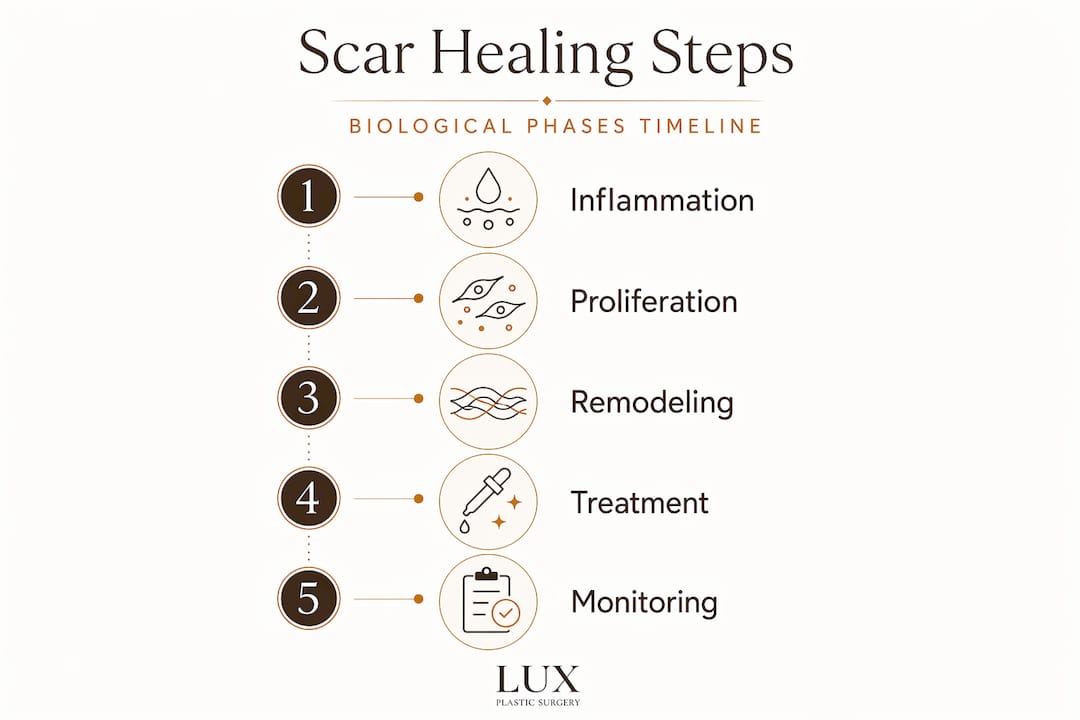
Understanding the scar healing timeline prevents panic when progress feels slow. Scars pass through three biological phases: inflammation (days one to seven), proliferation (weeks one to three), and remodelling (months one to two years). Most of the visible improvement you will achieve with any treatment happens during that remodelling window, which extends far longer than most people expect.
Tracking your progress systematically helps you and your clinician adjust the plan at the right time. Standardised photography and clinical documentation are used in clinical settings, but at home you can take a consistent photograph in the same lighting weekly to observe subtle changes in colour, texture, and dimension.
Watch for these common challenges during your scar healing steps:
- Irritation from silicone or tape: This is usually mild. Try reducing wear time and increasing gradually.
- No visible improvement after 8-10 weeks: Reassess scar type with a professional. You may need to add a clinical modality rather than continuing topical care alone.
- Darkening of the scar: Most often caused by sun exposure. Reinforce SPF use and consider a topical brightening agent.
- Pain or itching: Normal during active remodelling. Persistent or worsening pain warrants professional assessment.
- Raised or spreading scar edges: May indicate keloid tendency. Seek specialist review promptly rather than continuing self-treatment.
Setting realistic expectations is not pessimism. It is the thing that keeps people in their treatment programme long enough to see real results. Scars rarely disappear entirely. The goal of effective scar solutions is meaningful improvement in texture, colour, and height, not perfection. Emotional support matters too. For scars in visible locations, the psychological burden is real and deserves acknowledgement alongside the physical treatment plan.
My perspective on getting scar treatment right
In my experience, the biggest failures in scar treatment are not about which product or procedure someone chose. They are about sequencing and timing. I have seen people spend significant money on laser resurfacing before their wound has fully closed, and they wonder why results are poor. I have also seen people use silicone gel diligently for a year on a keloid scar and feel confused when it barely changes.
What I have learnt is this: personalised sequential therapies built around the specific scar type will always outperform generic approaches. Silicone is a useful tool, not a universal solution. The “silicone cures all” myth persists because it works well for certain scar types and certain people, but clinical evidence makes clear its limitations for larger, more established scars.
My strongest piece of advice: get a clinical assessment early, even if you plan to manage the scar at home initially. Knowing your scar type and having a mapped-out plan from the start saves time, money, and disappointment. Patience is not passive waiting. It is active, consistent, well-directed effort over time.
— Gregg
How professional care transforms scar outcomes

If your scar is not responding to home-based care, or if it was always the kind of scar that needed more than topical treatment could offer, professional support changes the equation entirely. At Luxplasticsurgery, Professor Sandip Hindocha leads a clinic that specialises in precisely this. From advanced laser protocols to scar revision surgery for more established or complex cases, the clinic provides a tailored, evidence-led approach for patients across Bedford, London, and Manchester.
Rather than working through a trial-and-error process alone, a professional consultation maps your scar type to the right treatment sequence from the outset. You can explore the full scope of what is available through Luxplasticsurgery’s overview of plastic surgery options and safety, which covers the procedures, their benefits, and what to expect throughout recovery.
FAQ
When should I start treating a scar?
Begin early wound care immediately after injury, focusing on cleanliness and moisture. Active scar treatment with silicone and massage should start as soon as the wound is fully closed, typically one to two weeks after suture removal.
Does silicone gel actually work for all scars?
Silicone gel is well tolerated and helpful for many scar types, but evidence shows it works best for smaller, stable scars when used consistently as part of a combined approach, not as the sole treatment.
How many laser sessions does scar treatment require?
This depends on scar type and severity. Fractional CO2 and other laser modalities typically require multiple sessions spaced four to eight weeks apart, as collagen remodelling is a gradual, cumulative process.
When should I see a specialist instead of treating at home?
If your scar is spreading, thickening, becoming painful, or showing no improvement after two to three months of consistent home care, seek a specialist assessment to review whether clinical intervention is appropriate.
Can natural remedies for scars replace clinical treatment?
Natural remedies such as oils and moisturisers support the healing process and are a useful part of scar management, but they cannot replicate the tissue remodelling achieved by laser, microneedling, or steroid injections for moderate to severe scars.