Medically reviewed by Professor Sandip Hindocha, GMC-registered Consultant Plastic Surgeon and NHS Clinical Director. Articles are reviewed against current UK guidance from the GMC, BAAPS, BAPRAS and NICE.
TL;DR:
- Heavy lidded eyes can result from excess skin, muscle weakness, or neurological conditions, affecting appearance and vision. Proper diagnosis is essential to choose effective treatments, which range from non-surgical options like Botox and drops to surgical procedures like blepharoplasty and ptosis repair. Consulting a specialist ensures personalised care for functional and aesthetic concerns, with staged approaches often providing the best outcomes.
If you have heavy lidded eyes, you may already know the feeling: people assume you are tired, disinterested, or even unwell, when the truth is far more complex. This appearance can stem from several distinct causes, ranging from natural ageing and excess skin to muscle weakness or even neurological conditions. Understanding what is actually happening behind your lids matters enormously, because the right treatment depends entirely on the right diagnosis. This article covers anatomy, assessment, and every credible option available to you, from a swipe of eyeliner through to surgery.
Key takeaways
| Point | Details |
|---|---|
| Causes vary significantly | Heavy lidded eyes may result from excess skin, muscle weakness, brow descent, or systemic conditions. |
| Diagnosis precedes treatment | A thorough eye examination is required before choosing any treatment to avoid mismanagement. |
| Non-surgical options exist | Prescription drops, Botox, fillers, and makeup techniques can all offer meaningful improvement without surgery. |
| Surgery delivers lasting results | Upper eyelid blepharoplasty and ptosis repair are reliable, outpatient procedures with high satisfaction rates. |
| Sudden changes need urgent review | A rapid onset of droopy eyelids can signal a neurological emergency and requires prompt medical attention. |
What causes heavy lidded eyes
To understand why your eyelids sit heavily, it helps to know what keeps them lifted in the first place. The upper eyelid is raised primarily by the levator muscle, which attaches to the tarsal plate inside the lid. A secondary muscle, Müller’s muscle, provides additional lift under sympathetic nerve control. When either structure weakens, stretches, or loses its attachment, the lid drops. Add loose skin on top of that and the heaviness compounds.
There are several distinct causes, and they behave quite differently:
- Involutional ptosis. The most common form in adults. Age-related levator changes stretch or separate the muscle or tendon, causing the lid to fall gradually over years.
- Dermatochalasis. Excess skin accumulates in the upper lid due to ageing, genetics, or sun damage. The lid itself may sit at the correct height, but the skin overhangs it, creating a heavy, hooded look.
- Brow ptosis. The brow descends with age, pushing skin downward onto the lid. Brow descent is frequently overlooked as a contributing factor and must be addressed separately if present.
- Neurological causes. Conditions such as Horner’s syndrome, third nerve palsy, or myasthenia gravis can all produce droopy eyelids as a symptom.
- Traumatic or post-surgical causes. Prior injury, prolonged contact lens wear, or previous eye surgery can damage the levator, producing acquired ptosis in younger adults.
The symptoms go beyond appearance. Heavy eyelids covering the pupils can restrict the upper visual field, specialist to compensatory behaviours such as raising the eyebrows constantly or tilting the head backward. Over time, these postures cause tension headaches and neck strain. This distinction between cosmetic concern and functional impairment matters greatly when considering treatment pathways.
Medical assessment and when to seek help
Not every case of heavy lidded eyes requires a hospital visit, but every case deserves a proper evaluation before treatment begins. Identifying the cause is the single most important step, because a treatment that works beautifully for excess skin may do nothing at all for genuine muscle weakness, and vice versa.
A typical assessment follows this sequence:
- Visual history. The clinician asks how long the heaviness has been present, whether it has progressed, and whether it affects vision or varies throughout the day.
- Margin reflex distance measurement. This measures how far the lid sits from the centre of the pupil, giving an objective grading of any ptosis present.
- Levator function test. The examiner measures how far the lid travels when looking from down gaze to up gaze. Poor excursion suggests significant muscle weakness.
- Assessment of brow position and skin laxity. This determines whether the heaviness originates in the lid itself, the skin, or the brow.
- Additional investigations. Blood tests and imaging may be ordered if a systemic or neurological cause is suspected.
Red flags that demand urgent attention include: sudden onset of ptosis in one eye, ptosis accompanied by double vision or a dilated pupil, and any association with limb weakness or facial drooping. Sudden ptosis with neurological signs can indicate a vascular event or compressive lesion and requires same-day emergency assessment.
Pro Tip: If your heavy lids are worse at the end of the day or fluctuate hour to hour, mention this specifically to your clinician. Variable ptosis is a classic feature of myasthenia gravis and changes the entire diagnostic workup.
Non-surgical options worth knowing about
Many adults with heavy lidded eyes achieve meaningful improvement without going near a theatre. The key is matching the intervention to the cause and maintaining realistic expectations about the degree of change achievable.
- Oxymetazoline eye drops. A prescription option that stimulates Müller’s muscle to lift the lid by approximately 1 to 2 millimetres. The mechanism targets Müller’s muscle specifically, which means it works only for acquired ptosis with an intact sympathetic nerve supply. It will not help if your issue is excess skin, brow descent, or neurological damage. Daily application is required and the effect stops when you stop using the drops.
- Botox for brow lifting. Small doses of botulinum toxin injected beneath the brow tail relax the depressor muscles, allowing the frontalis to pull the brow upward. The result is a subtle lift that opens the eye without touching the lid at all. This is particularly effective for brow ptosis contributors.
- Dermal fillers. Volume loss in the brow and upper orbital area accelerates the appearance of hooding. Fillers and volume restoration can support the brow, reduce hollowness, and create a more open, rested appearance.
- Skin tightening treatments. Radiofrequency and ultrasound devices can tighten lax upper lid skin to a modest degree. Results are gradual and suit patients with early-stage dermatochalasis rather than significant excess.
- Makeup techniques. For those not yet ready for treatment or wanting to manage appearance day-to-day, specific techniques make a substantial difference. A light concealer on the brow bone, a darker shadow in the crease to create depth, and avoiding heavy product on the mobile lid all help visually counteract the hooded look.
Pro Tip: Non-surgical treatments work best as early interventions or adjuncts to surgery rather than replacements for it. If your lids are significantly affecting your vision, do not delay a surgical assessment in favour of trying drops or Botox first.
Surgical options: blepharoplasty and ptosis repair
For adults with moderate to severe heavy lids, surgery remains the most reliable and long-lasting solution. Two distinct procedures are commonly used, and understanding which one applies to your situation is critical.
Upper eyelid blepharoplasty
This procedure addresses dermatochalasis: excess skin, and sometimes fat, in the upper lid. The surgeon places an incision within the natural eyelid crease, removes the redundant tissue, and closes with fine sutures. Upper eyelid blepharoplasty is typically performed as an outpatient procedure taking approximately 20 minutes per eye. The result is a brighter, more open eye with a natural crease rather than a cosmetically operated appearance.
Ptosis repair surgery
Where the problem is genuine levator muscle weakness, blepharoplasty alone will not correct the lid height. Ptosis repair involves shortening or reattaching the levator muscle. A key advantage of performing this under local anaesthesia is that intraoperative lid height adjustment can be made with the patient awake and cooperative, allowing the surgeon to match both lids precisely and reduce revision rates. Ptosis repair goals include restoring normal lid height, symmetry, and comfortable eye closure.

The table below summarises what to expect from each surgical option:
| Feature | Upper blepharoplasty | Ptosis repair |
|---|---|---|
| Problem addressed | Excess skin and fat | Levator muscle weakness |
| Anaesthesia | Local or sedation | Local (preferred) |
| Procedure time | ~20 minutes per eye | 30 to 60 minutes per eye |
| Recovery period | 1 to 2 weeks | 1 to 2 weeks |
| Result longevity | Many years | Many years |
| Revision rate | Low | Low with intraoperative adjustment |
| Functional benefit | Improved visual field if vision was obstructed | Restored lid height and visual field |
Both procedures carry a small risk of dry eye, asymmetry, over or under correction, and infection, though serious complications are uncommon when performed by an experienced surgeon.
Choosing between surgical and non-surgical approaches
The choice between surgical and non-surgical treatment should never be based solely on fear of the operating table or a desire to avoid it. It should be based on cause, severity, and what you are hoping to achieve.
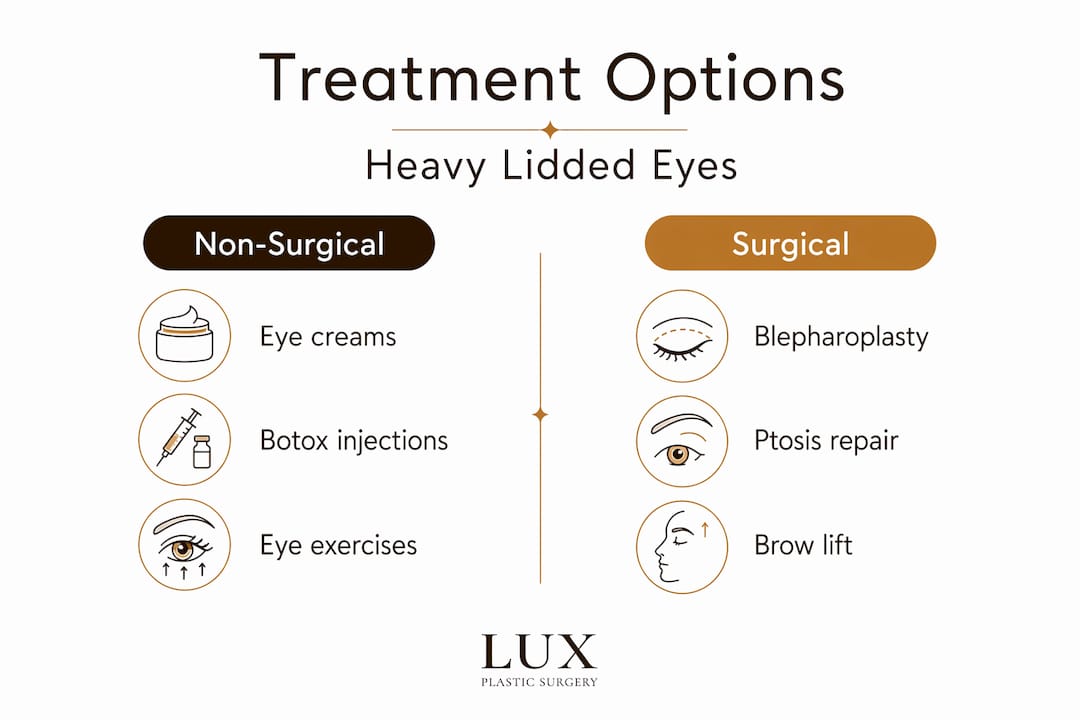
| Factor | Non-surgical | Surgical |
|---|---|---|
| Best suited for | Mild hooding, brow ptosis, early ageing | Moderate to severe excess skin or muscle weakness |
| Cost | Lower upfront, but repeat sessions needed | Higher upfront, but long-lasting |
| Downtime | Minimal to none | 1 to 2 weeks |
| Permanence | Temporary (months to 1 to 2 years) | Long-lasting (many years) |
| Functional vision improvement | Unlikely to resolve significant obstruction | Yes, where vision is affected |
A staged approach often makes the most sense. Starting with non-surgical options gives you a sense of what improvement is achievable, helps you understand your anatomy better, and can delay or reduce the extent of surgery needed later. That said, treatments effective for one cause may be ineffective or even counterproductive for another, which is precisely why consulting a specialist before committing to any pathway matters so much. Consider a brow lift assessment as part of your overall evaluation if brow descent is involved, since treating the lid alone may leave you with an incomplete result.
My experience with patients who have heavy lids
I have seen this more times than I can count: someone arrives assuming they need one thing and leaves with a completely different understanding of what is actually happening on their face. Heavy lidded eyes are genuinely one of the most misdiagnosed concerns in aesthetics, not because clinicians are careless, but because the contributing factors stack on top of each other in ways that are easy to miss at a glance.
What I have learned is that patients often underestimate the psychological weight of this concern. Feeling like you look permanently exhausted, or being told repeatedly that you look tired when you feel absolutely fine, erodes confidence in a way that is hard to articulate. That deserves to be taken seriously, not dismissed as vanity.
The patients who tend to have the best experiences are those who arrive with an open mind about the cause. Many expect to hear “it’s just skin” and are surprised when levator function testing reveals genuine muscle weakness. Others are certain they need surgery and respond brilliantly to a brow injection and some well-placed filler. The lesson: do not walk in with the treatment already decided. Walk in wanting the right answer.
My strongest advice is to see a clinician who evaluates both the functional and aesthetic picture before recommending anything. And if you notice a sudden change in lid position, especially with any other symptoms at all, get it checked the same day. Not next week.
— Gregg
Personalised eyelid treatments at Luxplasticsurgery
At Luxplasticsurgery, Professor Sandip Hindocha and his team specialise in exactly this kind of nuanced assessment. Whether your concern is cosmetic or functional, they take the time to understand what is driving your heavy lids before recommending a path forward.

From upper eyelid surgery in Bedford to non-surgical aesthetic treatments that refresh the eye area without downtime, the clinic offers bespoke options designed around your anatomy, not a template. For patients unsure where to start, the full services overview covers every available treatment alongside guidance on candidacy. Booking a consultation is the simplest and most useful first step you can take. You will leave knowing exactly what is happening and what your realistic options are.
FAQ
What are heavy lidded eyes exactly?
Heavy lidded eyes refer to an appearance where the upper eyelid sits lower than normal or excess skin overhangs the lid, creating a tired or sleepy look. The cause may be excess skin, muscle weakness, brow descent, or a combination.
Can heavy eyelids affect vision?
Yes. When the upper lid or overhanging skin covers part of the pupil, it reduces the upper visual field. This can cause compensatory head tilting and headaches and may qualify the condition as functionally significant rather than purely cosmetic.
Is blepharoplasty the same as ptosis surgery?
No. Blepharoplasty removes excess skin and fat from the upper lid, while ptosis surgery corrects the levator muscle to raise the lid height. Many patients need one or the other, and some benefit from both performed together.
When should I see a doctor urgently about droopy eyelids?
Seek same-day assessment if ptosis appears suddenly, especially if it is accompanied by a dilated pupil, double vision, facial asymmetry, or any weakness in your limbs. These symptoms can indicate a serious neurological event.
Do non-surgical treatments work for heavy lids?
They can, depending on the cause. Botox, fillers, and prescription eye drops offer genuine improvement for mild cases or brow-related heaviness. However, underlying muscle weakness or systemic illness requires medical treatment and cannot be resolved with cosmetic interventions alone.