Medically reviewed by Professor Sandip Hindocha, GMC-registered Consultant Plastic Surgeon and NHS Clinical Director. Articles are reviewed against current UK guidance from the GMC, BAAPS, BAPRAS and NICE.
TL;DR:
- Fat transfer uses your own fat for natural, long-lasting volume and contour improvements.
- It offers benefits like a natural feel, reduced rejection risk, and skin regenerative effects.
- Proper technique and aftercare are essential for optimal, lasting results and minimal complications.
Most people assume that implants and synthetic fillers are the only ways to reshape or restore volume to the body. That assumption is wrong. Fat transfer, also known as autologous fat grafting, uses fat harvested from your own body to sculpt, volumise, and rejuvenate. No foreign materials, no artificial fillers. The procedure has grown significantly in popularity across the UK because it delivers results that look and feel remarkably natural. This guide walks you through exactly how fat transfer works, where it can be applied, what benefits and risks you should understand, and how to maximise your results if you decide to proceed.
Key Takeaways
| Point | Details |
|---|---|
| Natural-looking results | Fat transfer uses your own tissue for subtle, natural enhancements with very low rejection risk. |
| Low complication rates | When performed by experts, fat transfer shows excellent safety and long-lasting results. |
| Aftercare matters | Careful recovery and weight stability improve fat survival and procedure satisfaction. |
| Not for everyone | Certain health and lifestyle factors mean fat transfer may not be suitable for some people. |
What is fat transfer and how does it work?
Fat transfer is a surgical procedure that removes unwanted fat from one area of your body, processes it, and then re-injects it into an area that needs more volume or improved contour. Think of it as intelligent redistribution. You are not introducing anything synthetic. The fat is entirely your own tissue, which makes it biologically compatible and reduces rejection risk dramatically.
The procedure is used across a surprisingly broad range of treatment areas:
- Breast augmentation and reconstruction where patients want a modest, natural-feeling increase in size without implants
- Buttock enhancement (often called the Brazilian Butt Lift or BBL) for volume and improved shape
- Facial rejuvenation including cheeks, temples, under-eyes, and nasolabial folds
- Hand rejuvenation to restore lost volume and improve skin appearance
- Post-weight-loss body contouring to correct hollowing, irregularities, or areas that have lost volume
- Breast deformity correction following previous surgery or cancer treatment
The process follows three core stages. First, gentle liposuction removes fat from a donor site such as the abdomen, thighs, or flanks. The technique used matters enormously here. Atraumatic, low-pressure harvesting preserves fat cell viability. Second, the extracted fat is purified. This can involve centrifugation (spinning the fat at high speed to separate it from blood, fluid, and dead cells) or filtration methods. Third, the purified fat is carefully re-injected into the target area using fine cannulas in small droplets, known as micro-aliquot injections, to encourage blood supply and maximise the number of surviving cells.
Advanced techniques have significantly improved outcomes over the years. Advanced methodologies now include the Coleman technique, microfat and nanofat grafting (where fat is mechanically emulsified for superficial skin-quality improvements), stem cell enrichment, and micro-aliquot injections, all of which improve the precision and longevity of results. Nanofat, for example, is particularly valuable for improving skin texture and fine lines in areas like the under-eye region.
| Treatment area | Primary benefit | Typical donor site |
|---|---|---|
| Face | Volume restoration, skin quality | Abdomen, thighs |
| Breast | Natural augmentation, reconstruction | Flanks, abdomen |
| Buttocks | Shape and volume | Abdomen, flanks |
| Hands | Rejuvenation, volume | Abdomen |
| Post-weight loss | Contouring, filling hollows | Multiple sites |
Candidates who tend to get the best outcomes are those at a stable weight, in good general health, non-smokers, and with sufficient fat stores available for harvest. If you are considering fat transfer to the body, understanding candidacy criteria before your consultation will help you ask the right questions.
Pro Tip: Ask your surgeon specifically which purification technique they use for the fat. Centrifugation and filtration each have different effects on fat cell survival rates, and this detail can meaningfully influence your long-term results.
For patients seeking volume restoration after illness, significant weight loss, or ageing, fat transfer is often considered the gold standard because it addresses both contour and tissue quality simultaneously.
Benefits of fat transfer: Why choose this technique?
The appeal of fat transfer goes well beyond the fact that it avoids synthetic materials. There is a genuine cluster of advantages that make it a distinct and often superior choice for the right patient.
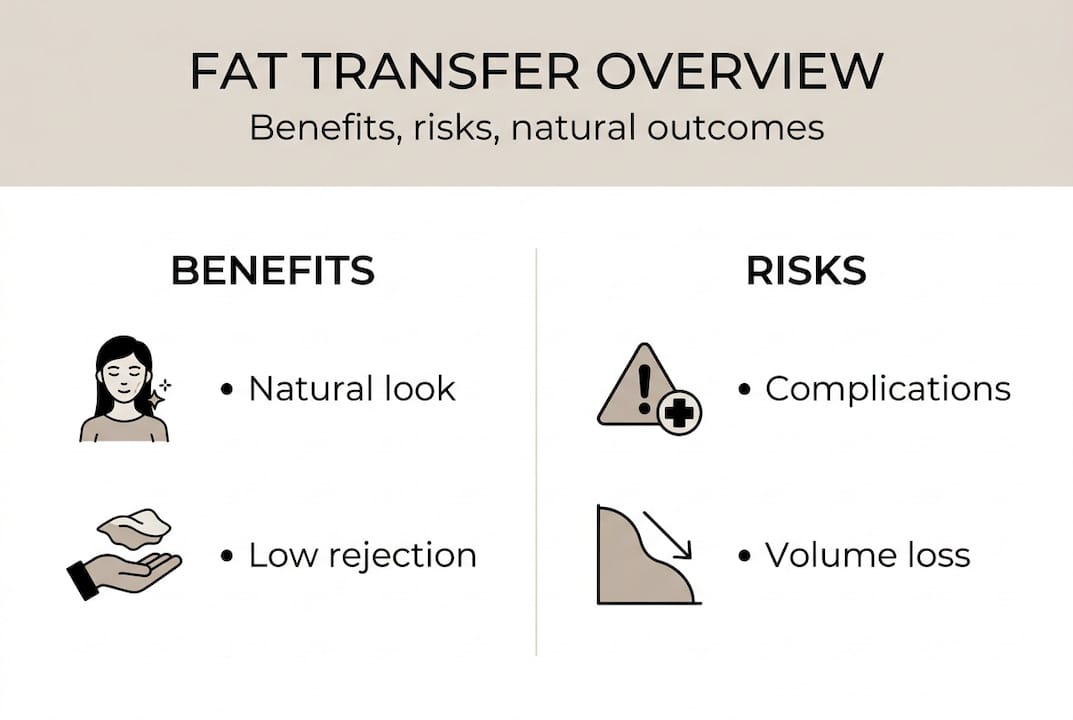
Natural look and feel. Because the tissue comes from your own body, it integrates naturally with surrounding structures. Implants, by contrast, can shift, ripple, or feel firm in ways that transferred fat simply does not. Many patients describe fat-transferred areas as feeling indistinguishable from the tissue around them.
Reduced allergy and rejection risk. Synthetic fillers carry a small but real risk of granuloma formation (where the body forms a lump around a foreign substance) or allergic reaction. Implants carry risks of capsular contracture (where scar tissue tightens around the implant). Because fat transfer uses your own biological material, these specific risks do not apply.
Dual benefit: sculpting and adding volume at once. One of the most underappreciated advantages of fat transfer is that you are simultaneously contouring the donor area and enhancing the target area. A patient who has lower abdominal fat they want reduced and wants fuller cheeks can achieve both goals in a single procedure.
Regenerative skin improvements. This is where fat transfer really separates itself from conventional fillers. Transferred fat contains stromal vascular fraction and adipose-derived stem cells. These cells have regenerative effects that actively improve skin quality and vascularity in the treated area, which is why patients often notice smoother, brighter skin in addition to the volumising effect.
Minimal visible scarring. Liposuction entry points are typically a few millimetres long. Injection sites are equally small. Compared with implant surgery, which requires incisions several centimetres long, the scarring profile of fat transfer is dramatically lower.
“Fat transfer is one of the few procedures that genuinely improves the body in two places at once. Patients gain contour where they wanted less, and fullness where they wanted more. The skin benefits are often a pleasant surprise.”
When reviewing body contouring options, many patients initially overlook fat transfer in favour of implants or non-surgical treatments. However, for those who qualify, the satisfaction rates are high, particularly when carried out by surgeons experienced in advanced grafting techniques. Patient satisfaction studies consistently show that the naturalness of results is the most commonly cited reason people prefer fat transfer over alternatives.
Risks, complications, and who should avoid fat transfer
Transparency matters when you are making a surgical decision. Fat transfer is not without risks, and understanding them helps you enter any consultation informed and confident in your questions.
Common complications include:
- Fat necrosis: Dead fat cells can form firm lumps beneath the skin. In breast fat transfer, these may appear on mammograms and resemble abnormalities, leading to higher recall rates for additional investigation.
- Cysts and calcifications: Pockets of fluid or calcified fat deposits can develop over time.
- Infection: As with any surgical procedure, infection is a possibility, though generally manageable with proper antibiotic protocols.
- Asymmetry: Uneven fat survival on each side can result in visible differences in volume.
- Donor site irregularities: The area where fat is harvested can develop contour irregularities if not performed carefully.
- Prolonged swelling and bruising: These are expected to some degree but occasionally persist longer than anticipated.
Rare but serious complications include pneumothorax (a collapsed lung, reported in approximately 0.1% of cases) and fat embolism, where fat enters the bloodstream. These are exceptionally rare but underscore why surgeon expertise and clinical environment matter.

| Complication | Approximate rate |
|---|---|
| Overall complications | 4.2% |
| Fat necrosis | 0.7% |
| Infection | 1.0% |
| Cysts or calcifications | 0.6% |
| Breast-specific complications | 7.5% |
| Pneumothorax | 0.1% |
Who should NOT consider fat transfer:
- Active smokers (smoking impairs blood supply, reducing fat cell survival and increasing infection risk)
- Those planning significant weight changes after surgery (weight loss will reduce the transferred fat volume)
- Individuals with insufficient fat stores in donor areas
- Those with unstable underlying health conditions
- Anyone seeking very large volume increases (fat transfer has limits in how much volume can be reliably achieved in one session)
Before proceeding, it is worth reviewing the safety steps for cosmetic surgery that any reputable clinic will follow. For breast-specific cases, understanding what distinguishes fat transfer from a conventional safe breast augmentation procedure is equally important.
Pro Tip: If you are considering breast fat transfer, inform your mammography team about your surgical history. This allows radiologists to interpret imaging correctly and avoids unnecessary follow-up investigations related to benign fat necrosis.
Maximising your results: What most people miss about aftercare and candidacy
Most of the conversation around fat transfer focuses on the surgery itself. Far less attention goes to what happens after, and yet aftercare is arguably where a large proportion of outcomes are won or lost.
Here are the most important steps for protecting your results:
- Avoid pressure on treated areas. In breast and buttock fat transfer especially, pressure on the newly transferred fat can reduce blood supply before the fat cells have integrated. Specialist cushions or pillows are often recommended to offload pressure during sitting or lying.
- Do not smoke. Not just before surgery. Smoking in the weeks and months after surgery impairs the formation of new blood vessels that the transferred fat depends on for survival.
- Maintain stable weight. Fat cells respond to weight changes just as native fat does. If you lose significant weight post-operatively, you will lose volume in the transferred area too.
- Follow compression garment guidance. For donor areas, compression garments reduce swelling, improve skin retraction, and minimise contour irregularities.
- Plan for staged sessions if appropriate. Some patients achieve their goals in a single session. Others benefit from a second or third round to build further volume gradually.
The evidence on staged procedures is compelling. Fat survival rates reach approximately 73% after five or more sessions compared with just 45 to 50% after one or two sessions, which illustrates why patience and planning are genuine clinical strategies, not just reassurances.
Realistic expectations are essential. Some volume loss in the first three to six months is entirely normal as the body reabsorbs a portion of the transferred cells. The fat that remains after this initial settling period tends to be stable and long-lasting. This is very different from hyaluronic acid fillers, which the body metabolises fully within 12 to 18 months.
Good aftercare for plastic surgery also includes attending all follow-up appointments, reporting any unusual symptoms early, and giving your body adequate nutrition and rest during recovery. If you want more detailed guidance, resources on plastic surgery recovery tips cover the practical day-to-day steps that support quicker, smoother healing.
Pro Tip: Schedule your surgery when you can genuinely rest for at least two weeks. Returning to demanding physical activity too early increases swelling and can compromise fat survival in the critical early healing phase.
The crucial difference: Why fat transfer isn’t just another filler
Here is something that rarely gets said plainly in cosmetic surgery discussions. Fat transfer is not simply a “natural version” of a filler. It is a fundamentally different category of procedure, and treating it like a simple swap-out leads patients to underestimate its complexity and overestimate its interchangeability with non-surgical options.
Fillers are temporary. They volumise. They disappear. Fat transfer, done well, integrates permanently into living tissue. The regenerative component, driven by stem cells within the fat, does not just fill space. It actively improves the tissue environment. Patients often describe skin in treated areas as looking healthier, brighter, and more youthful in ways that go beyond what volume alone could explain.
What truly separates excellent outcomes from mediocre ones is not the patient’s luck. It is the surgeon’s technique and the protocols used before, during, and after surgery. Shortcuts in harvesting, processing, or injection lead to poor fat survival and unsatisfying results. Selecting personalised fat transfer treatments from an experienced specialist is not a luxury consideration. It is a clinical necessity.
Patient selection is equally decisive. No technique compensates for poor candidacy. Surgeons who take the time to decline inappropriate patients protect both outcomes and reputations.
Ready to take the next step? Trusted fat transfer and contouring options
If this guide has helped you understand fat transfer more clearly, the natural next step is a consultation with a specialist who can assess your candidacy and discuss realistic outcomes for your specific goals.
At Lux Plastic Surgery, Professor Sandip Hindocha and his team offer personalised fat transfer and body contouring procedures tailored to your anatomy and aesthetic goals, across clinics in Bedford, London, and Manchester. With an emphasis on safety, advanced technique, and natural-looking results, the team provides the expert care and honest guidance that decisions of this kind genuinely require. You can also explore wider aesthetic medicine options to understand which combination of treatments might be most suitable for you.
FAQ
How long do fat transfer results last?
Results can last for many years, with research showing 53.1% fat retention at three or more years in facial cases when proper technique is applied. The fat that survives the initial three to six months post-surgery tends to remain stable long term.
Is fat transfer safe compared to implants or fillers?
Fat transfer carries an overall complication rate of approximately 4.2%, which compares favourably with implant surgery, though expert technique and appropriate candidacy selection remain critical to achieving safe outcomes.
Can fat transfer be combined with other procedures?
Yes. Fat transfer is frequently combined with breast reconstruction, facelift surgery, or skin resurfacing to achieve more comprehensive rejuvenation or contouring outcomes in a single surgical setting.
Who should NOT have fat transfer surgery?
Individuals who smoke, are planning significant weight changes, or do not have adequate fat stores available for harvesting are generally not suitable candidates for fat transfer surgery.