Medically reviewed by Professor Sandip Hindocha, GMC-registered Consultant Plastic Surgeon and NHS Clinical Director. Articles are reviewed against current UK guidance from the GMC, BAAPS, BAPRAS and NICE.
TL;DR:
- A non-surgical facelift involves a structured process that includes consultation, treatment with injectables and energy-based devices, and post-treatment care. It requires careful assessment, personalised protocols, and maintenance sessions to achieve natural, subtle results over time. The success depends heavily on qualified practitioners prioritising safety, realistic expectations, and a comprehensive treatment plan.
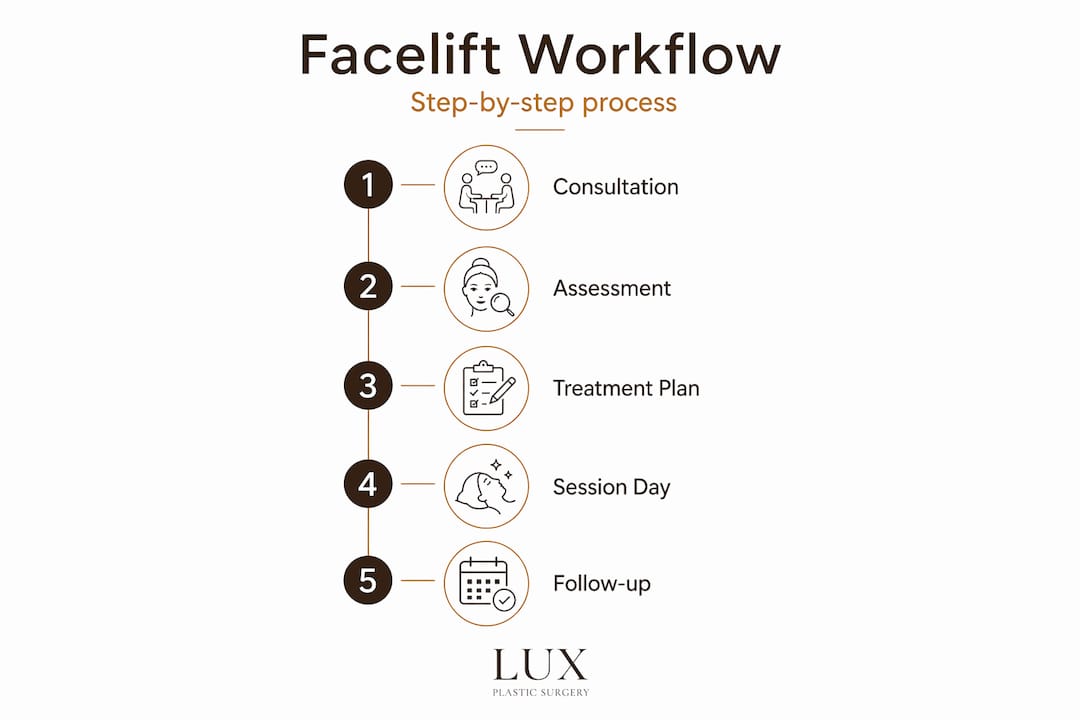
If you are weighing up the idea of facial rejuvenation but surgery feels like a step too far, understanding the non-surgical facelift workflow gives you the clarity to make a genuinely informed decision. In clinical terms, this is often called a non-invasive facelift process or a minimally invasive facial rejuvenation programme, and it covers everything from your first consultation right through to post-treatment care. This guide breaks down every stage so you know exactly what to expect, what questions to ask, and how to assess whether the results you see match the results you were promised.
Key takeaways
| Point | Details |
|---|---|
| Consultation is non-negotiable | A structured, face-to-face consultation is the foundation of any safe non-surgical facelift programme. |
| Combined modalities outperform single treatments | Pairing injectables with energy-based devices produces more natural, longer-lasting lifting effects. |
| Results develop over weeks | Collagen remodelling takes time; visible improvement often peaks at three to six months post-treatment. |
| Maintenance is part of the plan | Non-surgical facial rejuvenation requires repeat sessions over time, so factor in lifetime costs from the start. |
| Choose a qualified practitioner | The practitioner’s credentials and the quality of their consultation directly determine your safety and outcome. |
The non-surgical facelift workflow: before you begin
Before a single product is placed or a device switched on, qualified practitioners follow a structured preparation protocol. This is not a formality. It is the stage that separates a safe, satisfying outcome from a preventable complication.
A thorough pre-treatment process typically includes:
- Medical history review. Practitioners assess medications, previous aesthetic treatments, skin conditions, and contraindications such as autoimmune disorders. Knowing who should not use certain modalities matters as much as knowing who will benefit from them.
- Suitability and eligibility assessment. Not every patient is a candidate for every technique. Bone structure, skin quality, degree of laxity, and age all influence which combination of treatments will deliver results.
- Informed consent. 94.3% of aesthetic practitioners regard informed consent as a non-negotiable requirement in non-surgical aesthetic practice. You should receive a clear, written explanation of risks, benefits, and realistic outcomes before agreeing to anything.
- Psychological screening. This step is less universally adopted but increasingly recognised as important. 61.4% of practitioners support psychological screening as mandatory, particularly to identify patients whose expectations cannot realistically be met, or those who may present with body dysmorphic disorder.
- Expectation management. A good practitioner will show you before-and-after imagery relevant to your skin type and age, and be honest about what non-surgical techniques can and cannot achieve.
Structured frameworks such as the SAGA model screen physical, psychological, and aesthetic factors in a single consultation. These frameworks improve clinical decision-making and aftercare quality significantly. You can read more about how consultations shape outcomes at Lux Plastic Surgery’s resource hub.
Pro Tip: Ask your practitioner which consultation framework they use and whether psychological screening is part of their standard process. If they cannot answer, that tells you something important.
Treatment techniques: what the workflow uses
The facelift without surgery steps you experience in the treatment room are built around two broad categories of technique: injectables and energy-based devices. Understanding what each does helps you follow what is happening and why.
Injectables: fillers and botulinum toxin
Dermal fillers, typically hyaluronic acid-based, restore volume to areas such as the cheeks, temples, and jawline. When placed correctly, they produce a subtle lifting effect by repositioning sagging tissue rather than simply adding bulk. Botulinum toxin targets overactive muscles, softening lines around the eyes and forehead while contributing to an overall lifted appearance.
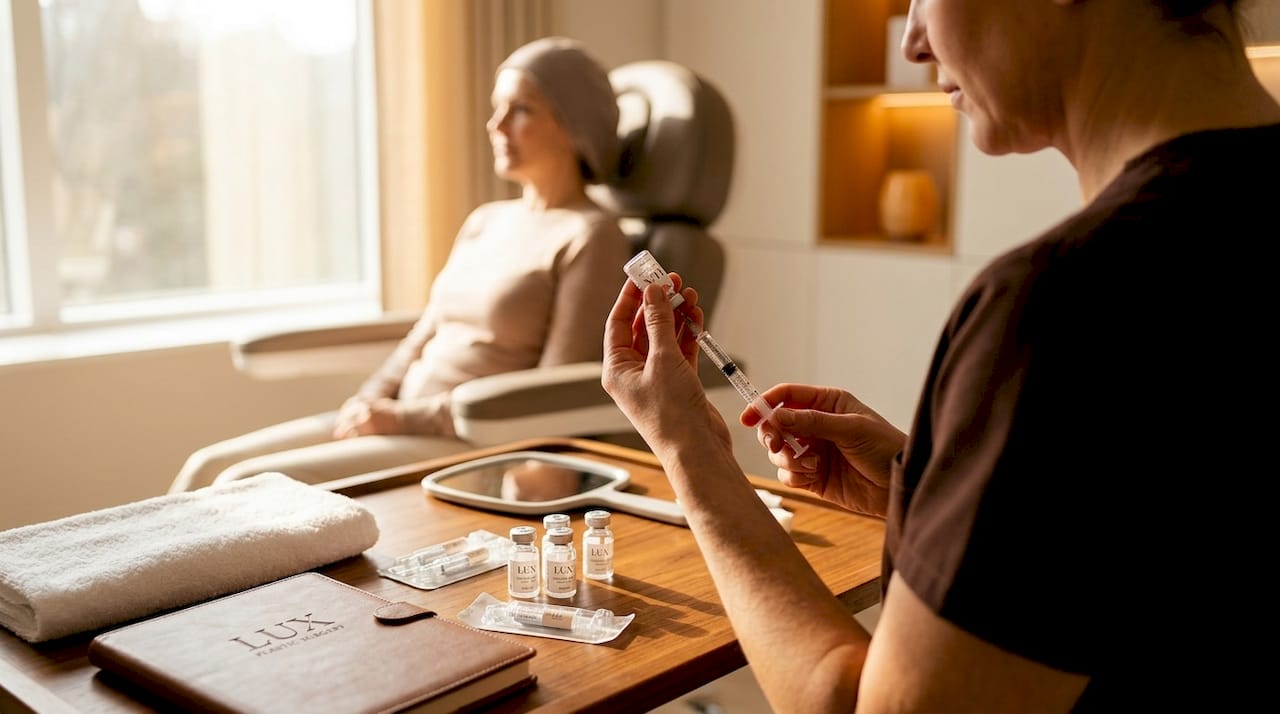
These two work differently at a tissue level. Fillers replace what age has taken away. Botulinum toxin relaxes what tension has exaggerated. Together, they address both volume loss and dynamic movement, which are the two primary drivers of an aged appearance. Different techniques act on multiple tissue layers, specialist to cumulative rejuvenation effects that neither achieves alone.
Energy-based treatments
Radiofrequency (RF), microfocused ultrasound (HIFU), and laser modalities work by heating tissue at varying depths. RF targets the deeper dermal and subdermal layers to contract existing collagen and stimulate new production. HIFU reaches the SMAS layer, the same layer addressed in surgical facelifts, without breaking the skin. Laser treatments target the superficial dermis, improving skin texture, tone, and fine lines.
A dual-modality approach using laser and microfocused ultrasound has been shown to produce greater improvement in wrinkle scores and skin laxity at six months compared with either treatment used alone. The Fitzpatrick Wrinkle Scale dropped from 1.88 to 1.13, a clinically meaningful change.
Pro Tip: When comparing clinics, ask whether they personalise the combination of modalities to your anatomy or apply a one-size-fits-all protocol. The former consistently produces more natural-looking results.
| Treatment type | Target tissue layer | Downtime | Session duration | Longevity of results |
|---|---|---|---|---|
| Dermal fillers | Mid to deep dermis | Minimal (24–48 hours) | 30–60 minutes | 9–18 months |
| Botulinum toxin | Neuromuscular junction | None | 15–30 minutes | 3–6 months |
| Radiofrequency | Deep dermis and subdermal | Minimal | 45–75 minutes | 12–24 months |
| Microfocused ultrasound (HIFU) | SMAS and deep dermis | Minimal | 60–90 minutes | 12–18 months |
| Laser resurfacing | Superficial to mid dermis | Moderate (3–7 days) | 30–60 minutes | 1–3 years |
Step-by-step: what happens during the session
Understanding the minimally invasive facelift techniques used is one thing. Knowing exactly how a session unfolds is what makes the difference between walking in anxious and walking out confident.
- Topical anaesthetic application. Where RF or ultrasound devices are used, a numbing cream is applied approximately 20 minutes before treatment begins. This timing is clinically specified to allow full absorption and comfort during the procedure.
- Facial assessment and mapping. Your practitioner reviews your consultation notes and maps the specific areas to be treated based on your anatomy. No two faces are identical, and the treatment plan should reflect yours specifically.
- Treatment delivery. For an RF session, approximately 1,200 shots are delivered over 25 to 30 minutes, with total appointment time around one hour. For injectable treatments, the practitioner works through mapped zones in a precise order, checking symmetry throughout.
- Comfort monitoring. Most patients tolerate RF procedures without sedation, and any redness typically resolves before leaving the clinic. Your practitioner should check in with you regularly during the session rather than working in silence.
- Post-treatment protocols. Immediately after the session, you will receive specific aftercare instructions: avoid heat, direct sun exposure, and active skincare ingredients such as retinoids for 24 to 48 hours. Ice packs and gentle massage may be advised depending on the treatment used.
- Combining modalities in one session. When injectables and energy-based treatments are planned together, practitioners typically perform energy-based treatments first, as the heat can affect filler distribution. This sequencing is clinically significant, not cosmetic preference.
Pro Tip: If a clinic offers same-day consultations followed immediately by treatment, be cautious. Reputable practitioners separate the consultation from the procedure to give you time to consider and consent properly.
You can explore what the non-surgical treatment process looks like in practice through Lux Plastic Surgery’s patient resources.
Results, timelines, and what to expect long term
How does a non-surgical facelift work in terms of results? The answer depends on which mechanism is doing the work.
Injectables produce visible results within days. Volume is restored, lines are softened, and the face looks refreshed almost immediately. Energy-based treatments work differently. RF and HIFU trigger a wound-healing response in the tissue, which means collagen remodelling continues for three to six months after the session. The best results often appear well after the treatment is forgotten.
Key expectations to set before you begin:
- Improvement, not transformation. Non-surgical approaches produce subtler changes than surgical facelifts. They work best on mild to moderate laxity, not advanced ptosis.
- Results are not permanent. Fillers last between nine and eighteen months. RF and HIFU results typically last twelve to twenty-four months. Patients should consider lifetime costs rather than single-session pricing when comparing non-surgical and surgical options.
- Maintenance is part of the programme. Most patients require repeat sessions annually or biannually to maintain results. A good practitioner will build this into your treatment plan from the start.
- Side effects are generally mild. Swelling, bruising, and temporary redness are common. Serious complications such as vascular occlusion from fillers are rare but possible when practitioners are not adequately trained.
- Success is measurable. Practitioners can use validated scales such as the Fitzpatrick Wrinkle Scale and the Baker Gravitational Ptosis Classification to objectively assess improvement across sessions, giving you evidence-based markers rather than subjective impressions.
My perspective on what actually matters
I have watched the non-surgical facial rejuvenation sector evolve considerably, and one thing stands out above every device upgrade and new formula. The consultation is where outcomes are decided.
In my experience, the most technically accomplished treatment delivered after a poor consultation still leads to disappointment. Either the patient expected something the procedure could not deliver, or a contraindication was missed, or the wrong modality was chosen for that person’s specific anatomy. None of that is recoverable with aftercare.
What I find genuinely exciting is the move towards combination protocols. Treating the face as a single, multi-layered system rather than isolated wrinkles or volume pockets produces results that look natural rather than cosmetically obvious. A filler placed to lift the cheek changes how the jawline reads. An RF session six weeks later tightens the surrounding tissue and extends the effect. This sequencing is both an art and a science.
The most important thing I would tell anyone considering the steps for a non-surgical facelift is this: the practitioner’s credentials and their willingness to say “no” matter more than the equipment they own. Clinics with every device available but no structured patient safety framework are the ones that generate headlines for the wrong reasons. Prioritise the quality of the conversation before you ever prioritise the treatment menu.
— Lux
How Lux Plastic Surgery approaches non-surgical rejuvenation

At Lux Plastic Surgery, every non-surgical facial rejuvenation consultation is structured, face-to-face, and conducted by a qualified specialist before any treatment is agreed. Professor Sandip Hindocha brings award-winning expertise to each patient assessment, considering anatomy, skin condition, and individual goals to produce personalised treatment plans, not templated protocols. Whether you are exploring dermal fillers, energy-based lifting, or a combined approach, the clinic’s commitment is to natural-looking, safely delivered results grounded in clinical evidence. If you are ready to understand your options properly, selecting the right clinic is the most important step you can take.
FAQ
What is a non-surgical facelift workflow?
A non-surgical facelift workflow is the structured, step-by-step process of achieving facial rejuvenation without surgery, covering consultation, treatment delivery using injectables or energy-based devices, and post-treatment care. It is the clinical equivalent of facelift without surgery steps followed by qualified aesthetic practitioners.
How long does a non-surgical facelift session take?
Sessions vary by modality, but a typical RF lifting appointment takes approximately one hour, including 20 minutes for topical anaesthetic and 25 to 30 minutes of active treatment. Combined injectable and energy-based sessions may take longer depending on the areas treated.
When do non-surgical facelift results become visible?
Injectable results appear within days. Energy-based treatments such as RF and HIFU stimulate collagen remodelling, meaning results develop gradually and typically peak at three to six months after treatment.
How many sessions are needed?
Most patients require at least two to three sessions over twelve months to maintain optimal results, depending on the modalities used and the degree of laxity being addressed. Maintenance should be planned from the outset rather than treated as optional.
Is psychological screening necessary before a non-surgical facelift?
While not universally adopted, psychological screening is supported as mandatory by 61.4% of aesthetic practitioners and is recommended best practice for identifying patients whose expectations or psychological profile may make treatment unsafe or unsatisfying.