Breast augmentation is far more common than many people realise, yet persistent myths and outdated fears continue to cloud the conversation. Whether you are curious about the procedure for the first time or have been quietly considering it for years, sorting fact from fiction matters enormously. Breast augmentation is the most popular cosmetic surgery in the UK, which means thousands of women just like you are navigating the same questions. This article covers the real data, the genuine benefits, the risks you need to understand, and why expert, personalised guidance is the single most important factor in getting the outcome you want.
Key Takeaways
| Point | Details |
|---|---|
| Widespread procedure | Breast augmentation is the most popular cosmetic surgery for UK women, with procedures rising yearly. |
| Personalised reasons vital | Women choose breast augmentation for various personal goals, making expert, tailored advice essential. |
| Implants need maintenance | Most implants last 10–20 years and require ongoing monitoring for safety. |
| Risks and reality check | Understanding surgery risks and NHS guidance helps set realistic expectations and ensures lasting satisfaction. |
| Support impacts outcomes | Selecting the right clinic and having strong aftercare support are key to a positive breast augmentation experience. |
How common is breast augmentation in the UK?
If you have ever felt alone in considering breast augmentation, the numbers tell a very different story. Over 5,000 BAAPS procedures and up to 66,000 annually are performed in the UK each year, making it the most sought-after cosmetic surgery in the country. That figure spans private clinics, independent hospitals, and practitioners outside the BAAPS membership, which means the true scale of demand is considerable.
Several factors are driving this sustained interest. Improved surgical techniques have made results look more natural than ever before. Greater openness about cosmetic procedures on social media and in mainstream culture has reduced stigma significantly. Financing options have made the procedure more accessible to a broader range of women. Together, these shifts have moved breast augmentation from a niche conversation into a mainstream one.
Breast augmentation consistently tops the UK’s annual cosmetic surgery statistics, reflecting how widely women are choosing to invest in their confidence and wellbeing.
The motivations behind each decision are as varied as the women making them. Some women seek breast augmentation surgery to restore volume lost after pregnancy or breastfeeding. Others want to address a natural asymmetry that has affected their confidence for years. Many simply feel that their body does not reflect how they see themselves, and augmentation offers a way to align the two.
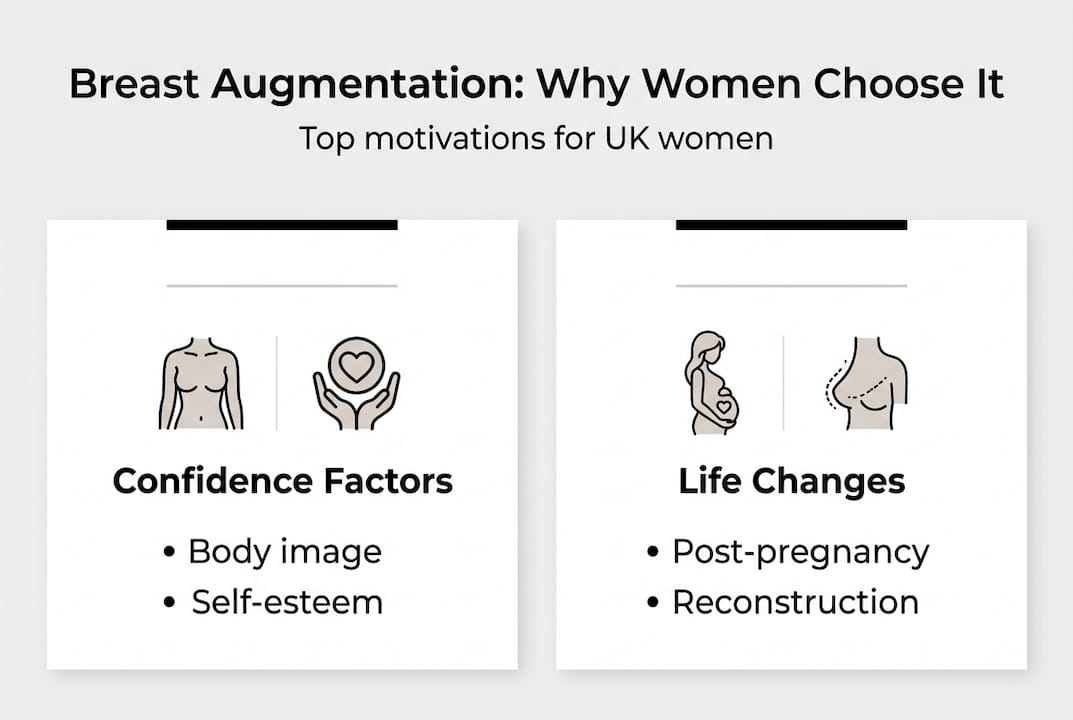
| Motivation | Percentage of patients (approximate) |
|---|---|
| Boosting body confidence | 45% |
| Restoring post-pregnancy shape | 30% |
| Correcting asymmetry | 15% |
| Other personal reasons | 10% |
Understanding why so many women choose this path helps remove the judgement that sometimes surrounds the decision. Among the popular cosmetic procedures available in the UK, breast augmentation stands out not just for its frequency but for the consistently high patient satisfaction rates reported in clinical literature. It is a procedure with a long track record, and when performed by a qualified surgeon, the outcomes can be genuinely significant.
Personal reasons and benefits: is it right for you?
Once you understand why so many women consider the procedure, it is vital to explore what breast augmentation can truly offer on a personal level. The benefits are real, but they are most meaningful when the decision is grounded in honest self-reflection and professional guidance.

The most commonly reported benefit is a significant improvement in body confidence. Women describe feeling more comfortable in clothing, more at ease in intimate settings, and more aligned with their own sense of self. For women who have experienced changes after pregnancy or breastfeeding, restoration of their pre-pregnancy shape can feel deeply personal and emotionally significant. Correcting a noticeable asymmetry, where one breast is considerably larger or differently shaped than the other, is another powerful motivator that is often underestimated.
Psychological outcomes are generally positive when expectations are realistic. Research consistently shows that patient satisfaction is highest among women who enter the process with clear, achievable goals rather than a desire to replicate someone else’s results. A personalised consultation with a GMC-registered surgeon is essential to match the procedure to your lifestyle, body type, and goals.
Here is what a thorough consultation should cover:
- Your personal motivations and what you hope to achieve
- Your current health, medical history, and any medications
- Implant type, size, shape, and placement options
- The use of 3D imaging to preview potential outcomes
- Recovery timelines and how they fit around your work and family life
- Realistic expectations about scarring, sensation changes, and longevity
Before you evaluate plastic surgery options, it is worth considering whether augmentation alone meets your goals or whether a combination approach, such as augmentation alongside breast lift options, might deliver a more satisfying result.
Pro Tip: During your consultation, specifically ask how different implant profiles and placements affect the appearance of a natural result. The answer will tell you a great deal about how well the surgeon listens and understands what you actually want.
What to know about implants: types, longevity, and monitoring
After weighing the motivations and potential benefits, understanding what breast implants actually involve lets you make more confident decisions. The technical side does not need to be overwhelming, but a solid grasp of the basics is genuinely empowering.
The two main implant types used in the UK are silicone gel and saline. Silicone implants are far more common because they feel more similar to natural breast tissue and tend to produce a softer, more realistic result. Saline implants contain sterile salt water and are generally firmer. Both come in a range of shapes, including round and anatomical (teardrop), and in varying profiles from low to high projection.
Implants generally last 10 to 20 years and are not lifetime devices. This is one of the most important facts to absorb before committing. The idea that implants are a one-time procedure is a persistent myth. Most women will need at least one revision or implant removal or exchange during their lifetime.
The UK now has the Breast and Cosmetic Implant Registry (BCIR), which records implant details for every patient. This means that if a safety issue arises with a particular implant brand or batch, you can be contacted directly. It is a meaningful step forward for patient safety.
| Implant type | Feel | Common use case |
|---|---|---|
| Silicone gel | Soft, natural | Most augmentation cases |
| Saline | Firmer | Specific size adjustments |
| Round | Symmetrical fullness | Upper pole enhancement |
| Anatomical | Graduated shape | Natural-looking results |
Here is what to ask your surgeon about implants:
- Which implant type and profile suits my body frame?
- Where will the incision be placed and why?
- What monitoring will I need after surgery, including MRI scans?
- How will I know if there is a problem with my implant?
- What does revision surgery involve and how is it costed?
Regular monitoring, typically including MRI scans every few years for silicone implants, is strongly recommended. Your surgeon should build this into your aftercare plan from the outset.
Risks, limitations, and NHS perspective: what you need to weigh
Knowing the technical details is only part of the decision. Understanding possible risks and the realities from the NHS perspective is equally crucial before you commit.
Risks include capsular contracture, rupture, BIA-ALCL, and sensation changes, and the NHS is clear that breast augmentation is a lifelong commitment, not a single event. Here is a breakdown of the key risks:
- Capsular contracture: The scar tissue around the implant hardens, causing discomfort or distortion. This affects approximately 5 to 15% of patients.
- Rupture: Silicone implants can rupture silently without obvious symptoms. Studies suggest up to 20 to 30% of implants show some rupture at the 10-year mark.
- Infection: Serious infection occurs in fewer than 1 in 1,000 cases but requires prompt treatment.
- BIA-ALCL: A rare type of lymphoma linked to textured implants. The risk is approximately 1 in 24,000, but it is important to be aware of it.
- Sensation changes: Temporary or permanent changes in nipple or breast sensation affect a proportion of patients.
- Rippling or wrinkling: More common with saline implants or in women with very little natural breast tissue.
The NHS is explicit that cosmetic breast augmentation is not funded by public money. It is available on the NHS only for reconstructive purposes, such as following mastectomy. This means the full cost, including any future revision surgery, falls to you. Budgeting for long-term care, not just the initial procedure, is essential.
If you are also considering breast reduction information or asymmetry correction alongside augmentation, your surgeon should discuss how combining procedures affects both the risk profile and the recovery period.
Before proceeding, ask your clinic these questions directly:
- What is your personal complication rate for this procedure?
- How do you manage capsular contracture if it occurs?
- What is your protocol if I suspect a rupture?
- Are you registered with BAAPS or BAPRAS?
- What does your aftercare package include?
Why the right support makes all the difference in your journey
The data, the implant types, the risk percentages: all of it matters. But in our experience, the single biggest predictor of a positive outcome is not the implant brand or the surgical technique. It is the quality of the relationship between patient and surgeon, built on honest communication and genuine care.
Women who feel truly heard during their consultation, who are encouraged to ask difficult questions and given time to think, consistently report higher satisfaction. Those who feel rushed or sold a package without proper dialogue are far more likely to feel uncertain afterwards, regardless of the physical result.
The uncomfortable truth is that not every clinic prioritises your values above their sales targets. A surgeon worth trusting will sometimes tell you that augmentation alone is not the right answer, or that now is not the right time. That kind of honesty is rare, and it is worth seeking out. When choosing your plastic surgeon, look beyond credentials alone and pay attention to how the clinic communicates with you from your very first enquiry.
Pro Tip: Insist on clinics that offer comprehensive aftercare as a standard part of their package, not an optional extra. Ongoing support after surgery is where the real difference in outcomes is made.
Explore your options with confidential expert guidance
If you are ready to take the next step, or simply want more tailored guidance, expert support makes the journey safer and more reassuring at every stage.
At Lux Plastic Surgery, Professor Sandip Hindocha and his team offer bespoke consultations for women considering breast augmentation in Bedford and across the UK. Whether you are exploring implant options, thinking about combining augmentation with breast lift surgery, or simply want to understand what recovery after surgery looks like in practice, we are here to answer your questions without pressure. Every consultation is confidential, unhurried, and focused entirely on what is right for you.
FAQ
How long do breast implants last before replacement might be needed?
Breast implants typically last 10 to 20 years, but they are not lifetime devices. Regular monitoring allows any issues to be identified and addressed before they become significant problems.
What are the most common risks linked to breast augmentation?
The main risks are capsular contracture, rupture, and infection, along with the rare lymphoma BIA-ALCL. A thorough pre-operative discussion with your surgeon will help you understand your individual risk profile.
Will breast augmentation be covered by the NHS?
The NHS does not fund breast augmentation for aesthetic purposes. It is only available through the NHS in reconstructive cases, such as following breast cancer treatment.
How do I choose the right surgeon for breast augmentation?
Seek a GMC-registered surgeon who holds membership with BAAPS or BAPRAS, and prioritise clinics that offer a thorough, unhurried consultation process focused on your individual goals.