Ask three clinics what a mummy makeover includes and you’ll get three different answers. There’s no fixed definition, no standard package, and no agreed number of procedures.
That’s because the name describes a combined operation, not a single surgery. What goes into yours depends on what pregnancy changed for you, what you want to be different, and what your surgeon judges is safe to do in one go.
Here’s what a mummy makeover actually involves, how long to wait beforehand, what the safety evidence says about combining procedures, and what recovery looks like.
Key takeaways
| Point | Details |
|---|---|
| It’s a combination, not one operation | Usually a tummy tuck plus breast surgery, sometimes with liposuction. The mix is tailored to you. |
| Timing matters | Surgeons commonly advise waiting until breastfeeding has finished, breast size has settled, and your weight is stable. |
| Combining is generally safe in suitable patients | A large US database study found combined breast and abdominal surgery carried a similar 30-day complication rate to a tummy tuck alone. |
| Your risk profile matters more than the combination | Diabetes, age, obesity and higher anaesthetic risk raise complication rates sharply. |
| One longer recovery | You recover once, but it is a substantial recovery. Plan help with childcare. |
| Rarely NHS-funded | Cosmetic post-pregnancy surgery isn’t routinely commissioned, so most patients pay privately. |
What a mummy makeover actually is

A mummy makeover combines procedures that address what pregnancy and breastfeeding can leave behind: stretched abdominal skin, separated stomach muscles, changes in breast shape and volume, and fat that doesn’t respond to exercise.
The cornerstone is usually a tummy tuck, and a clear patient guide to abdominoplasty explains how that operation works on its own. Everything else is built around it. Some patients need two procedures, others add a third or fourth.
Which procedures can be included
Tummy tuck (abdominoplasty)
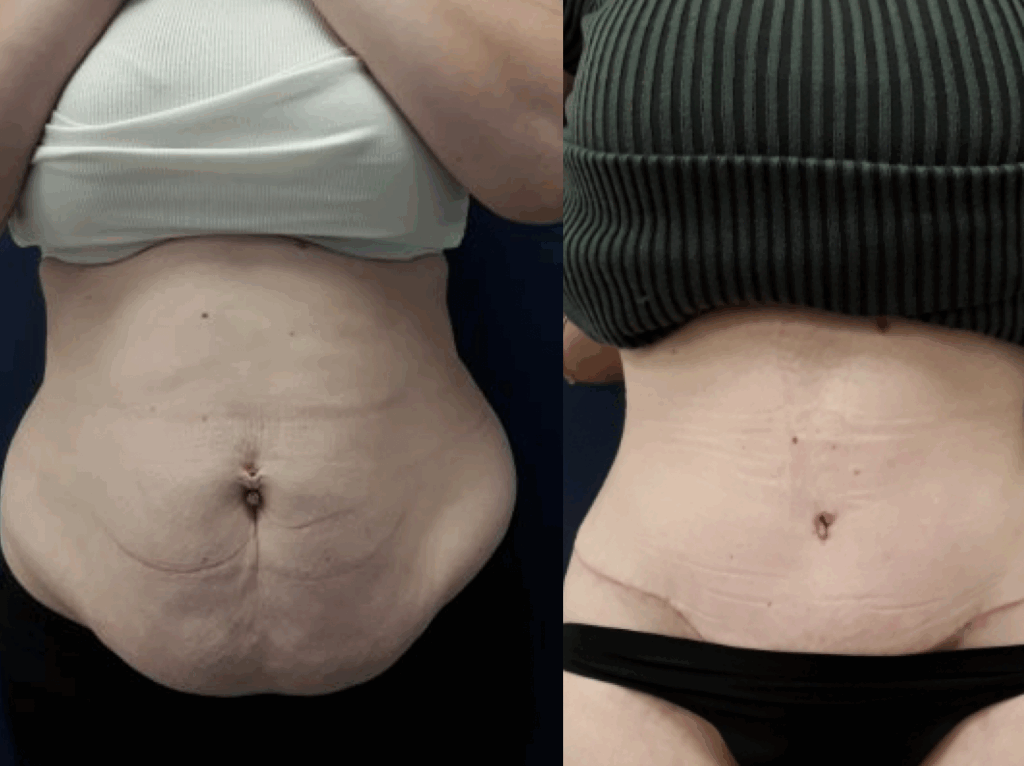
This removes loose skin below the navel, tightens separated abdominal muscles (diastasis recti), and repositions the belly button. The scar sits low across the abdomen, placed so that most underwear and swimwear will cover it.
Breast surgery
A breast lift repositions tissue that has dropped, an augmentation restores lost volume, and a reduction does the opposite for breasts that are now uncomfortably heavy. Seeing how each breast surgery option compares makes the consultation far easier to prepare for.
Liposuction and other additions
Liposuction can refine the waist, flanks or back, and some patients add an arm lift or thigh work. Each addition lengthens the operation, which is why the final list is a judgement call, not a menu to order from.
What it can and can’t change
Surgery can remove loose skin, repair muscle separation, and restore a breast shape that has changed. It can’t remove fat that sits behind the abdominal muscle wall, stabilise a weight that is still shifting, or erase stretch marks outside the skin that is removed.
Getting that brief right matters, and what natural-looking results really mean is worth reading before you decide what you want changed.
How long to wait after pregnancy
Surgeons commonly advise waiting until you’ve finished having children, stopped breastfeeding, and held a stable weight for a few months. Breast size and shape keep changing while you nurse and for a while afterwards, so operating too early can mean results that shift.
Around six months after your last breastfeed is a figure often quoted, but your surgeon will set the timing for you. Another pregnancy can stretch the tummy again and undo the work, so most want your family complete first.
If you’re not at that point yet, what helps with excess skin after pregnancy in the meantime covers what exercise and non-surgical options can realistically do.
Is it safe to combine procedures?

For suitable patients, the evidence is reassuring. A large US database study of combined abdominal and breast surgery analysed 58,756 women. Combined procedures had a 9.40% rate of any complication within 30 days, against 9.75% for abdominal surgery alone and 2.66% for aesthetic breast surgery alone.
Individual risk matters more than the combination itself. The authors built a risk score from diabetes, age over 53, obesity and higher anaesthetic risk, and complication rates rose from 9.78% in low-risk patients to 16.63% in medium-risk and 38.46% in high-risk patients. Those figures include minor complications, but they show why screening matters.
Why operating time matters
Longer anaesthetics raise the risk of complications, including blood clots, which is why careful surgeons limit how much they combine. A good plan keeps theatre time in check, uses clot prevention such as compression stockings and early walking, and splits the surgery when one operation would run too long.
One operation or staged surgery?
A combined operation means one anaesthetic and one recovery, but a longer time on the table. Staging means shorter operations and lower anaesthetic load each time, at the cost of two recoveries and more time away from your family.
Neither is better for everyone. The right choice depends on your health, your goals, and how long the full plan would take.
What recovery looks like
Expect to wear a compression garment for several weeks, sleep with your upper body raised, and walk gently from the first day. Many people take around four to six weeks off work, longer if the job is physical, and your surgeon will confirm your own timeline.
The tummy tuck is usually the limiting factor. Tightness across the abdomen makes standing fully upright difficult for the first week or two, and heavy lifting and strenuous exercise generally wait around six weeks or more.
With young children, practical planning matters as much as the surgery. You will not be able to lift a toddler for a while, so line up help before the operation date.
How much does it cost?
There’s no single price because there’s no single package. The total is built from the procedures you choose, the surgeon’s and anaesthetist’s fees, hospital costs, and theatre time. Combining can cost less than separate operations, since you pay for one anaesthetic and one hospital stay, but the saving varies.
For a sense of the components, UK excess skin removal pricing shows how the body procedures are typically priced, and a written quote should itemise every element.
Is it available on the NHS?
Not as a package. One ICB’s abdominal loose skin removal policy states that the procedure is not routinely commissioned, and describes excess skin caused by pregnancy among the reasons people ask for it.
Policies vary by area, and exceptional funding requests are rare and clinically led. Ask your GP what your local ICB says before assuming either way.
Who isn’t a good candidate
Surgery is usually postponed if you smoke or use nicotine, your weight is still changing, you plan more pregnancies, or a health condition such as poorly controlled diabetes raises your risk. A good surgeon will say so plainly, even if it means a longer wait.
Questions to ask your surgeon
Ask how many hours the full plan would take and whether any of it should be staged. Ask who will operate, whether they are a GMC-registered consultant plastic surgeon, how clot prevention is handled, and what happens if you need revision surgery.
How Lux Plastic Surgery approaches the mummy makeover
Professor Sandip Hindocha, FRCS (Plast), GMC-registered Consultant Plastic Surgeon and NHS Clinical Director, plans each combination around the individual, not a fixed package. Consultations take place at clinics in Bedford, London, and Manchester.
To see how it works at Lux, read about the mummy makeover service or send an enquiry through the contact page to arrange a consultation.
This article is for general information only and does not constitute medical advice. Results and risks vary by individual, so treat everything here as general guidance rather than a personal prediction.
FAQ
How long after having a baby can I have a mummy makeover?
Surgeons commonly advise waiting until breastfeeding has finished and your weight and breast size have settled, often around six months after your last feed. Your surgeon will confirm the right timing for you.
Is a mummy makeover one operation?
Usually yes, but not always. Several procedures are performed under one anaesthetic, though a surgeon may recommend staging if the total operating time would be too long.
Can I have a mummy makeover if I want more children?
Most surgeons advise waiting until your family is complete, since another pregnancy can stretch the abdomen and change the breasts again.
What scars does a mummy makeover leave?
The tummy tuck leaves a low scar across the abdomen, and breast surgery leaves scars whose pattern depends on the technique used. Your surgeon will show you where they would sit.
Can I get a mummy makeover on the NHS?
Not as a package. Post-pregnancy skin removal and cosmetic breast surgery aren’t routinely commissioned, so most patients pay privately.