Medically reviewed by Professor Sandip Hindocha, GMC-registered Consultant Plastic Surgeon and NHS Clinical Director. Articles are reviewed against current UK guidance from the GMC, BAAPS, BAPRAS and NICE.
TL;DR:
- Choosing an aesthetic clinic requires verifying practitioner credentials, safety protocols, and consultation quality to ensure safe and effective treatment.
- It is crucial to assess practitioner registration, facility accreditation, emergency preparedness, and honest patient reviews, not just clinic appearance or online ratings.
Choosing an aesthetic clinic is one of the most consequential decisions you will make about your health and appearance. Knowing how to select the right aesthetic clinic goes well beyond comparing prices or scrolling through Instagram before-and-after photos. The real work lies in verifying qualifications, understanding safety protocols, and finding a practitioner who treats you as a patient, not a transaction. This guide gives you a practical, UK-focused framework to make that decision with genuine confidence, covering everything from treatment types and credentials to consultation red flags and emergency readiness.
Key takeaways
| Point | Details |
|---|---|
| Define your goals first | Know whether your procedure is surgical or non-surgical before comparing clinics, as medical requirements differ significantly. |
| Verify credentials rigorously | Check practitioner registration with the GMC or relevant body and confirm facility accreditation before booking. |
| Treat the consultation as a test | A quality clinic asks detailed questions about your health history; a rushed consultation is a warning sign. |
| Safety protocols matter enormously | Confirm the clinic holds emergency medicines such as hyaluronidase and has trained staff for complication management. |
| Balance reviews with your instincts | Consistent patient feedback and relevant before-and-after galleries are useful, but your in-person impression counts too. |
How to select the right aesthetic clinic: start with your goals
Before you evaluate a single clinic, get clear on what you actually want. The type of procedure you are considering shapes every other factor in your decision.
Aesthetic procedures broadly fall into three categories:
- Surgical procedures such as rhinoplasty, breast augmentation, or facelifts require a consultant-grade surgeon, accredited operating facilities, anaesthetic support, and comprehensive aftercare planning.
- Non-surgical injectables including dermal fillers and anti-wrinkle injections sit in a middle ground. They are minimally invasive but carry real medical risks and must be performed by a qualified, registered practitioner.
- Skin treatments such as laser resurfacing, chemical peels, and microneedling vary in their medical requirements depending on depth and technology used.
Knowing which category your treatment falls into helps you immediately filter out clinics that are not equipped for your needs. A beauty salon offering lip fillers alongside facials, for example, is a very different proposition from a medically supervised aesthetic clinic with registered practitioners on-site.
Write down your treatment goals and any health considerations before you start searching. Are you managing a specific concern such as facial volume loss, or are you considering a more significant surgical change? Do you have existing health conditions, take regular medications, or have a history of reactions to previous treatments? These details will shape the questions you ask at consultation and help you identify whether a clinic is genuinely equipped to care for you.
Pro Tip: Ask yourself whether you want a one-off treatment or a longer-term relationship with a clinic. If you are exploring multiple procedures over time, continuity of care from the same practitioner is genuinely valuable.
Checking credentials and qualifications
This is where many people make their first mistake. They assume that a clean, modern clinic with good reviews automatically means qualified practitioners. It does not.
Medical aesthetic providers include doctors, nurse practitioners, physician assistants, registered nurses, and licensed aestheticians, each with distinct scopes of practice and training requirements. Not all of them are equally qualified for every procedure. The key is understanding what your specific treatment demands and confirming the practitioner delivering it meets that standard.
In the UK, doctors performing aesthetic procedures should be registered with the General Medical Council (GMC). Nurses should hold registration with the Nursing and Midwifery Council. For surgical procedures, you should be looking for a consultant plastic surgeon with the appropriate specialist registration. The American Academy of Cosmetic Surgery similarly emphasises checking surgeon credentials and surgery facility accreditation as the foundation of safe clinic selection, and the principle applies directly in a UK context.
Watch out for these red flags:
- Vague titles like “aesthetic specialist” or “beauty therapist” listed without any clinical registration details
- No information on the clinic website about practitioner qualifications or GMC/NMC registration numbers
- Reluctance to share credentials when you ask directly
- A physician listed as medical director who is never present during treatments
That last point matters more than most people realise. Simply listing a physician as medical director is insufficient for patient safety. The AMA has explicitly warned that physicians must be immediately available for care, not just nominal figureheads on paper.
For surgical or invasive procedures, facility accreditation is equally critical. Accredited facilities assure that equipment, staffing, and safety standards meet rigorous external benchmarks. In the UK, look for Care Quality Commission (CQC) registration for any clinic carrying out regulated activities.
Pro Tip: You can verify a doctor’s GMC registration and any conditions on their licence directly on the GMC website at gmc-uk.org. It takes two minutes and can tell you a great deal.
What a good consultation looks like
The initial consultation is your single best indicator of clinic quality. Treat it as a two-way assessment. You are evaluating them as much as they are discussing your suitability for treatment.
A thorough consultation should follow this sequence:
- Detailed medical history review. Your practitioner should ask about existing health conditions, current medications, previous surgeries, allergies, and any history of complications from aesthetic treatments. Thorough patient history intake is both a safety and ethical baseline.
- Discussion of your goals and motivations. A responsible practitioner will explore what you hope to achieve and whether your expectations are realistic for the treatment you are considering.
- Explanation of the procedure, risks, and alternatives. You should be told clearly what the treatment involves, what the realistic outcomes look like, and what could go wrong. If risks are glossed over, that is a problem.
- Assessment of your physical suitability. For injectables, this means facial anatomy assessment. For surgical procedures, it should include a physical examination and discussion of your health baseline.
- No pressure to book on the day. You should be given time to reflect. Any clinic that pushes you to commit during the first appointment is prioritising revenue over your wellbeing.
The Cleveland Clinic recommends patient-centred evaluation and open communication as the foundations of safe outcomes. If your consultation felt rushed, if the practitioner seemed more interested in recommending add-on treatments than understanding your actual concern, or if you left feeling uncertain rather than informed, trust that instinct.
Good communication during consultation also predicts how the clinic will handle any complications that arise post-treatment. A practitioner who listens carefully and explains thoroughly is far more likely to manage aftercare with the same diligence.

Safety protocols and emergency readiness
This section addresses the factor most people forget to ask about. And it may be the most important one of all.
Even minimally invasive treatments carry real risks. Dermal filler treatments, for example, can in rare cases cause vascular occlusion, where filler material inadvertently blocks a blood vessel. Immediate treatment within 4 to 6 hours is critical for preventing permanent damage, and the intervention requires hyaluronidase, an enzyme that dissolves hyaluronic acid filler.
“Emergencies like filler vascular occlusion require clinics to be prepared with protocols practised routinely, not just theoretical readiness.” — Springer Nature review on vascular occlusion
Here is how two typical clinic scenarios compare on this critical safety point:
| Safety factor | Clinic with proper protocols | Clinic without proper protocols |
|---|---|---|
| Hyaluronidase availability | Stocked on-site at all times | Not available or must be ordered |
| Emergency training | Regular staff drills and protocol review | No documented emergency procedures |
| Medical supervision | Registered clinician on-site during treatments | Remote or absent medical oversight |
| Facility accreditation | CQC registered or equivalent | No external accreditation |
| Complication response time | Immediate on-site intervention possible | Patient referred elsewhere with delay |
Ask the clinic directly: “Do you stock hyaluronidase on-site? What is your protocol if a patient experiences a vascular complication?” A clinic that cannot answer this question clearly is not a safe environment for filler treatment.
The same principle extends to surgical procedures. Facility accreditation covers emergency readiness, equipment standards, and staffing competence, all of which directly affect patient safety during invasive procedures.
Pro Tip: For any injectable treatment, ask specifically whether the person performing the procedure has completed recognised emergency management training such as an ICCM or equivalent UK course. This is increasingly considered the minimum standard.
Evaluating patient reviews and reputation
Once you have verified credentials and safety standards, patient experience and reputation add important texture to your decision. But you need to read reviews critically rather than just counting stars.
Look for these signals when assessing clinic reputation:
- Consistency across platforms. A clinic with strong reviews on Google, Trustpilot, and RealSelf, rather than just one channel, is more credible. Volume matters, but so does the spread.
- Specific and detailed testimonials. Reviews that describe a particular treatment, the practitioner by name, and the full experience from consultation to recovery carry far more weight than generic five-star comments.
- Before-and-after galleries relevant to your procedure. The key word here is relevant. If you are considering a rhinoplasty, look for rhinoplasty results specifically. Choosing a GMC-registered practitioner with a visible portfolio of your procedure type is far more reassuring than a general catalogue of mixed treatments.
- How the clinic responds to negative reviews. A professional, measured response to a complaint tells you as much about a clinic’s values as a five-star review.
Personal referrals from friends, family members, or GPs who have direct experience with a clinic are still the gold standard. They come with context that no online review can replicate.
One final consideration: your gut feeling during the in-person visit matters. Does the clinic feel clean and organised? Are staff welcoming and professional without being aggressively sales-focused? Do you feel like a patient being cared for or a customer being upsold? These impressions, while subjective, consistently correlate with the quality of care you will receive.
My honest take on what most people get wrong
I’ve seen people spend hours comparing treatment prices between clinics while spending five minutes, if that, checking whether the practitioner they are about to let inject their face is actually qualified to do so. The priority inversion is striking.
In my experience, the single most meaningful safety distinction you can make is whether the clinic operates as a genuine medical practice or as a cosmetic venue with medical-sounding branding. The most meaningful safety distinction is genuine medical oversight, not the quality of the waiting room music or the aesthetics of the reception desk. Plenty of sleek, photogenic clinics have very little medical substance behind the facade.
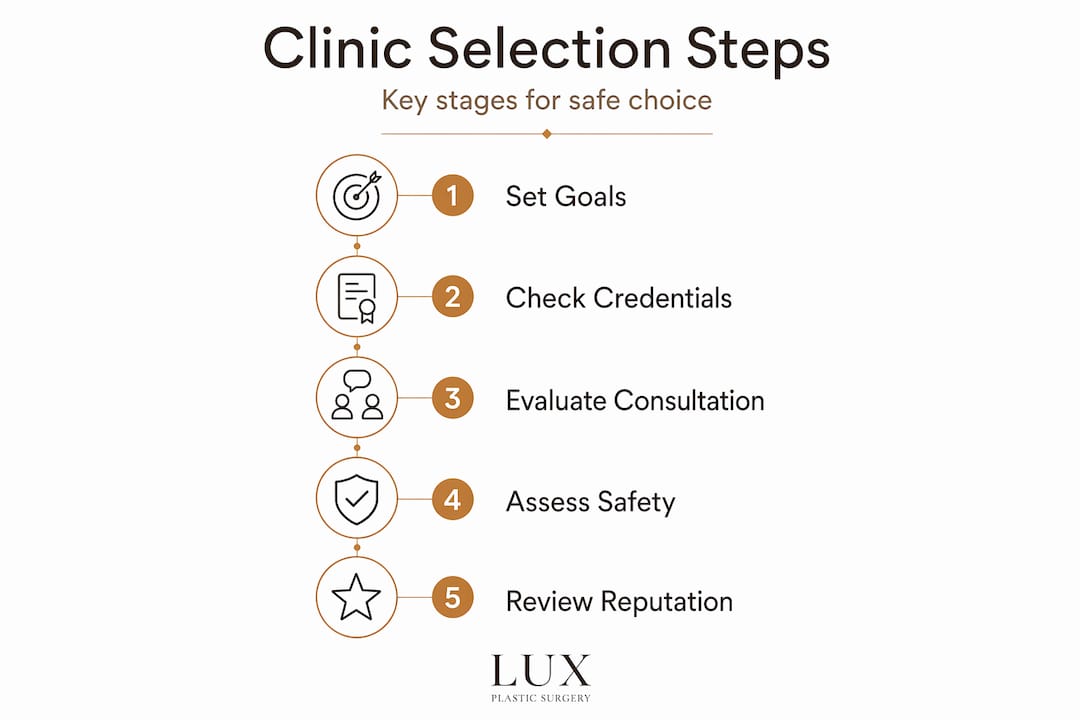
What I’ve found actually works is this: ask uncomfortable questions. Ask who will be performing your treatment, what their specific qualifications are, and what happens if something goes wrong. A good clinic welcomes these questions. A clinic that hedges or deflects is telling you something important.
The peace of mind that comes from a thorough vetting process is real and lasting. When you know your practitioner is qualified, your facility is accredited, and your clinic has safety protocols in place, you can approach your treatment with genuine confidence rather than suppressed anxiety. That mental state, frankly, contributes to a better overall experience and recovery. For deeper guidance on making safe cosmetic decisions, the safe cosmetic surgery steps resource is worth your time.
— Gregg
Why Luxplasticsurgery is worth your consideration
If you have worked through this guide and you are ready to take the next step, Luxplasticsurgery offers the kind of medically led, personalised care this article has been describing.
Led by Professor Sandip Hindocha, an award-winning consultant with specialist expertise across surgical and non-surgical procedures, the clinic operates across Bedford, London, and Manchester with a strong focus on patient safety, transparent communication, and results that look natural. Every consultation is thorough, unhurried, and built around your specific goals and health profile. You can explore the full range of services across body contouring, facial procedures, breast surgery, and non-surgical aesthetics, or book a consultation directly to discuss your individual needs with a practitioner who genuinely knows what they are doing.
FAQ
What qualifications should an aesthetic practitioner have?
Aesthetic practitioners in the UK should hold registration with the GMC (for doctors) or the NMC (for nurses), and should have specific training in the procedures they perform. For surgical treatments, look for consultant-grade plastic surgeons with specialist registration.
How do I check if an aesthetic clinic is registered in the UK?
Clinics carrying out regulated activities in the UK must be registered with the Care Quality Commission. You can verify registration directly on the CQC website. Individual practitioner registration can be checked on the GMC or NMC registers.
What questions should I ask at an aesthetic consultation?
Ask about the practitioner’s qualifications, the specific risks of your procedure, what emergency protocols the clinic has in place, and how complications are managed. A reputable clinic will answer these questions clearly and without hesitation.
How can I tell if clinic reviews are trustworthy?
Look for detailed, procedure-specific reviews across multiple platforms rather than generic praise on a single site. Personal referrals from people who have had the same treatment you are considering remain the most reliable indicator of consistent quality.
Why does facility accreditation matter for aesthetic treatments?
Facility accreditation confirms that equipment, staffing, and emergency readiness meet external standards, which is especially important for surgical or more invasive procedures where complications require immediate, competent on-site response.