Medically reviewed by Professor Sandip Hindocha, GMC-registered Consultant Plastic Surgeon and NHS Clinical Director. Articles are reviewed against current UK guidance from the GMC, BAAPS, BAPRAS and NICE.
TL;DR:
- Anyone in the UK can set up non-surgical aesthetic clinics without medical training, specialist to inconsistent standards.
- Proper regulation and practitioner qualifications, such as CQC registration and GMC or JCCP membership, are essential for safety.
- Conduct thorough research using safety checklists, verify credentials, and prioritise clinics with transparent practices and patient-centreed care.
Surprisingly, almost anyone in the UK can set up a non-surgical aesthetic clinic and begin offering treatments without any formal medical training or registration. That reality shocks most people considering cosmetic treatments for the first time, and it makes choosing the right clinic one of the most important decisions you will ever make about your health and appearance. Standards vary enormously across the industry, practitioners hold vastly different levels of qualification, and the regulatory landscape is still catching up. This guide will walk you through exactly what to look for, what to question, and how to tell a genuinely excellent clinic from one that simply looks the part.
Key Takeaways
| Point | Details |
|---|---|
| Check clinic qualifications | Always verify CQC registration for surgery and appropriate qualifications for non-surgical treatments. |
| Use safety checklists | Follow a step-by-step assessment before committing to any aesthetic clinic. |
| Prioritise communication | Choose clinics offering open, pressure-free consultations and clear aftercare. |
| Understand new regulations | Stay up-to-date on UK laws that may affect who can perform aesthetic treatments safely. |
| Quality goes beyond paperwork | A truly excellent clinic combines standards with bespoke care and genuine trust-building. |
Understanding types of aesthetic clinics and treatments
Now that you understand why standards matter, let us clarify what types of clinics and treatments are available and who is allowed to perform them. The difference is more significant than most people realise, and getting this wrong could affect both your safety and your results.
Surgical versus non-surgical clinics
Aesthetic clinics broadly fall into two categories. Surgical clinics offer procedures such as liposuction, abdominoplasty, breast augmentation, and thread lifts. These clinics must be registered with the Care Quality Commission (CQC), the independent regulator of health and social care in England. CQC registration is not optional here. It is a legal requirement, and it comes with robust inspection standards covering everything from infection control to staff qualifications.
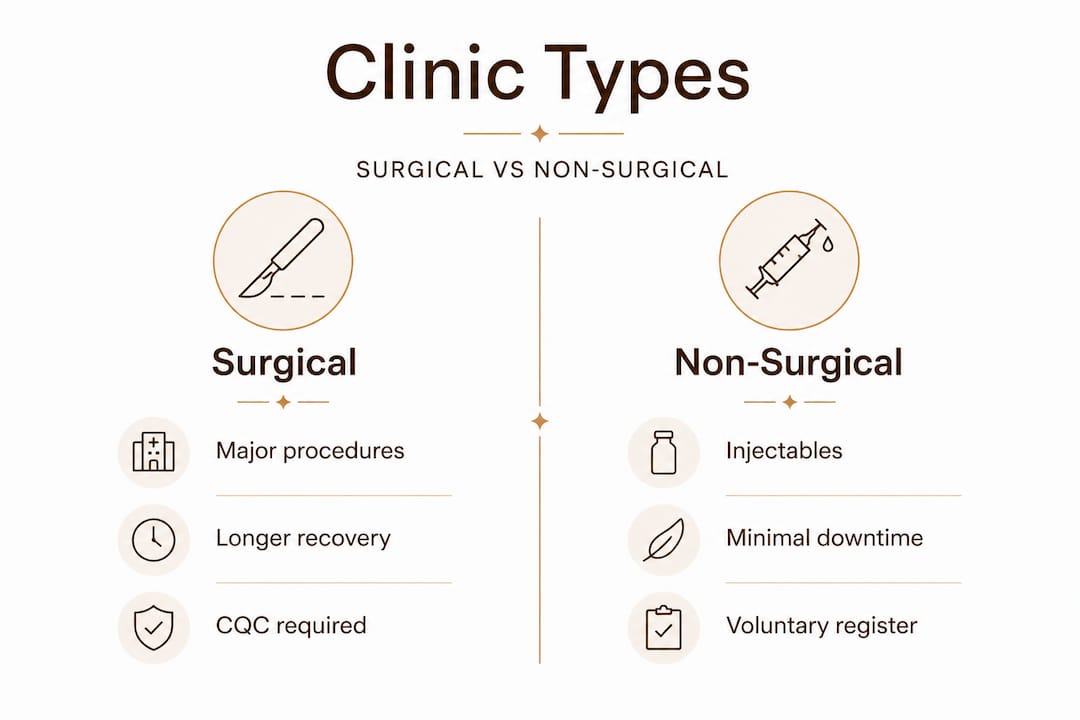
Non-surgical clinics offer treatments such as Botox (botulinum toxin), dermal fillers, chemical peels, laser treatments, and body contouring using devices rather than surgery. Historically, this space has been far less regulated. However, the UK government’s consultation on licensing non-surgical procedures confirms that CQC registration is required for surgical treatments, and that Level 7 qualifications and new mandatory licensing are being introduced for many non-surgical injectable procedures, with a strict minimum age of 18.
Understanding aesthetic medicine explained helps you grasp the full spectrum of what reputable clinics offer and what proper standards look like in practice.
| Treatment type | Examples | Required oversight |
|---|---|---|
| Surgical | Liposuction, breast augmentation, facelifts | CQC registration mandatory |
| Non-surgical injectables | Botox, dermal fillers | Level 7 qualification; licensing incoming |
| Energy-based devices | Laser, radiofrequency | Licensing varies by procedure risk |
| High-risk ‘red’ procedures | Buttock fillers | CQC-regulated healthcare professionals only |
Who should be performing your treatment?
For injectables specifically, the distinction matters enormously. A practitioner with a Level 7 qualification in aesthetics has completed postgraduate-level training in anatomy, pharmacology, and complication management. This is far beyond the weekend training courses that have historically been permitted. As licensing becomes mandatory for what the government classifies as “green” and “amber” risk procedures, the baseline for who can treat you will rise considerably.
“The introduction of mandatory licensing for non-surgical cosmetic procedures marks a critical turning point for patient safety in England. It is no longer acceptable for unqualified individuals to perform procedures that carry real clinical risk.”
The minimum age rule of 18 for non-surgical cosmetic procedures exists because younger individuals are still physically developing, and their aesthetic concerns may not yet be well-defined. Responsible clinics enforce this rigorously, not merely as a tick-box exercise.
Essential safety checks before choosing your clinic
Once you understand the types of clinics, it is vital to know exactly how to verify safety and quality before making a decision. The following checklist makes this process straightforward and removes the guesswork.
The 5 C’s framework
According to BAPRAS guidance on cosmetic surgery, a reliable framework for choosing wisely involves five key areas: Clinic, Check surgeon, Costs, Complications, and Cool off. These five elements should structure every enquiry you make.
- Clinic: Verify that the clinic is CQC-registered if you are seeking surgical procedures. Check inspection reports publicly available on the CQC website. Look for evidence of governance, cleanliness, and staff accountability.
- Check surgeon: For surgery, your practitioner should appear on the GMC Specialist Register under “Plastic Surgery.” Membership of BAPRAS (the British Association of Plastic, Reconstructive and Aesthetic Surgeons) or BAAPS (the British Association of Aesthetic Plastic Surgeons) is a strong additional indicator of professional credibility. These memberships are not cosmetic; they require peer review and ongoing audit.
- Costs: High quality has a cost. CQC-registered aesthetic clinics must maintain policies on consent, infection control, staff DBS checks, and professional indemnity, with first-year compliance costs typically ranging from £8,000 to £25,000. A clinic charging unusually low fees may simply be cutting corners on these essential safeguards.
- Complications: Ask directly how the clinic handles complications. A reputable clinic will have a clear protocol, access to emergency medical support, and a named practitioner responsible for aftercare. Evasive answers here are a serious warning sign.
- Cool off: Never allow yourself to be rushed into a decision. A cooling-off period between your consultation and your procedure is standard practice at responsible clinics. It exists to protect you from pressure-selling and to give you time to reflect honestly on your goals.
Pro Tip: Search your surgeon’s name on the GMC register at gmcuk.org before your consultation. The search takes under two minutes and tells you whether they are licensed to practise and whether any concerns have been raised.
What good practice looks like
The standards required of a registered clinic are concrete. Consent procedures must be documented and signed before any treatment begins. Infection control policies must be written, reviewed, and followed. Staff must hold valid DBS (Disclosure and Barring Service) certificates. These requirements are not bureaucratic formalities; they exist because failures in each area have caused genuine harm to patients.
Learning about safer cosmetic surgery steps and safely selecting procedures builds the knowledge base you need to ask better questions and recognise honest answers. A clinic that welcomes your enquiries about their protocols is a clinic worth trusting. Understanding what shapes surgeon qualifications and outcomes gives you a further layer of confidence when comparing practitioners.
| Green flag | Red flag |
|---|---|
| CQC registration publicly verifiable | No mention of registration |
| GMC Specialist Register listing | Vague claims about “medical training” |
| Cooling-off period offered | Pressure to book immediately |
| Written aftercare plan provided | Aftercare described as “just call us” |
| Transparent pricing breakdown | Unusually low or undisclosed fees |
Clinic standards, qualifications, and emerging UK regulations
Even when a clinic appears reputable, it is important to understand what qualifications and regulatory standards really mean and how they are evolving rapidly.
Voluntary registers and what they signal
Two organisations are particularly relevant here: the Joint Council for Cosmetic Practitioners (JCCP) and Save Face. Both operate voluntary registers for aesthetic practitioners. The JCCP has over 1,130 registrants and has been actively pushing for statutory licensing as a safer long-term solution. Registrants on these schemes have met specific educational and clinical standards, making them a more reliable choice even before mandatory licensing arrives.
However, it is worth understanding what “voluntary” means in this context. A practitioner who is not registered with JCCP or Save Face is not automatically unqualified or unsafe. But their absence from these lists means less external accountability and fewer checks on their ongoing practice. In a field where techniques and safety evidence change rapidly, ongoing professional development matters enormously.
The emerging regulatory framework
The government’s licensing consultation response introduced a tiered classification of procedures by risk level. Red procedures, such as buttock fillers, carry the highest clinical risk and can only be performed by CQC-regulated healthcare professionals. Amber and green procedures face different but still meaningful restrictions as licensing progresses.
Most respondents to the consultation supported this tiered approach, recognising that a single blanket rule cannot adequately address the full range of risks. The underlying logic is sound: the risk profile of a chemical peel is genuinely different from that of a buttock augmentation with filler, and the regulatory response should reflect that difference.
Pro Tip: When researching a clinic, visit the JCCP and Save Face registers directly online. Both offer searchable databases by location, making it easy to verify your practitioner’s status in minutes.
What this means for you right now
Even before all regulations are fully in place, you can treat the voluntary register system as your benchmark. Clinics that take the trouble to maintain JCCP or Save Face registration are demonstrating a commitment to standards that goes beyond the legal minimum. This voluntary commitment often predicts the quality of care you will receive. For a fuller picture of how to assess your options carefully, the guidance on evaluating surgery safety is worth reading before any consultation.
Making your decision: quality, trust, and setting expectations
Now that you know how to check credentials and regulation, it is time to focus on the softer but equally crucial factors in finding the right clinic.
Consultation quality matters as much as qualifications
A practitioner who holds all the right qualifications but rushes you through a consultation, dismisses your questions, or oversells outcomes they cannot guarantee is not serving your interests well. The consultation is your opportunity to assess not just their technical knowledge but their honesty, their listening skills, and their respect for your autonomy. The role of consultations in shaping safe, satisfying outcomes cannot be overstated.
Clear red flags to avoid
Watch for the following during any clinic interaction:
- Pressure to book on the day or offers that “expire” if you do not commit immediately
- Reluctance to discuss risks, recovery, or realistic outcomes
- Practitioners who cannot name the specific products they plan to use
- Clinics without a clear written aftercare plan
- No mention of what happens if something goes wrong
What a genuinely excellent clinic looks like
The government’s non-surgical licensing framework makes clear that licensed procedures will require practitioners to demonstrate ongoing training and patient safety commitments. A clinic already operating at this standard before licensing is mandated is demonstrating genuine leadership in the field, not merely compliance.
Realistic advice is a hallmark of quality. If a practitioner tells you that your desired outcome is achievable without caveats, ask more questions. The very best surgeons and aesthetic practitioners set honest expectations, explain the range of possible results, and decline to perform treatments that are not in your best interest.
Written consent and detailed aftercare instructions are not optional extras at responsible clinics. They are standard practice, and their presence tells you a great deal about how seriously the clinic takes its duty of care to you.
Why regulation is not enough: the human factor in choosing an aesthetic clinic
Having addressed the practical steps and the latest regulations, it is also important to recognise what truly makes for an outstanding aesthetic clinic experience.
Many clinics in the UK meet the current minimum standards yet deliver vastly different patient experiences. Two CQC-registered clinics can occupy opposite ends of the quality spectrum, with one offering bespoke, thoughtful care and another delivering a conveyor-belt service focused on throughput rather than outcomes. The paperwork can look identical. The patient experience could not be more different.
What makes the real difference? In our experience, it comes down to the quality of human connection throughout the process. A practitioner who takes the time to understand not just what you want but why you want it, who challenges assumptions gently and explores alternatives, and who is genuinely interested in your long-term wellbeing rather than your immediate booking is operating at a level that regulation alone cannot guarantee.
Open, honest, pressure-free conversations build trust. They also lead to better outcomes, because a patient who fully understands their procedure, its risks, and its realistic results is better prepared both physically and psychologically. The outcome is more satisfying when expectations were calibrated carefully from the outset.
Regulation lays an important groundwork, but patient empowerment is just as vital. This means asking hard questions, reading the information you are given, and never feeling that your concerns are an inconvenience. Expert surgeon consultations that are structured around your individual goals rather than a standard menu of treatments are where the real value lies. The clinic that sees you as an individual, not an appointment, is the one worth choosing.
Trusted next steps: begin your journey with confidence
Choosing an aesthetic clinic is one of the most personal and consequential decisions you can make, and it deserves the same careful research you would apply to any serious healthcare choice.

At Lux Plastic Surgery, Professor Sandip Hindocha brings award-winning surgical expertise and a genuine commitment to bespoke, patient-centred care across clinics in Bedford, London, and Manchester. Every consultation is pressure-free, fully informative, and designed around your specific goals. Whether you are exploring plastic surgery types and benefits for the first time, researching the benefits of plastic surgery for your wellbeing and confidence, or ready to book a consultation through our Bedford aesthetic clinic services, we are here to guide you with honesty, expertise, and care at every step.
FAQ
Do all aesthetic clinics in the UK require CQC registration?
Only clinics offering surgical procedures are legally required to register with the CQC; many non-surgical clinics currently operate without this registration, though mandatory licensing for certain non-surgical procedures is being introduced in England.
What qualifications should a practitioner have for dermal fillers and Botox in the UK?
Practitioners performing injectables should ideally hold a Level 7 aesthetic qualification, and upcoming licensing will formalise minimum standards for these treatments to further protect patients.
How can I check if an aesthetic clinic is safe and reputable?
For surgery, verify CQC registration and check that the surgeon is on the GMC Specialist Register under Plastic Surgery; for non-surgical treatments, check whether the practitioner appears on the JCCP or Save Face register.
Are there age limits for cosmetic treatments in the UK?
Yes, a minimum age of 18 applies to most non-surgical cosmetic procedures in England, a requirement confirmed in the government’s licensing consultation to protect younger individuals from treatments that may not suit their stage of development.