Medically reviewed by Professor Sandip Hindocha, GMC-registered Consultant Plastic Surgeon and NHS Clinical Director. Articles are reviewed against current UK guidance from the GMC, BAAPS, BAPRAS and NICE.
Many people believe scars can be completely erased with the right treatment, but the reality is more nuanced. Scar treatments focus on improving appearance, texture, and symptoms rather than achieving perfection. A wide range of expert-reviewed options exists, including first-line non-surgical choices that can make a meaningful difference. This guide will help UK adults understand what to expect from scar treatments, what’s available through the NHS and private care, and how to navigate your options with confidence.
Key Takeaways
| Point | Details |
|---|---|
| Complete removal unrealistic | Scar treatments improve appearance and symptoms but rarely erase scars fully. |
| Multiple non-surgical options | Steroid injections, silicone therapy, cryotherapy and lasers all target scar improvement. |
| NHS funding is limited | Functional or severe facial scars may be funded, but most cosmetic requests are self-pay. |
| Early treatment gives best results | Scars less than 24 months old respond best to most treatments. |
| Expert advice essential | A specialist can guide you to safe and effective decisions for your scar’s unique needs. |
What is the true goal of scar treatments?
Scar revision means improving how a scar looks, feels, and behaves, not making it vanish entirely. Treatments primarily aim to improve appearance, texture, pliability, and symptoms like pain or itch rather than complete removal. Collagen overproduction causes thick or keloid scars, and most treatments work by adjusting collagen production and softening scar tissue. Success is measured by visible flattening, reduced redness, improved texture, and relief from discomfort, not by making scars invisible.
“The goal is to make scars less noticeable and more comfortable, not to eliminate them completely.”
Understanding this distinction helps you set realistic expectations. Treatments can deliver impressive improvements, but they work within biological limits. Key outcomes include:
- Flattening raised or thickened scars
- Softening rigid tissue to improve flexibility
- Reducing redness, darkness, or discolouration
- Relieving itch, pain, or tightness
- Improving overall appearance and confidence
For those exploring broader skin concerns, skin tag removal offers similar principles of targeted, professional care.
Types of scars and how they respond to treatment
Different scar types respond to treatments in distinct ways. Keloid and hypertrophic scars often improve with specific interventions, whilst older atrophic scars or self-harm scars present greater challenges. Keloid scars result from excess collagen, with higher risk in darker skin, people aged 10–30, and pregnant individuals.
| Scar type | Characteristics | Treatment response |
|---|---|---|
| Keloid | Grows beyond original wound, raised, often itchy | Responds to steroids, silicone, laser, cryotherapy |
| Hypertrophic | Raised but stays within wound boundaries | Good response to silicone, pressure, steroids |
| Atrophic | Depressed or sunken appearance | May need dermal fillers or surgical revision |
| Self-harm | Variable depth, often multiple sites | Challenging; requires specialist assessment |
Facial scars may receive better NHS support due to psychological impact. Self-harm scars have additional criteria, including evidence of no recurrence for three years. High-risk groups should monitor for keloid development after any injury or procedure.
Pro Tip: Photograph your scar every month during treatment to track subtle improvements that might not be obvious day-to-day.
For comprehensive guidance on surgical options, explore scar revision options that complement non-surgical approaches.
Overview of non-surgical scar treatment options in the UK
Steroid injections, silicone gels, cryotherapy and laser therapy are first-line treatments for keloid and hypertrophic scars seeking cosmetic improvement. Each approach works differently and requires commitment to achieve results.

Steroid injections flatten keloids and hypertrophic scars by reducing inflammation and collagen production. Sessions occur every 4–6 weeks, with most patients needing 3–6 treatments. Results appear gradually over several months.
Silicone gels and sheets reduce scar size and soften tissue through hydration and pressure. You’ll wear them for 12–24 hours daily for at least 3 months. They’re particularly effective for newer scars and work well alongside other treatments.
Laser therapy targets scar colour and texture using focused light energy. Sessions are spaced 4–8 weeks apart, with 3–5 treatments typical. Different laser types address specific concerns, from redness to raised tissue.
Cryotherapy freezes scar tissue to reduce size and flatten raised areas. Treatment sessions occur every 3–4 weeks, with multiple visits needed for meaningful change.
| Treatment | Frequency | Typical duration | Best for |
|---|---|---|---|
| Steroid injections | Every 4–6 weeks | 3–6 sessions | Keloid, hypertrophic scars |
| Silicone therapy | Daily application | 3–6 months | All raised scars |
| Laser therapy | Every 4–8 weeks | 3–5 sessions | Colour, texture issues |
| Cryotherapy | Every 3–4 weeks | 4–6 sessions | Keloid scars |
Pro Tip: Combine treatments for better results. Silicone therapy works brilliantly alongside steroid injections or laser sessions.
For advanced laser options, laser skin resurfacing provides targeted solutions for various scar types.
What to expect: treatment results and limitations
Immature scars under 6–24 months old respond best to treatment, whilst older scars present greater challenges. Cosmetic improvements are common, including flattening, lightening, and softening, but expect the scar to remain visible to some degree.
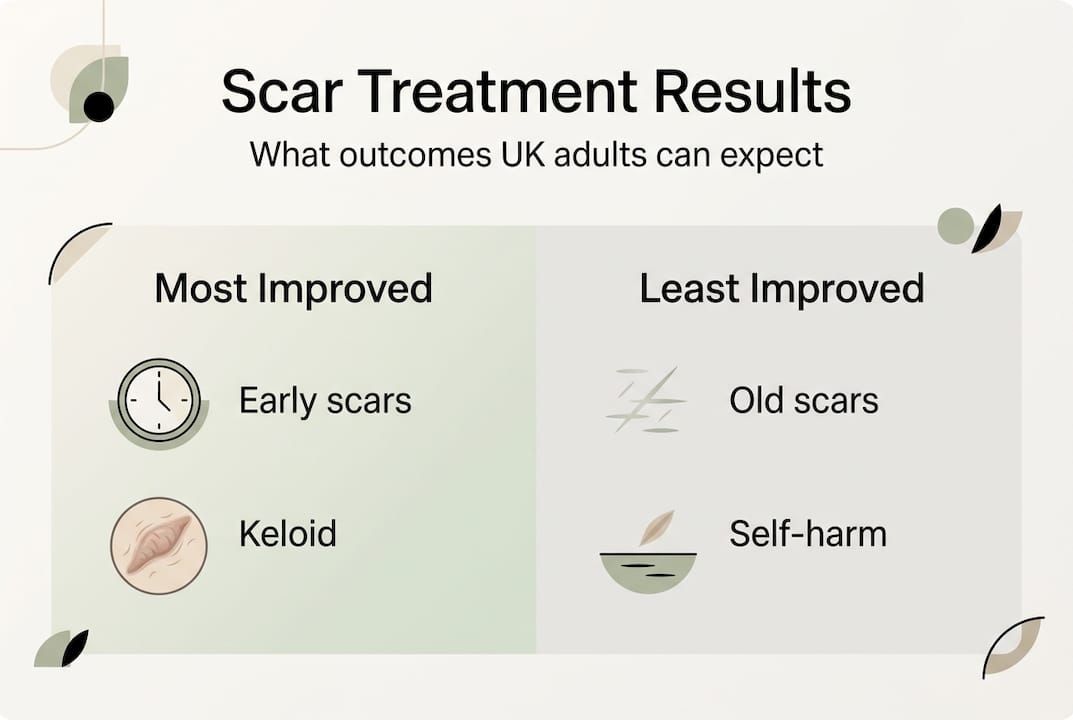
Multiple sessions are usually necessary. A single treatment rarely delivers dramatic change. Self-harm scars or very old scars are particularly challenging, with options focusing on reduction rather than removal.
Realistic outcomes include:
- 30–50% reduction in scar height or thickness
- Noticeable softening of rigid tissue
- Fading of redness or dark pigmentation
- Relief from itch, pain, or tightness
- Improved confidence and reduced self-consciousness
Key statistic: Studies show that 60–70% of patients report meaningful improvement with consistent non-surgical treatment, though complete removal remains rare.
Expect gradual progress over months, not weeks. Patience is essential, as biological remodelling takes time. Some scars plateau after initial improvement, whilst others continue responding to treatment for a year or more.
For visual evidence of what’s achievable, review results from laser therapies to understand realistic expectations.
NHS funding for scar treatments: who qualifies?
NHS funding prioritises scars causing functional impairment; cosmetic cases are not routinely funded except for specific criteria. Functionally impairing or severely disfiguring facial scars may receive funding after 18–24 months, with photographic evidence required.
Self-harm scars need three years’ documented absence of recurrence plus a psychiatric report confirming stability. Most cosmetic scar improvements require self-funding or private care.
NHS funding criteria:
- Functional impairment affecting daily activities or movement
- Severe facial disfigurement with documented psychological impact
- Scar maturation period of 18–24 months completed
- Photographic evidence showing severity and progression
- For self-harm scars: three years’ no recurrence plus psychiatric clearance
“The NHS focuses resources on scars that significantly impair function or cause severe distress, not purely cosmetic concerns.”
Private treatment offers faster access and broader options. Many patients choose private care for cosmetic improvements that don’t meet NHS thresholds. Understanding these criteria helps you plan realistically and explore appropriate funding routes.
For detailed information on private options, visit NHS criteria for scar revision to understand your choices.
Expert tips for maximising scar improvement
Immature scars respond better to treatment, but patience for full maturation remains NHS standard. Starting treatment within the first 6–24 months offers the best chance of meaningful improvement.
Follow instructions meticulously for daily silicone therapy or post-procedure aftercare. Consistency matters more than intensity. Missing applications or sessions reduces effectiveness significantly.
Pro Tip: Set phone reminders for silicone application and treatment appointments. Consistency is the single biggest factor in successful outcomes.
Monitor for signs of keloid recurrence if you’re in a high-risk group. Early intervention prevents larger problems. Key actions include:
- Start treatment early, ideally within 6–24 months of injury
- Follow all aftercare instructions without exception
- Protect scars from sun exposure with SPF 50+ sunscreen
- Attend all scheduled follow-up appointments
- Report any changes in size, colour, or symptoms immediately
- Avoid picking, scratching, or irritating healing tissue
Seek professional advice for all visible or symptomatic scars. Self-care may miss underlying risks or more effective treatment options. A specialist assessment ensures you’re on the right path from the start.
For personalised revision advice, professional consultation provides tailored strategies based on your specific scar type and goals.
For professional scar assessment and tailored care
A specialist can help you select the right treatment for your scar type and appearance goals. Professional assessment identifies which approaches will deliver the best results for your specific situation, saving time and disappointment.
Lux Plastic Surgery offers experienced care in scar revision, laser therapies, and bespoke planning. Professor Sandip Hindocha brings award-winning expertise to every consultation, ensuring you receive evidence-based guidance tailored to your needs.
Whether you’re exploring non-surgical options or considering more advanced interventions, expert assessment makes all the difference. Take the next step with a no-obligation consultation to discuss your goals and discover what’s possible. Explore our full range of plastic surgery services, book a scar revision consultation, or learn more about laser scar treatment options available across Bedford, London, and Manchester.
FAQ
Can all scars be removed completely with treatment?
No, most treatments improve appearance and symptoms but do not erase scars entirely. Complete removal is rare, with realistic goals focusing on meaningful reduction and improved comfort.
Which non-surgical treatment works fastest for keloid scars?
Steroid injections repeated every 4–6 weeks often show visible results within several months, especially with consistent sessions. Results vary by individual response and scar characteristics.
Will the NHS fund scar treatment if I just want a cosmetic improvement?
NHS funding prioritises functional impairment or severe facial disfigurement. Purely cosmetic improvements typically require private funding unless specific criteria are met.
Are there risks with non-surgical scar treatments?
Yes, laser, steroid and other therapies can cause irritation, pigment change, or rarely, scar worsening. Always consult a specialist to understand risks specific to your situation.
How long should I wait before considering treatment after injury?
Most experts recommend waiting 18–24 months post-trauma for scar maturation before surgical or NHS-supported treatment. Earlier non-surgical interventions may be appropriate in some cases.